
Intellectual Property
Hot selling product recommendations
View More
















When 400G Becomes Your Daily Reality: Living with Cisco's N9K-C93600CD-GX
There's a particular moment in every network engineer's career when you realize the infrastructure you're building isn't just about connecting devices—it's about creating pathways for data that didn't exist a few years ago. The Cisco N9K-C93600CD-GX represents one of those moments, a switch that makes 400G connectivity feel less like cutting-edge technology and more like practical reality.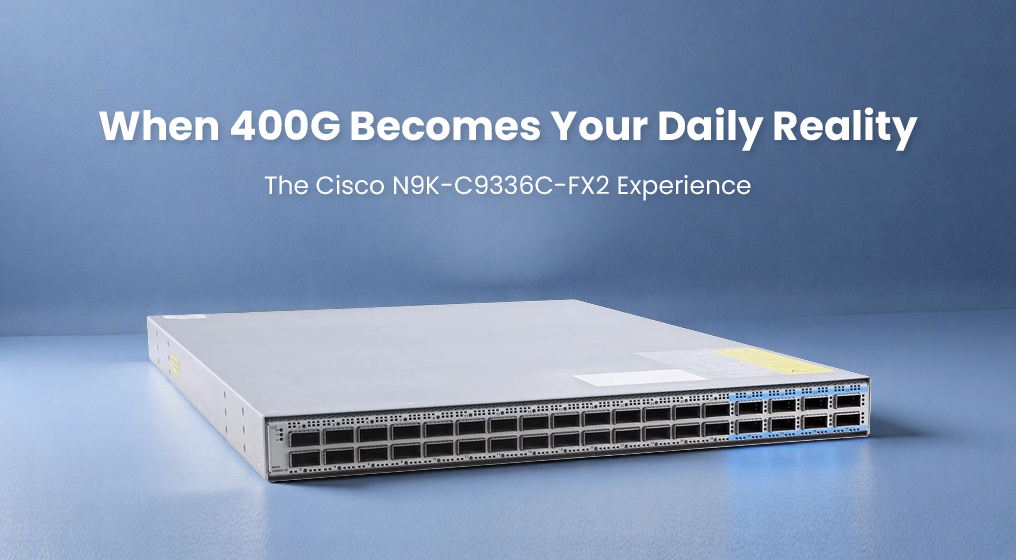
When you first encounter this switch in a data center rack, what strikes you is how much capability Cisco packed into a single rack unit. At just 1.72 inches tall, it doesn't look particularly imposing until you notice the port configuration: 28 QSFP28 ports and 8 QSFP-DD ports staring back at you. The industrial design is clean and purposeful—no unnecessary flourishes, just efficient engineering. The dual hot-swappable power supplies at the rear provide that enterprise-grade reassurance, while the three fan modules (available in port-side exhaust or intake variants) handle thermal management with quiet efficiency.
What this switch actually does in practice is transform how you think about data center connectivity. It serves as either a leaf or spine in modern fabric architectures, handling everything from AI/ML workloads to cloud-scale virtualization. Those 8 QSFP-DD ports aren't just for show—they're your migration path to 400G, allowing you to future-proof your infrastructure while maintaining backward compatibility with existing 40G and 100G equipment.
Here are the numbers that matter when you're planning deployments:
|
Specification |
What It Means in Practice |
|---|---|
|
Port Configuration |
28 × 100/40G QSFP28 + 8 × 400/100G QSFP-DD |
|
Switching Capacity |
12 terabits per second |
|
Forwarding Rate |
4.0 billion packets per second |
|
System Memory |
32 GB (16 GB for NX-OS, 24 GB for ACI) |
|
Storage |
128 GB SSD |
|
CPU Cores |
4 |
|
Form Factor |
1RU (1.72" × 17.37" × 25.5") |
|
Weight |
28 lb (12.7 kg) |
|
Power Supplies |
Dual 1100W (hot-swappable) |
|
MTBF |
295,515 hours |
The dual-mode operation is where this switch truly shines from an operational perspective. You can run it in traditional NX-OS mode for familiar CLI-based management, or switch to Application Centric Infrastructure (ACI) for policy-driven automation. This flexibility means you don't need separate hardware for different deployment scenarios—the same switch adapts to your needs. The 28 QSFP28 ports support breakout configurations down to 10G/25G, giving you up to 112 lower-speed ports if needed, though you'll want to plan those configurations carefully during implementation.
From a day-to-day operational standpoint, the 93600CD-GX offers both rewards and learning opportunities. The comprehensive telemetry through NetFlow and ERSPAN gives you unprecedented visibility into traffic patterns, though interpreting that data requires some adjustment if you're coming from simpler switches. The web interface provides a decent graphical management option, though most experienced engineers still prefer the CLI for complex configurations. The hardware-based MACsec encryption across all ports provides line-rate security without performance penalties—a feature that's becoming essential in regulated industries.
Where this switch delivers exceptional value is in total cost of ownership over a typical 5-7 year lifecycle. While the initial investment is significant, the rack space savings alone often justify the expense in dense data center environments. The power efficiency—around 586 watts typical consumption—translates to lower operating costs, especially when multiplied across dozens of switches. The ability to handle both traditional and ACI environments means you can consolidate hardware and reduce operational complexity, though the learning curve for ACI shouldn't be underestimated.
The strengths of this platform are immediately apparent: exceptional port density in a compact form factor, flexible speed configurations, solid performance for demanding workloads, and seamless integration with Cisco's broader ecosystem. The weaknesses reveal themselves over time: the limited buffer size (40MB) can feel restrictive during traffic bursts, some port restrictions exist with certain adapter combinations, and the transition to ACI requires significant retraining for teams accustomed to traditional networking.
Compatibility is where Cisco's ecosystem truly delivers value. The 93600CD-GX plays nicely with other Nexus switches, integrates with DNA Center for centralized management, and supports the full range of Cisco transceivers and cables. For organizations already invested in Cisco infrastructure, the integration feels natural and straightforward. The switch also supports VXLAN/EVPN for network virtualization, making it suitable for multi-tenant environments and private cloud deployments.
Software support follows Cisco's established lifecycle, with NX-OS releases typically receiving updates for 5-7 years. The switch supports in-service software upgrades (ISSU), allowing you to update firmware without taking the entire fabric offline—a feature that becomes invaluable in 24/7 operations. Regular security patches and feature updates keep the platform current, though some organizations find the pace of ACI updates challenging to keep pace with, requiring dedicated training resources.
What you're really getting with the 93600CD-GX is a platform that handles the heavy lifting of modern data center networking while providing a clear migration path to higher speeds. The occasional quirks—like the specific port numbering conventions or the need to carefully plan breakout configurations—are manageable once you understand them. For teams building cloud-scale infrastructure, supporting AI/ML workloads, or modernizing legacy data centers, this switch provides a solid foundation that balances performance, flexibility, and future readiness.
The true test of any network device isn't how it performs in lab tests, but how it holds up under production loads while you're dealing with the hundred other tasks that fill a network engineer's day. The 93600CD-GX generally passes this test, offering enough headroom for growth and enough stability to let you focus on delivering services rather than babysitting hardware. In the end, that's what matters most—a switch that does its job reliably, even as the demands on your network continue to evolve in ways you couldn't have imagined just a few years ago.