
Intellectual Property
Hot selling product recommendations
View More



















When Ports Decide to Take a Nap: The Cisco N9K-C93216TC-FX2 Reality Check
If you've ever spent a Friday evening staring at a network switch wondering why port Eth1/30/3 refuses to come online after you've plugged in a perfectly good cable, you're not alone. There's a particular Cisco bug—CSCvv17486 for those keeping score—that causes groups of four ports on the N9K-C93216TC-FX2 to stubbornly remain in "Initializing" state after 24 hours of uptime. It's the kind of quirk that separates marketing materials from real-world operations, and it's where our story with this particular switch begins.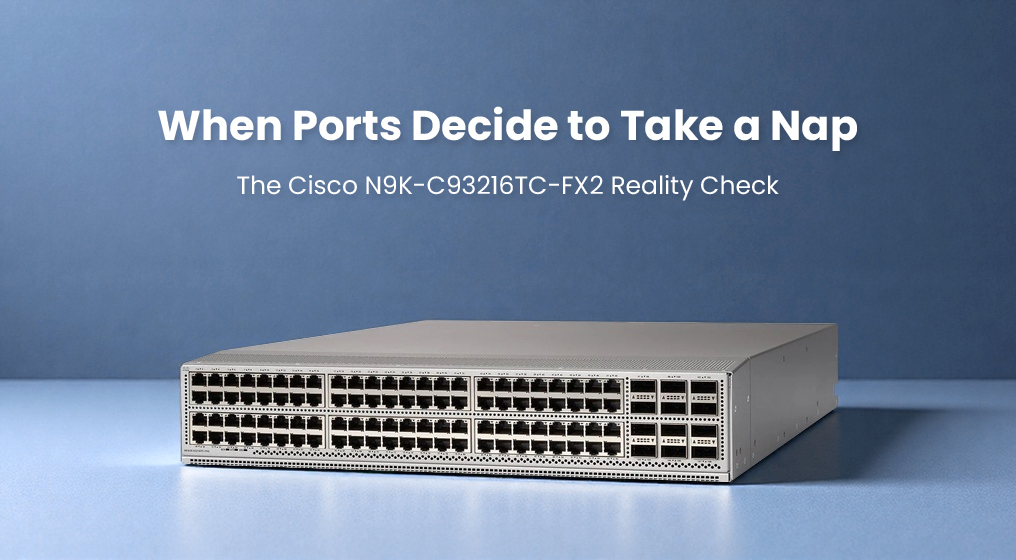
This 2RU workhorse sits at the edge of modern data center fabrics, designed to connect servers with 10GBase-T copper while providing 100G uplinks to the rest of your infrastructure. With 96 RJ45 ports staring back at you, it promises to handle everything from virtualization hosts to storage arrays, though those promises sometimes come with caveats that only reveal themselves during late-night troubleshooting sessions.
What this switch actually does in practice is provide a migration path for organizations still heavily invested in copper infrastructure. Those 96 ports aren't just for show—they're your connection to legacy servers, network-attached storage, and equipment that hasn't yet made the jump to fiber. The 12 QSFP28 uplinks give you breathing room for growth, though you'll want to plan those configurations carefully to avoid the fabric-peering issues documented in bug CSCwb58876.
Here are the numbers that matter when you're planning your deployment:
|
Specification |
What It Means in Real Operations |
|---|---|
|
Port Configuration |
96 × 10GBASE-T RJ45 + 12 × 40/100G QSFP28 |
|
Switching Capacity |
4.32 terabits per second |
|
Forwarding Rate |
2.5 billion packets per second |
|
System Memory |
24 GB |
|
Storage |
128 GB SSD |
|
Buffer Size |
40 MB |
|
Form Factor |
2RU (3.38" × 17.41" × 23.6") |
|
Weight |
27.4 lb (without PSU and fans) |
|
Power Supplies |
Dual 1200W AC (hot-swappable) |
|
MTBF |
295,515 hours |
Physically, the switch presents a dense, industrial appearance. The front panel is dominated by those 96 RJ45 ports, arranged in a grid that makes cable management both a challenge and an art form. The rear houses the 12 QSFP28 uplinks, plus your dual power supplies and three fan modules. At just over 27 pounds, it has that satisfying heft of enterprise-grade hardware, though you'll appreciate the rack ears when lifting it into position.
Where the 93216TC-FX2 truly delivers value is in its flexibility. Every RJ45 port supports auto-negotiation down to 100Mbps, making it suitable for mixed environments where not everything has caught up to 10G. The QSFP28 uplinks support breakout configurations to 25G or 10G, giving you additional flexibility in how you connect to the rest of your fabric. Hardware-based MACsec encryption across all ports provides line-rate security, though you'll need to ensure your licensing supports this feature.
From an operational standpoint, this switch offers both rewards and frustrations. The comprehensive telemetry through NetFlow and ERSPAN gives you visibility into traffic patterns, though interpreting that data requires some adjustment if you're coming from simpler switches. The web interface provides a decent graphical management option, though most experienced engineers still prefer the CLI for complex configurations. The intelligent buffer management with Approximate Fair Dropping (AFD) helps prevent smaller flows from being starved by larger ones, though the 40MB buffer can feel tight during traffic bursts.
When it comes to value, the 93216TC-FX2 occupies a unique position in the market. It's one of the few switches that provides this density of 10GBase-T ports in a single chassis, making it cost-effective for organizations with significant copper infrastructure. The real savings come in operational simplicity: not needing media converters or separate switches for copper and fiber connections. Over a typical 5-year lifecycle, the reduced complexity often justifies the investment, though you'll want to factor in the learning curve for features like VXLAN EVPN if you're coming from traditional networking.
The strengths are immediately apparent: exceptional port density for copper connections, flexible uplink options, solid performance for most workloads, and integration with Cisco's broader ecosystem. The weaknesses reveal themselves over time: the occasional port initialization issues, the learning curve for advanced features, and the thermal management considerations in dense deployments.
Compatibility is where Cisco's ecosystem delivers consistent value. The 93216TC-FX2 integrates seamlessly with other Nexus switches, works with DNA Center for centralized management, and supports the full range of Cisco transceivers and cables. For organizations already invested in Cisco infrastructure, the integration feels natural. The switch also supports both NX-OS and ACI modes, allowing you to choose between traditional management and policy-driven automation.
Software support follows Cisco's established lifecycle, with NX-OS releases typically receiving updates for 5-7 years. The switch supports in-service software upgrades (ISSU), allowing you to update firmware without taking the entire fabric offline—a feature that becomes invaluable in 24/7 operations. Regular security patches and feature updates keep the platform current, though some organizations find the pace of updates challenging to keep pace with, requiring dedicated training resources.
What you're really getting with the 93216TC-FX2 is a bridge between legacy infrastructure and modern data center requirements. The ability to handle 10G copper while providing 100G uplinks makes it suitable for organizations in transition, though you'll want to plan your migration carefully to avoid the fabric-peering issues that can arise during complex deployments. For teams supporting mixed environments, modernizing legacy data centers, or building out new infrastructure with significant copper requirements, this switch provides a practical solution that balances performance, flexibility, and cost.
The true measure of any network device isn't how it performs in lab tests, but how it holds up under production loads while you're dealing with the hundred other tasks that fill a network engineer's day. The 93216TC-FX2 generally passes this test, offering enough headroom for growth and enough stability to let you focus on delivering services rather than babysitting hardware—even if it occasionally reminds you that enterprise networking is equal parts science and art, with just enough frustration to keep things interesting.