
Intellectual Property
Hot selling product recommendations
View More


















The Spine That Carries Your Data Center's Weight: Living with Cisco's N9K-C9364C
Let me tell you about the workhorse that quietly powers some of the most demanding networks out there. I've spent considerable time with Cisco's N9K-C9364C in production environments, and it's one of those pieces of infrastructure that you appreciate more the longer you work with it. This isn't just another switch—it's the backbone of modern data center fabrics.
When you first unbox the 9364C, you're greeted with a surprisingly dense 2RU chassis that feels substantial at around 27 pounds. The front panel is dominated by those 64 QSFP28 ports, with the last 16 marked in distinctive green to indicate hardware MACsec support. It's a clean, industrial design—no flashy lights or unnecessary ornamentation, just purposeful engineering. The dual hot-swappable power supplies and three fan modules at the rear give you that enterprise-grade reassurance before you even power it on.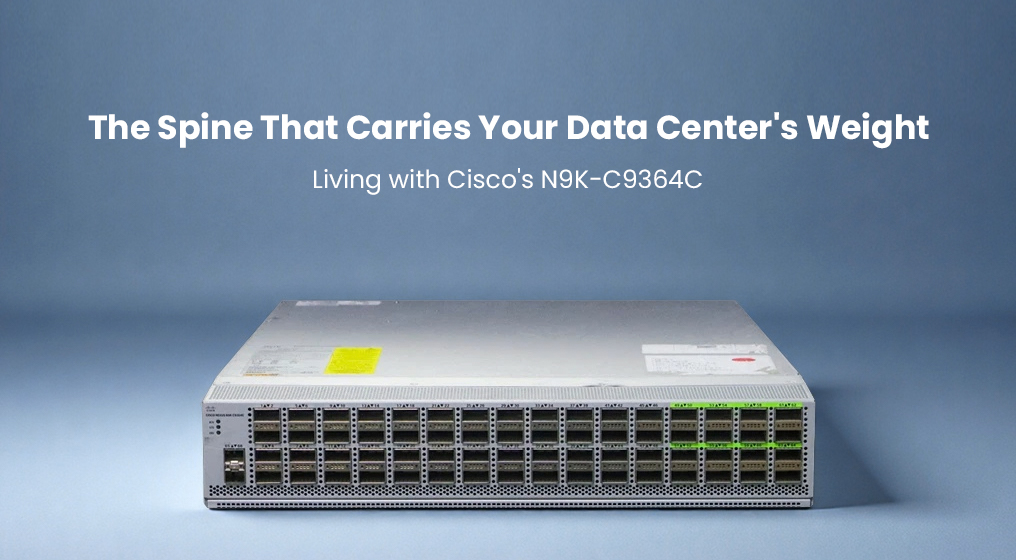
What really matters is what this switch does. The 9364C serves as the spine in leaf-spine architectures, connecting everything in your data center with 40G or 100G links. With 12.84 terabits per second of switching capacity and 4.3 billion packets per second forwarding rate, it handles traffic that would choke lesser switches. I've seen it effortlessly manage east-west traffic between hundreds of servers while maintaining consistent sub-microsecond latency.
Here are the numbers that matter:
|
Specification |
Value |
|---|---|
|
Port Configuration |
64 × 40/100G QSFP28 + 2 × 1/10G SFP+ |
|
Switching Capacity |
12.84 Tbps |
|
Forwarding Rate |
4.3 Bpps |
|
Memory |
32 GB RAM, 256 GB SSD |
|
Dimensions |
17.37" × 22.27" × 3.38" (2RU) |
|
Weight |
27.4 lb (12.4 kg) |
|
Power Supplies |
Dual 1200W AC or 930W DC (hot-swappable) |
|
Operating Temperature |
32°F to 104°F (0°C to 40°C) |
The real magic happens in deployment. Whether you're running it in traditional NX-OS mode or as part of Cisco's Application Centric Infrastructure (ACI), the 9364C integrates seamlessly. The dual-mode capability means you can start with conventional networking and transition to policy-based automation without hardware changes. Those last 16 ports with hardware MACsec encryption? They're perfect for securing spine interconnects in financial or healthcare environments where data protection isn't optional.
From an operational standpoint, the 9364C shines in several areas. The redundant power and cooling mean you can replace components without downtime—a feature I've appreciated during maintenance windows. The front-to-back airflow design works well in standard data center hot/cold aisle configurations. And while 64 ports might seem excessive, in hyperscale environments, that density becomes essential for reducing rack space and cabling complexity.
Where this switch truly delivers value is in total cost of ownership. Yes, the initial investment is significant, but when you factor in rack space savings, reduced cabling complexity, and lower operational overhead, the economics shift dramatically. Compared to needing multiple lower-density switches, the 9364C often comes out ahead over a 3-5 year horizon. The power efficiency—around 6.5 watts per 100G port—also contributes to lower operating costs in energy-intensive environments.
No product is perfect, and the 9364C has its trade-offs. The lack of port breakout capability means you can't split those 100G ports into multiple 25G or 10G connections, which limits flexibility in some deployment scenarios. The 2RU form factor, while necessary for the port density, consumes more rack space than 1RU alternatives. And while the hardware is robust, some organizations might find the learning curve for ACI deployment steeper than traditional networking.
On the software side, Cisco maintains solid support through their NX-OS release cycle, with major updates typically available through 2030 for current releases. The compatibility with Cisco's broader ecosystem—from DNA Center to Intersight—means you're not buying an island but part of an integrated solution. The ability to participate in ACI multi-site deployments starting with release 3.1 adds significant flexibility for distributed data centers.
What stands out most in daily operation is the reliability. With mean time between failures measured in hundreds of thousands of hours, this isn't equipment you worry about. The comprehensive telemetry and monitoring capabilities give you visibility into every aspect of performance, from buffer utilization to temperature gradients across the chassis.
For teams managing large-scale data centers, cloud infrastructure, or high-performance computing environments, the N9K-C9364C represents a solid foundation. It's not the newest model on the market—Cisco has since introduced the GX variant with additional features—but for 100G-centric deployments, it continues to deliver exceptional performance and reliability. The transition to newer platforms is straightforward when the time comes, preserving your investment in skills and operational processes.
The true test of any infrastructure component is how it performs when you're not thinking about it. With the 9364C, that's exactly what happens—it becomes part of the reliable foundation that lets you focus on delivering services rather than managing hardware. In a world where network performance directly impacts business outcomes, that kind of quiet confidence is worth every penny.