
The Silent Workhorse: A Deep Dive into the Cisco C1300-8T-E-2G
You know the specific frustration of trying to professionalize a home lab or a small office network, only to be stopped by the sheer noise of enterprise hardware? You buy a powerful switch to handle VLANs and routing, but then you can't put it in your office because it sounds like a jet engine taking off. This is the exact problem the Cisco Catalyst
C1300-8T-E-2G is designed to solve. It sits in that sweet spot between the "toy" grade switches you find in consumer electronics stores and the massive, rack-mounted data center gear. It is built to sit right on your desk, disappear into the background, and handle serious traffic without making a sound.

At its core, this device is a Layer 3 switch, which is a significant step up from the standard Layer 2 switches that simply pass data back and forth. The "Essentials" license (indicated by the 'E' in the model name) unlocks a suite of features that allow for static routing and advanced security. This means you can segment your network—keeping your guest traffic separate from your main work traffic—without bogging down your main router. It is designed for the "edge" of the network, acting as a smart, secure gateway for a small cluster of users.
When we look at what makes it tick, the specs are surprisingly robust for such a compact unit. It isn't just moving bits; it's processing them with a level of intelligence usually reserved for larger chassis. The inclusion of a dual-core ARM processor running at 1.4GHz and a generous 1GB of DDR4 memory means the interface remains snappy even when you have complex Access Control Lists (ACLs) running. It supports a MAC address table of 16,000 entries, which is overkill for a home but perfect for a busy small business or a dense IoT environment.
| Feature |
Specification |
| Processor |
1.4GHz Dual-Core ARM |
| Memory |
1GB DDR4 |
| Switching Capacity |
20 Gbps |
| Forwarding Rate |
14.88 Mpps |
| Ports |
8x Gigabit Ethernet, 2x Gigabit Combo Uplinks |
| Power Consumption |
Approx. 10.65W (220V) |
| Cooling |
Fanless (Passive Cooling) |
The physical experience of using the
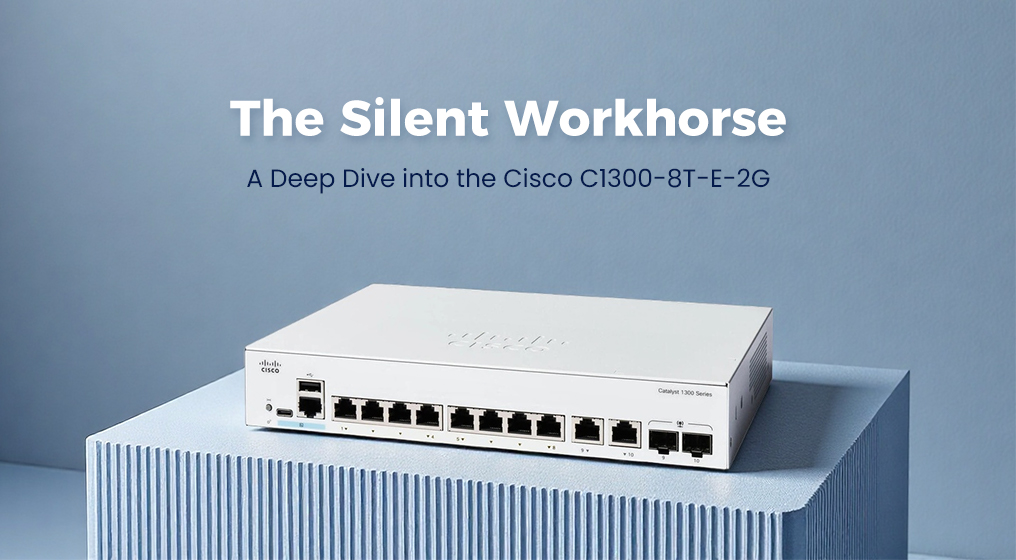
C1300-8T-E-2G is defined by its build quality. In a market flooded with flimsy plastic enclosures that flex when you plug in a stiff Ethernet cable, the C1300 feels like a tank. It sports a rugged metal chassis that measures roughly 268 x 185 x 44 mm. It’s compact, but it has heft. The front panel is clean, with intuitive LEDs for System, Link/Act, and Speed, allowing you to diagnose a bad cable or a negotiation error at a glance. Because it is fanless, it relies on the metal chassis to dissipate heat, which it does efficiently. You can run this thing 24/7 for months, and it will barely be warm to the touch.
Integrating this into an existing ecosystem is generally seamless, especially if you are upgrading from older Cisco Small Business switches like the SG350 or SG550 series. The C1300 is effectively the spiritual successor to those lines. It supports standard protocols like 802.1Q VLANs, LACP for link aggregation, and Spanning Tree Protocol (STP/RSTP/MSTP). For those invested in the broader Cisco world, it supports Cisco FindIT, a tool that helps you discover and configure devices on the network without needing to know IP addresses beforehand. It also supports 802.1X authentication, meaning you can lock down ports so that only authorized devices can connect—a critical feature for modern security compliance.
However, no piece of hardware is perfect, and it is important to understand the trade-offs. The biggest limitation of the
C1300-8T-E-2G is right there in the name: the "T" stands for Data Only. This unit does not support Power over Ethernet (PoE). If you were hoping to power your Wi-Fi access points or VoIP phones directly from the switch, you will need to look at the "8P" model or use separate power injectors. Additionally, while the "Essentials" license is great, it is limited to static routing. If you need dynamic routing protocols like OSPF for a complex multi-site network, you would need to step up to the "Premium" license or a higher-tier switch.
In terms of value, this device is a high-utility investment. While it is more expensive than unmanaged switches, you are paying for the "set it and forget it" reliability that Cisco is famous for. The software lifecycle is long, ensuring you get security updates for years. For a small office, a studio, or a serious home enthusiast, the
C1300-8T-E-2G offers the best of both worlds: the silence and size of a desktop switch, with the muscle and features of an enterprise router.