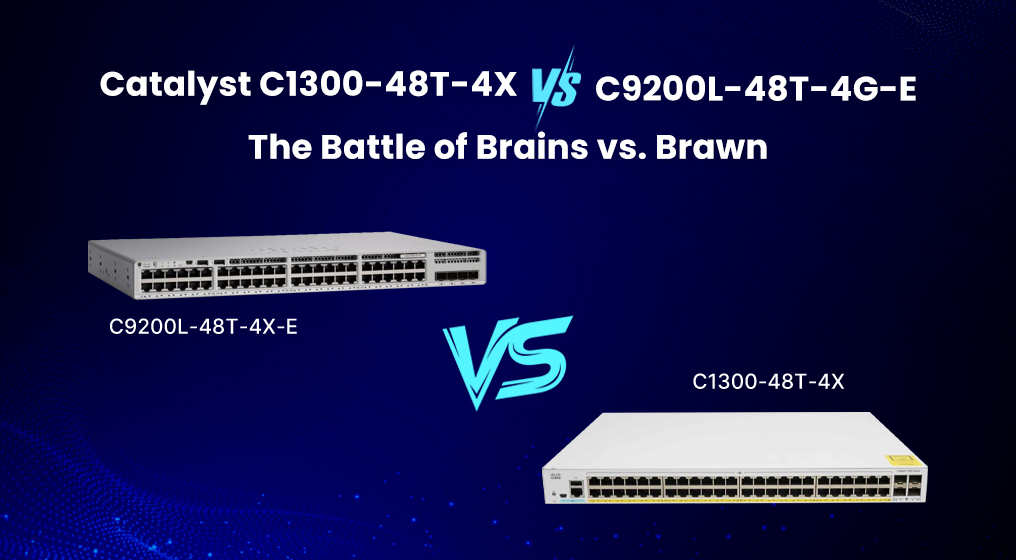

Catalyst C1300-48T-4X vs. C9200L-48T-4X-E: The Battle of Brains vs. Brawn
Choosing between the Catalyst
C1300-48T-4X and the
C9200L-48T-4X-E is a classic dilemma in network design. You are essentially deciding between raw switching power and enterprise intelligence. Both switches look nearly identical on the front panel—48 data ports and 4 uplinks—but under the hood, they operate on completely different philosophies. One is a high-performance "muscle" switch designed for speed and simplicity, while the other is a "smart" switch built for complex network orchestration and long-term scalability.
To understand which one fits your rack, we have to look at the silicon. The C1300-48T-4X is built around a 1.4GHz dual-core ARM processor. It is designed to move packets as fast as possible with minimal overhead. In contrast, the C9200L-48T-4X-E runs on Cisco’s UADP 2.0 Mini ASIC. This custom chip is designed not just for speed, but for programmability, allowing the switch to handle complex telemetry, automation, and security tasks that the C1300 simply cannot process.

| Feature |
Catalyst C1300-48T-4X |
Catalyst C9200L-48T-4X-E |
| Switching Capacity |
176 Gbps |
104 Gbps (184 Gbps w/ Stacking) |
| Forwarding Rate |
130.94 Mpps |
77.38 Mpps |
| Uplinks |
4x 10G SFP+ (Fixed) |
| Processor |
1.4GHz Dual-Core ARM |
UADP 2.0 Mini ASIC |
| Stacking |
Front Panel (Uses Uplinks) |
StackWise-80 (Dedicated) |
| OS Capability |
Layer 3 Lite / Static |
Full IOS XE (Dynamic Routing) |
| PoE Support |
No (Data Only) |
No (Data Only) |
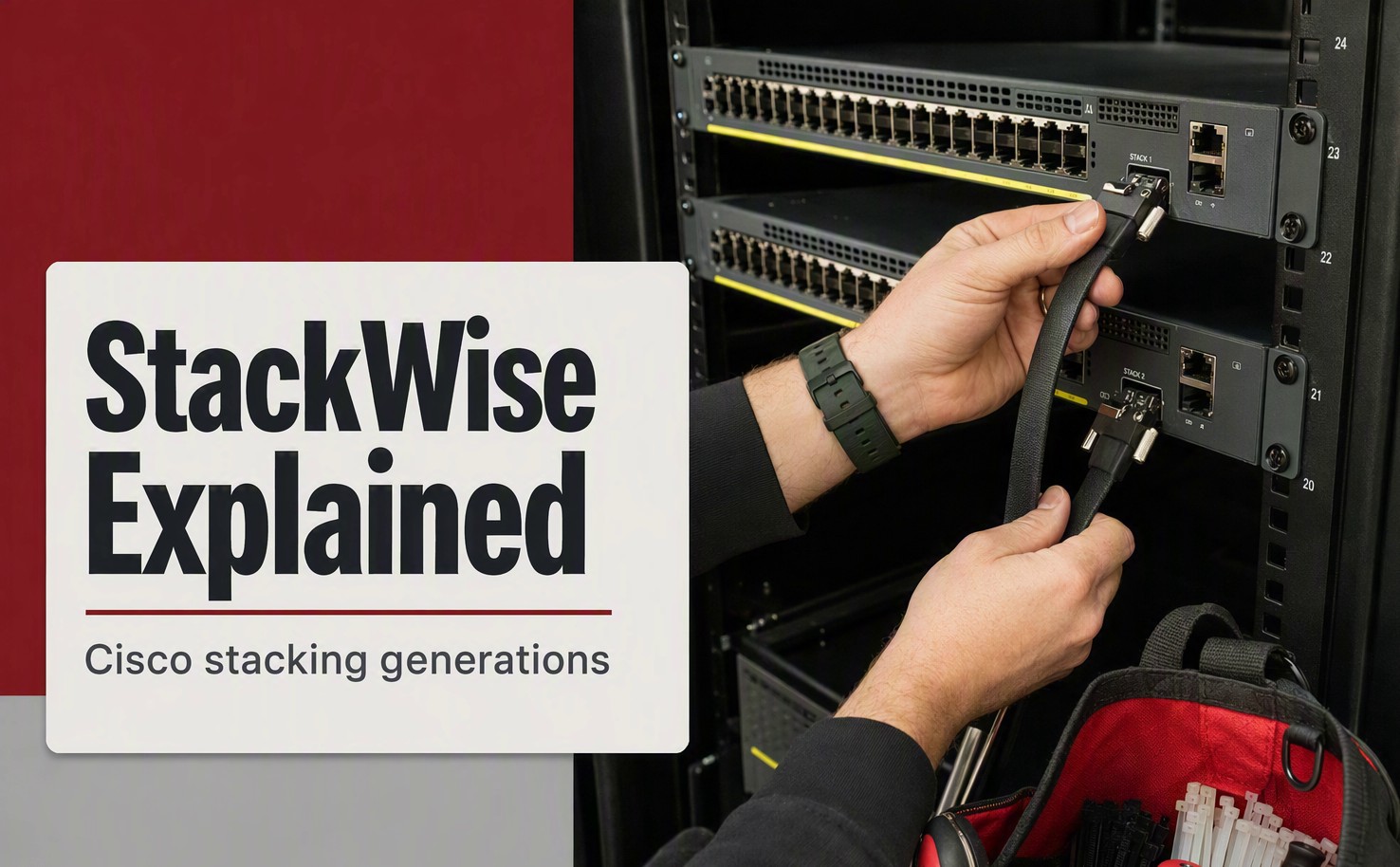
Physically, these units are nearly indistinguishable. They share the same 1RU form factor and depth, making them interchangeable in standard server racks. However, the "T" (Data only) designation means both units are surprisingly light compared to their PoE cousins. They run cool and quiet, making them suitable for office environments where noise is a concern. The main physical differentiator is actually on the backplane logic rather than the chassis itself. The C9200L is designed to be part of a StackWise-80 cluster using a dedicated stacking cable (often requiring a specific module or port usage depending on the exact sub-revision), whereas the C1300 relies on a simpler front-panel stacking method that consumes your valuable 10G uplink ports.
Performance is where the C1300-48T-4X shines as a "sleeper" hit. With a forwarding rate of 130.94 Mpps, it significantly outperforms the C9200L's 77.38 Mpps. If your primary goal is to move massive amounts of data from point A to point B with the lowest possible latency, the C1300 is the faster machine. It is a brute force switch that excels at basic Layer 2 switching and static routing. It doesn't get bogged down by heavy software processes because it simply doesn't run them.
The C9200L-48T-4X-E, while slower in raw throughput, offers superior "intelligence." It runs the full Cisco IOS XE operating system. This means it supports full dynamic routing protocols like OSPF and EIGRP, advanced security features like TrustSec, and automation via Cisco DNA Center. If your network requires the switch to make intelligent routing decisions or participate in a software-defined network (SDN), the C9200L is the only choice. The C1300 is limited to static routes and basic RIP, making it less suitable for complex network cores or distribution layers.
User experience differs significantly between the two. The C1300 is praised for its simplicity. It uses a web interface that is intuitive and a CLI that feels familiar to those who have used older Cisco SMB switches. It is a "set it and forget it" device. The C9200L requires a higher level of expertise. Managing IOS XE, handling licensing (DNA Essentials/Advantage), and configuring StackWise requires a seasoned network administrator. However, once set up, the C9200L offers better visibility into network health through telemetry, which the C1300 lacks.
Stability is a strong point for both, but they achieve it differently. The C1300 is stable because it is simple; there is less software to crash. It is a rugged, reliable appliance. The C9200L is stable because it is enterprise-hardened. It supports features like Non-Stop Forwarding (NSF) and Stateful Switchover (SSO) when stacked, ensuring that if one unit fails, the network stays up. This redundancy makes the C9200L a safer bet for mission-critical environments where downtime is not an option.
In terms of value, the C1300-48T-4X is the cost-performance king for pure bandwidth. Getting 176 Gbps of switching capacity and 10G uplinks at its price point is incredibly hard to beat. It is the perfect choice for a wiring closet that just needs to pipe data to a server room without any complex routing logic. The C9200L-48T-4X-E is more expensive, not just in hardware but in licensing, but you are paying for the "brain" of the switch. If you need to segment your network, automate policies, or stack switches without losing uplink ports, the extra investment in the C9200L is justified.
Ultimately, choose the C1300-48T-4X if you want raw speed and simplicity for a flat network. Choose the C9200L-48T-4X-E if you need a smart, manageable, and scalable platform that can grow with your enterprise needs.