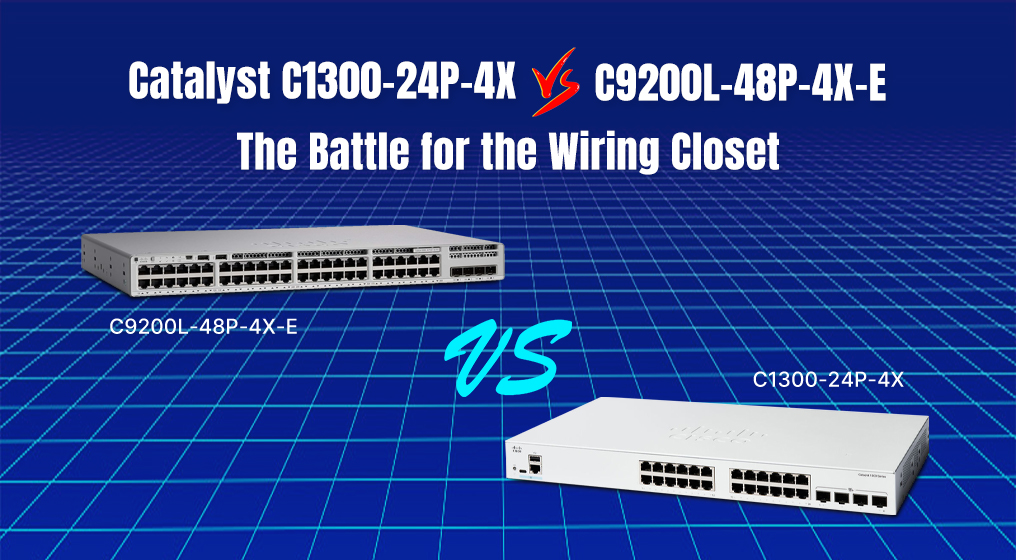

Catalyst C1300-24P-4X vs. C9200L-48P-4X-E: The Battle for the Wiring Closet
Selecting the right access switch often feels like a compromise between budget constraints and the relentless demand for bandwidth. When placing the Catalyst
C1300-24P-4X side-by-side with the Catalyst
C9200L-48P-4X-E, you are looking at two very different approaches to network access. One is a streamlined, modern entry-point designed for simplicity and speed, while the other is a high-density enterprise veteran built to carry heavy loads. To understand which one belongs in your rack, we have to look beyond the marketing acronyms and see how they actually perform in the field.
At a glance, the most glaring difference is port density, but the real story lies in the silicon architecture. The C1300 series is built on a 1.4GHz dual-core ARM processor, designed to be efficient and cost-effective. It handles traffic well but is architecturally distinct from the heavy iron of the Catalyst 9000 family. The C9200L, conversely, runs on Cisco’s proprietary UADP ASIC (Unified Access Data Plane), which is purpose-built for high-performance programmable forwarding. This fundamental hardware difference dictates how they handle complex routing tables and heavy data bursts.

| Feature |
Catalyst C1300-24P-4X |
Catalyst C9200L-48P-4X-E |
| Switching Capacity |
128 Gbps |
108 Gbps |
| Forwarding Rate |
95.23 Mpps |
77.38 Mpps |
| Downlink Ports |
24x Gigabit Ethernet (PoE+) |
48x Gigabit Ethernet (PoE+) |
| Uplinks |
4x 10G SFP+ |
4x 1G SFP |
| PoE Budget |
~195W (Varies by PSU) |
Up to 1000W (Modular) |
| Processor |
1.4GHz Dual-Core ARM |
Custom UADP ASIC |
| Stacking |
No (Uses uplinks) |
StackWise-80 |
| Layer 3 |
Static / Floating Static |
Full Dynamic Routing |
The physical experience of deploying these switches is night and day. The
C1300-24P-4X is surprisingly compact and lightweight. It is designed to be unobtrusive, making it a favorite for open-plan offices where the switch might sit in a closet near a conference room. It runs relatively cool and quiet. The
C9200L-48P-4X-E, however, is a beast. It is significantly deeper and heavier, primarily due to the massive power supplies required to drive 48 PoE ports. When you install the 9200L, you need to ensure your rack rails are secure. Furthermore, the noise profile is different; the C1300 is whisper-quiet, while the C9200L can generate a noticeable hum as its fans spin up to cool the high-wattage power supply under load.
Performance is where the C1300-24P-4X punches above its weight class. Despite being the "budget" option, it boasts a higher forwarding rate (95.23 Mpps) than the 48-port C9200L. This is largely because the C1300 has fewer ports to service. More importantly, the C1300-24P-4X comes standard with 4x 10G SFP+ uplinks. This gives you a massive 40Gbps pipe to your core, ensuring that the 24 users connected to it never feel congestion. The C9200L-48P-4X-E is limited to 1G uplinks. While it has double the number of downlink ports, that traffic has to squeeze through a much narrower exit, which can create bottlenecks during peak usage hours.
Functionally, the C9200L is the more capable device. It runs the full Cisco IOS XE operating system, supporting advanced automation, full dynamic routing protocols (like OSPF), and deep integration with Cisco DNA Center. It is a true enterprise access switch. The C1300 is more limited; it handles static routing and essential Layer 3 features well, but it lacks the deep programmability of the 9000 series. It is designed for simplicity—plug, play, and manage via a straightforward web interface or basic CLI.
From a user experience perspective, the C1300 is often praised for its "set and forget" reliability. It is an excellent choice for IT teams that need to deploy switches quickly without deep configuration. The C9200L requires a bit more expertise. Configuring PoE budgets, setting up complex VLANs, and managing StackWise-80 (which allows you to stack multiple switches as one) requires a seasoned network administrator. However, once configured, the stacking capability of the C9200L makes managing 48 ports much easier than managing two separate C1300 units.
Stability is a hallmark of both units. The C1300 runs very cool and has fewer points of failure since it lacks the complex modular power supplies of the 9000 series. The C9200L is also rock solid, but the PoE components add a layer of complexity. If you are pushing the power budget to the limit, thermal management becomes critical. You must ensure the environment is cool enough to dissipate the heat generated by converting AC power to DC for 48 ports.
In terms of value, the decision comes down to density versus speed. If you have a wiring closet with 40+ devices (phones, cameras, APs), the C9200L-48P-4X-E is the logical choice because it consolidates everything into one rack unit. However, if you have fewer devices but need high-speed uplinks for data-intensive tasks, the C1300-24P-4X is the superior performer. The 10G uplinks alone make it a future-proof investment for growing networks that want to avoid the "access layer bottleneck."
Ultimately, the C1300-24P-4X is the agile sprinter—fast, efficient, and perfect for high-speed connectivity for a smaller group. The C9200L-48P-4X-E is the marathon runner—carrying a heavy load of devices, powering everything in its path, but moving slightly slower. Choose the C1300 for speed and simplicity; choose the C9200L for density and enterprise features.