Intellectual Property
Hot selling product recommendations
View More
















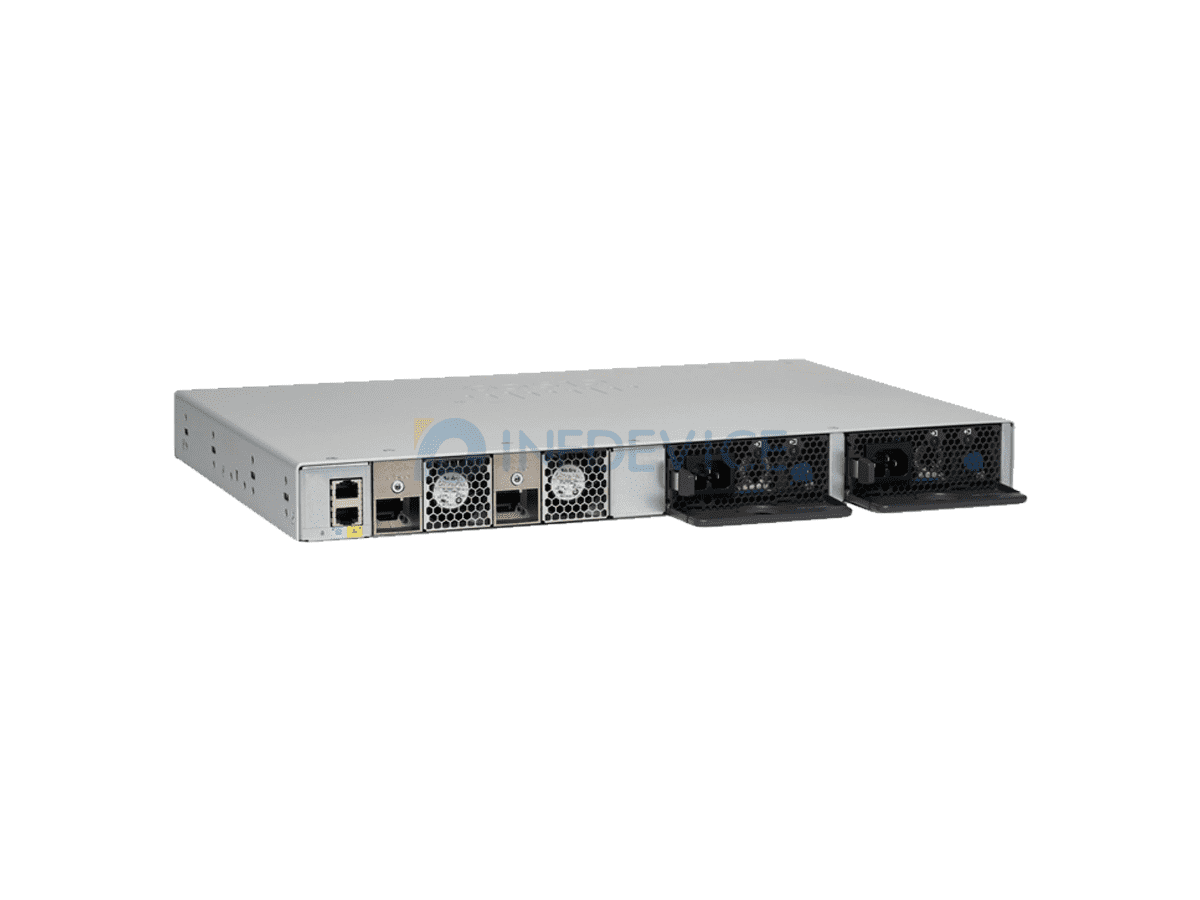







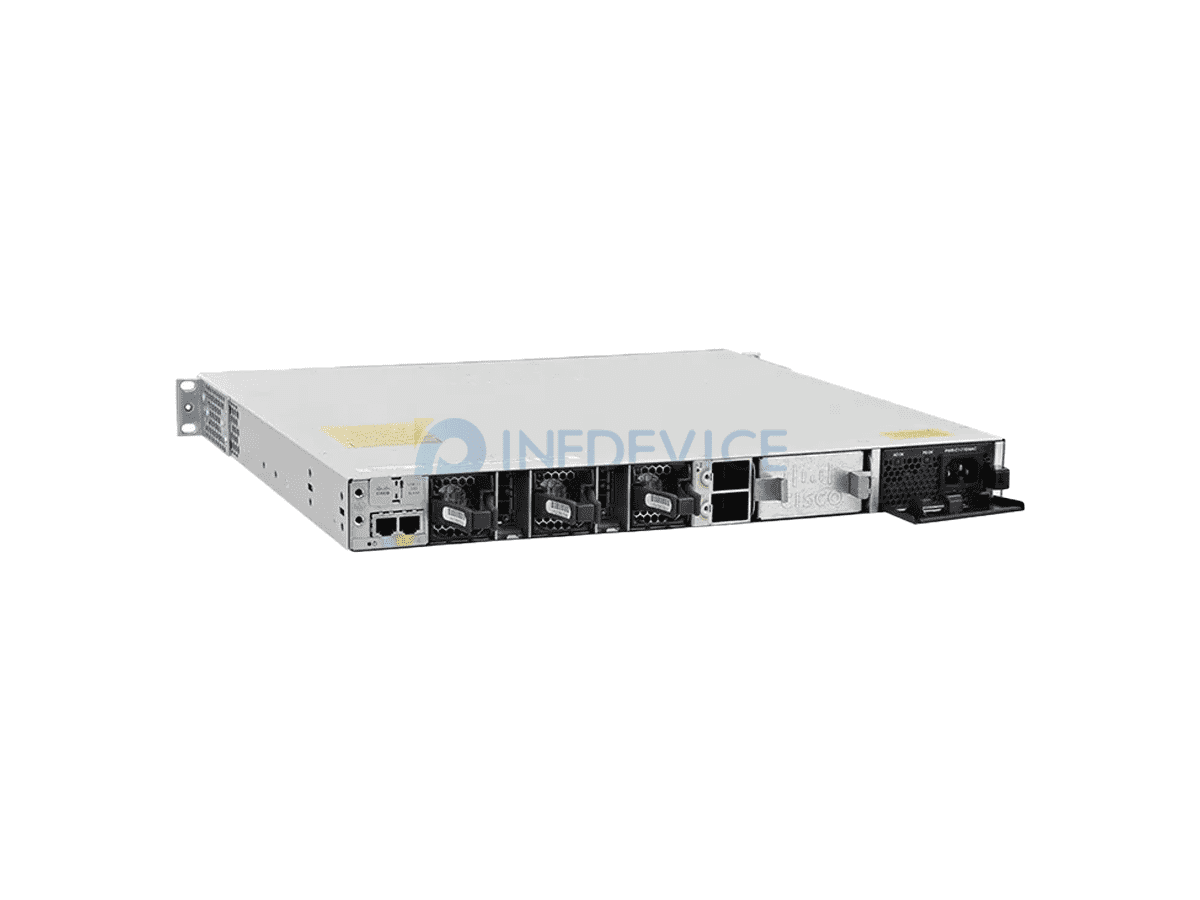
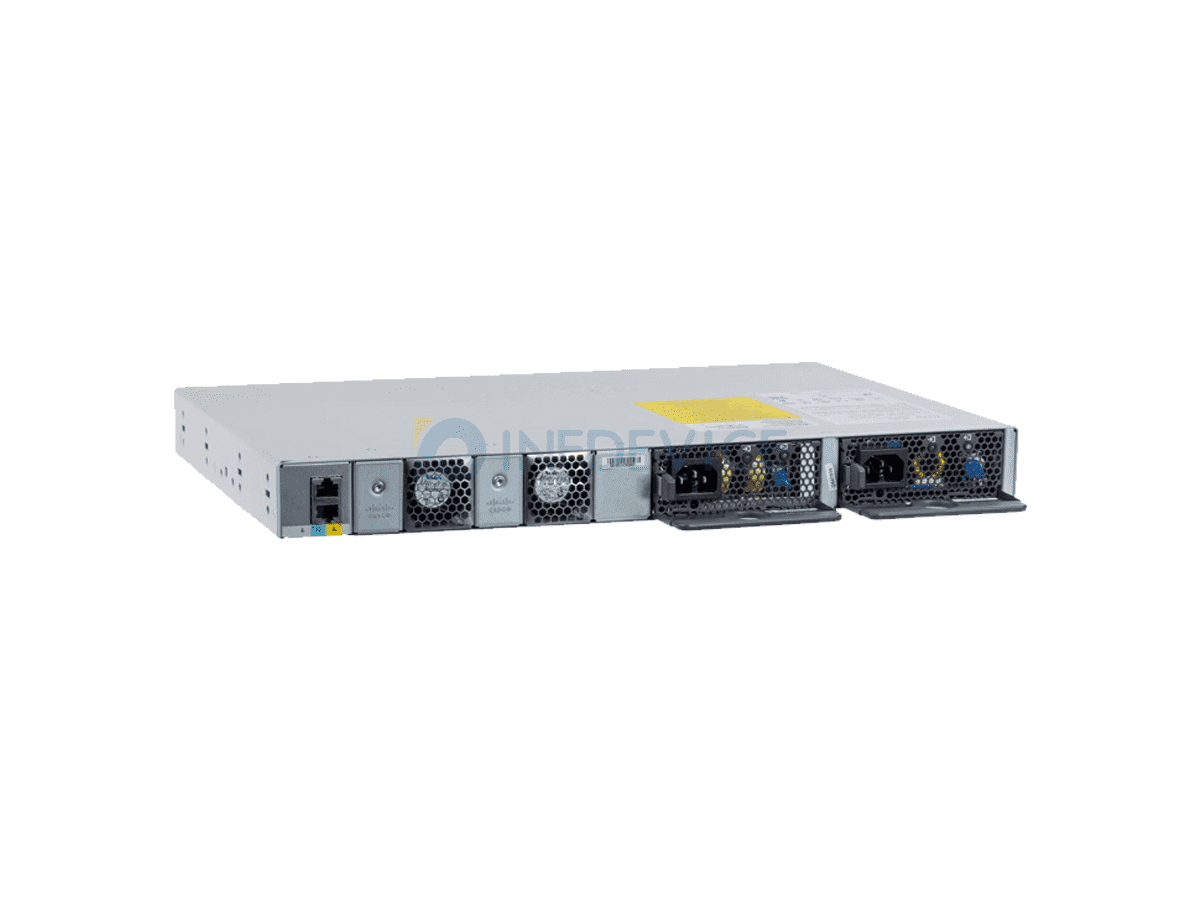
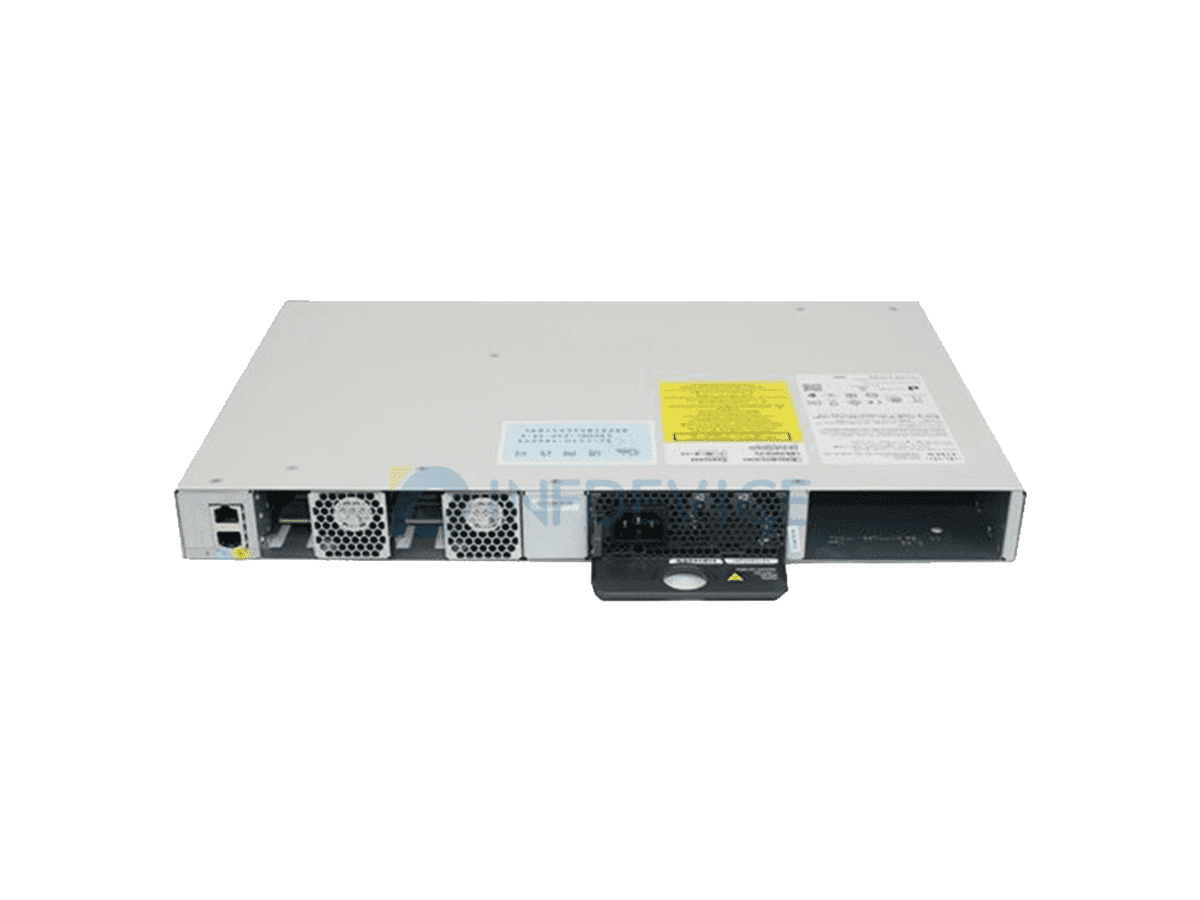
The C9300-48P-E is the 48-port PoE+ model in Cisco's Catalyst 9300 line — the platform most campus access closets standardised on after the 3850. It carries 48 × 10/100/1000 PoE+ ports, modular uplinks, StackWise-480 stacking and the Network Essentials tier.
Compared with the Catalyst 9200 family, three figures explain the price gap: 480 Gbps stacking, 256 Gbps switching capacity, and 32,000 IPv4 routes with a 16MB packet buffer. This guide puts the published numbers side by side and works out the PoE sizing that decides the power supply order.
| Parameter | C9300-48P-E |
|---|---|
| Downlink ports | 48 × 10/100/1000 PoE+ (RJ-45) |
| Uplinks | Modular network module slot (ordered separately) |
| Default power supply | PWR-C1-715WAC-P (715W) |
| PoE budget | 437W with the 715W supply; 822W with a 1100W supply |
| Switching capacity | 256 Gbps (736 Gbps with stacking) |
| Forwarding rate | 190.47 Mpps (547.62 Mpps with stacking) |
| Stacking | StackWise-480, 480 Gbps, up to 8 members |
| DRAM / flash | 8 GB / 16 GB |
| MAC / IPv4 routes | 32,000 / 32,000 (24,000 direct, 8,000 indirect) |
| Packet buffer / FNF | 16 MB / 64,000 flows |
| VLAN IDs | 4,094 |
| Fans | 3 field-replaceable fans, N+1 |
| Software | Cisco IOS XE, Network Essentials tier |
Source: Cisco Catalyst 9300 Series data sheet (performance, bandwidth, PoE and licensing tables). Forwarding rates measured with 64-byte IPv4 packets.
A 48-port PoE+ switch ships with 437W of PoE budget, because the default supply is 715W and the platform reserves the rest for the chassis. The full ladder Cisco publishes:
| Primary supply | PoE, single supply | With 350W secondary | With 715W secondary | With 1100W secondary |
|---|---|---|---|---|
| 715W (default) | 437W | 787W | 1,152W | 1,440W* |
| 1100W (upgrade) | 822W | 1,172W | 1,440W* | 1,440W* |
* Limited by port number and port rating — 48 PoE+ ports at 30W each is 1,440W, the chassis ceiling.
What that means in device counts:
So a fully populated class-4 closet never runs on the default supply, and it does not run on "upgrade to 1100W" alone either. The supply pair has to be sized from the port load, not from the port count.
Catalyst 9300 stacks at 480 Gbps with StackWise-480, up to eight members. The stacked bandwidth figures are 736 Gbps capacity and 547.62 Mpps forwarding — more than twice the 9200 platform's 288 Gbps, and roughly five times the 9200L's 136 Gbps.
The 9300 is also where stacking stops being only about access ports: 8 GB of DRAM and 32,000 IPv4 routes let a stack act as a routed access layer with meaningful table scale, rather than a Layer 2 fabric with a default gateway bolted on.
The uplink slot takes a network module ordered separately — 4 × 1G, 4 × 10G, 8 × 10G, 2 × 40G or 2 × 25G depending on the module. Two points to check before ordering:
Network Essentials on this platform covers Layer 2 plus routed access (RIP, EIGRP stub, OSPF up to 1,000 routes), PBR, PIM stub, 802.1X, MACsec-128, QoS and SSO. Network Advantage adds two groups that matter for campus designs:
If the closet runs HSRP gateways, BGP, or VRF segmentation, the part number needed is the C9300-48P-A. This is the single most common ordering mistake on 9300: the hardware is identical, the licence is not, and it is set at order time.
| C9300-48P-E | C9200-48P-E | C9200L-48P-4X-E | |
|---|---|---|---|
| Downlinks | 48 × PoE+ | 48 × PoE+ | 48 × PoE+ |
| Uplinks | Modular | Modular (1G/10G) | 4 × 10G fixed |
| Switching capacity | 256 Gbps | 176 Gbps | 176 Gbps |
| Forwarding rate | 190.47 Mpps | 130.95 Mpps | 130.95 Mpps |
| Stacking | 480 Gbps | 160 Gbps | 80 Gbps |
| DRAM / flash | 8 GB / 16 GB | 4 GB / 4 GB | 2 GB / 4 GB |
| IPv4 routes | 32,000 | 4,000 | 3,000 |
| PoE on default supply | 437W | 740W | 740W |
Read the PoE row carefully: the 9200 platforms give more PoE power on the default supply than the 9300 does (740W against 437W), because the 9300 ships with a 715W supply and reserves more for the chassis. The 9300 wins on stacking, table scale and module options, not on out-of-the-box power.
How much PoE does the C9300-48P-E provide?
437W with the default 715W supply and 822W with a 1100W supply; a second supply raises it further, up to the 1,440W chassis ceiling.
Why does a 9300 have less PoE than a 9200 on the default supply?
Because the default supply is 715W and the platform reserves more headroom for the chassis; the 9200's 48-port model ships with a 1KW supply and offers 740W.
Does it include uplinks?
No. Uplinks come from a network module ordered separately.
Can I upgrade Essentials to Advantage later?
Treat the tier as fixed at purchase; if HSRP, BGP or VRF is in the design, order the -A part number.
What are its switching capacity and forwarding rate?
256 Gbps and 190.47 Mpps standalone; 736 Gbps and 547.62 Mpps as a StackWise-480 stack.
Does it need a stacking kit or adapters?
No. The modular 9300 chassis carries its own stacking ports, so only the cable is ordered — unlike the 9200L, which needs C9200L-STACK-KIT with two adapters.
If the port count, uplink or power budget in this article is not the one your design calls for, these ship from the same series and the same stock position:
Need the C9300-48P-E with a specific module and supply pair? Send the port load, module type and quantity and we quote the complete configuration. Full C9300-48P-E product page and specifications · Compare with security platforms · Request a quote
Specification sources: Cisco Catalyst 9300 Series data sheet (Table 9 bandwidth, PoE power table, and the Cisco Switching Licensing Feature Matrix for Essentials/Advantage).