Intellectual Property
Hot selling product recommendations
View More
















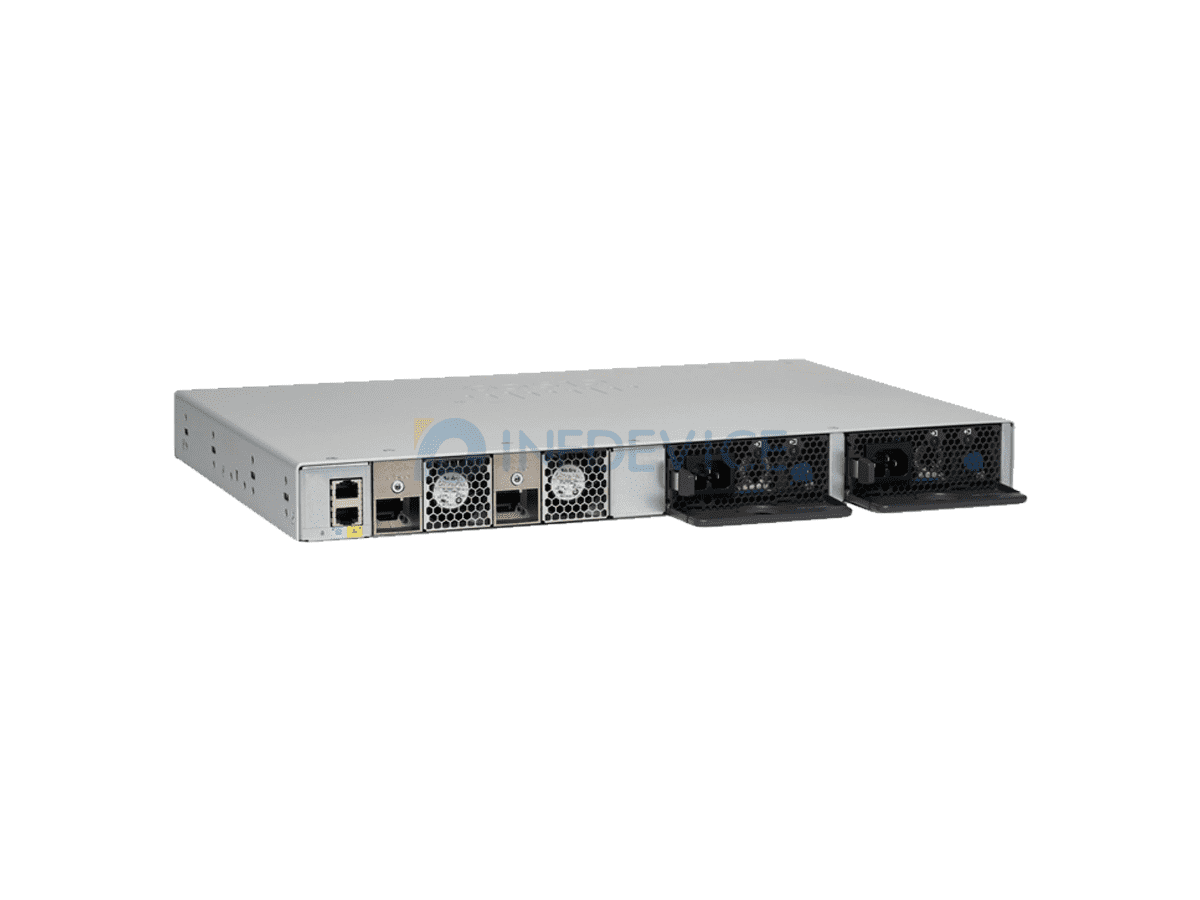







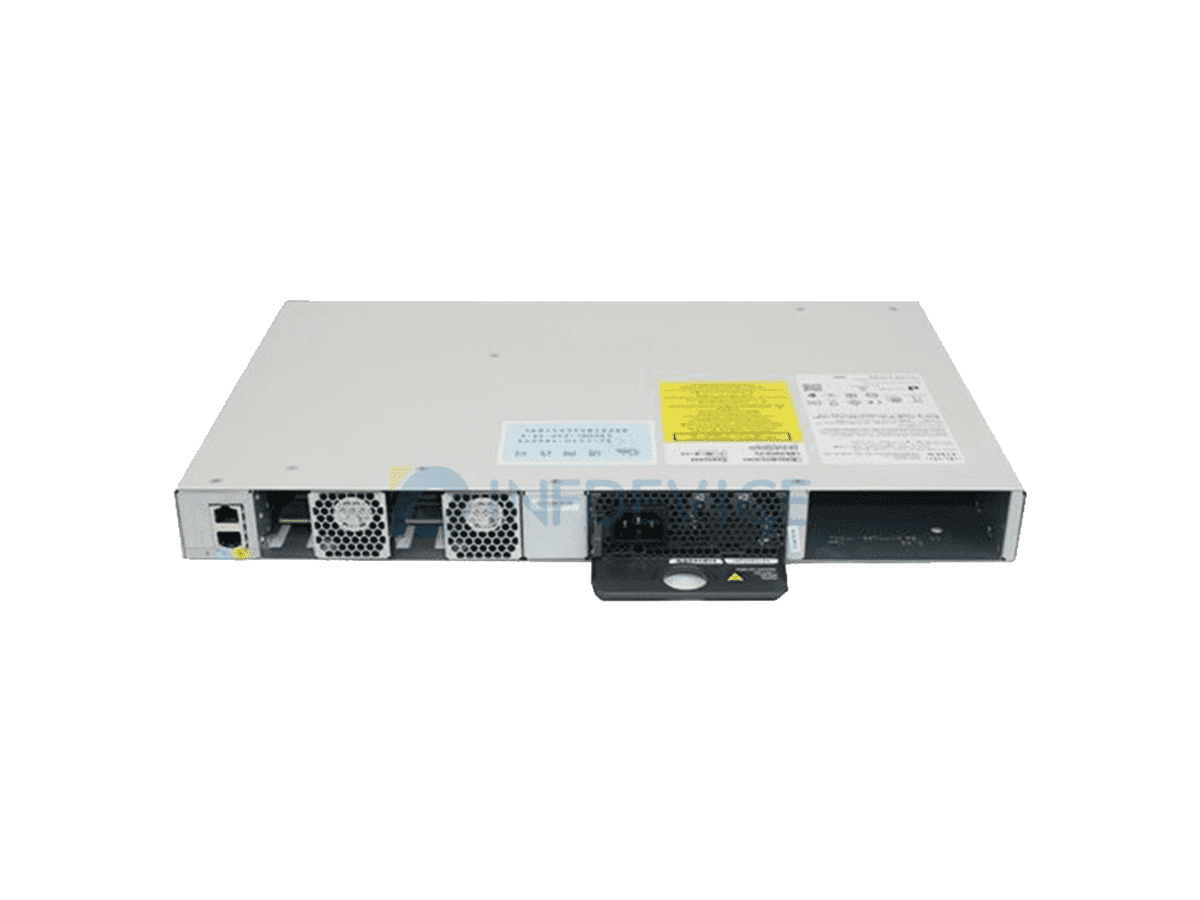
The C9200-24P-E looks almost identical to the 9200L 24-port PoE+ model on a quote sheet: same 24 PoE+ downlinks, same 370W starting PoE budget, same Network Essentials tier. The difference sits behind the faceplate, and it is the reason buyers who expect to grow into 10G keep choosing it over the cheaper -L part.
Here is what the extra money buys, using Cisco's data sheet numbers: a modular uplink slot, double the switching capacity, StackWise-160 instead of StackWise-80, and fans you can replace without swapping the chassis.
| Parameter | C9200-24P-E |
|---|---|
| Downlink ports | 24 × 10/100/1000 PoE+ (RJ-45) |
| Uplinks | Modular network module slot — C9200-NM-4G (4 × 1G) or C9200-NM-4X (4 × 1G/10G) |
| PoE budget | 370W with the default PWR-C6-600WAC; 740W with a second identical supply |
| Switching capacity | 128 Gbps (288 Gbps with stacking) |
| Forwarding rate | 95.23 Mpps (214 Mpps with stacking) |
| Stacking | StackWise-160, 160 Gbps, up to 8 members; needs C9200-STACK-KIT |
| DRAM / flash | 4 GB / 4 GB |
| VLAN IDs / SVIs | 4,096 / 1,000 |
| Fans | Dual fans, field-replaceable (C9200-FAN=) |
| Power supplies | Dual, field-replaceable; one shipped as standard |
| Software | Cisco IOS XE, Network Essentials tier |
Source: Cisco Catalyst 9200 Series data sheet (performance, bandwidth, PoE and network module tables).
On the 9200L, the four uplinks are fixed at 1G and stay 1G for the life of the switch. On this model the uplink is a network module, and Cisco lists two:
Two things follow. First, the module is a separate part with its own line on the order; a switch ordered with C9200-NM-BLANK arrives with an empty slot and no uplinks at all. Second, the same chassis can be deployed as a 1G closet switch today and re-used as a 10G aggregation point later by changing the module rather than the switch.
That is the argument for the 9200 over the 9200L in a wiring closet that is expected to serve Wi-Fi 6 or 6E access points within its service life. The 9200L forces that decision at purchase; the 9200 postpones it.
The published figures are 128 Gbps capacity and 95.23 Mpps forwarding for this model, against 56 Gbps and 41.66 Mpps on the 9200L 24-port. Stacked, the same model is rated 288 Gbps and 214 Mpps.
For a pure 1G access closet, both numbers are above what 24 access ports plus uplinks can generate, so the practical difference is headroom rather than throughput on day one. It matters when the uplink becomes 10G and the closet starts aggregating several hundred Mbps of sustained wireless traffic: the non-blocking margin is on the platform side, not the uplink side.
The default supply provides 370W, and a second identical supply raises it to 740W. The arithmetic that catches people out:
If the closet powers 24 PoE+ access points, budget for the second supply at the same time as the switch. Adding it later is possible — the supplies are field-replaceable and hot-swappable in the platform design — but it is a second shipment and a second maintenance window.
Catalyst 9200 (non-L) models stack at 160 Gbps with StackWise-160, up to eight members. The C9200-STACK-KIT contains two data stack adapters and one 0.5m cable (STACK-T4-50CM); 1m and 3m cables are separate parts. A four-switch ring therefore needs more than one kit's worth of cable — plan the cable count with the switch count.
Two compatibility rules from the data sheet: 9200 and 9200L do not stack together, and members should run the same licence level. Mixing a -E and a -A member in one stack is a licensing problem, not a cabling one.
The -E tier covers Layer 2 plus routed access (RIP, EIGRP stub, OSPF up to 1,000 routes), PBR and PIM stub. Network Advantage adds advanced routing, segmentation (VRF, VXLAN, LISP, MPLS, BGP-EVPN), advanced multicast (RP discovery, PIM Bi-Dir), 256-bit MACsec, PTP, IPsec, NBAR2 and full Flexible NetFlow.
Cisco's current switching licensing feature matrix lists PVLAN and VRRP inside the Essentials perpetual capability set, so a design that needs private-VLAN isolation or VRRP gateway redundancy does not necessarily need the -A part. Confirm the matrix version that applies to your IOS XE release before relying on it: the tier split has moved between releases, and quotes written against older data sheets still price these two features under Advantage. The tier is decided at order time, not by a later software change.
| C9200-24P-E | C9200L-24P-4G-E | C9200-48P-E | |
|---|---|---|---|
| Downlinks | 24 × PoE+ | 24 × PoE+ | 48 × PoE+ |
| Uplinks | Modular (1G or 10G module) | 4 × 1G fixed | Modular (1G or 10G module) |
| Switching capacity | 128 Gbps | 56 Gbps | 176 Gbps |
| Forwarding rate | 95.23 Mpps | 41.66 Mpps | 130.95 Mpps |
| Stacking | StackWise-160, 160 Gbps | StackWise-80, 80 Gbps | StackWise-160, 160 Gbps |
| PoE budget | 370W / 740W | 370W / 740W | 740W / 1,440W |
| Fans | Field-replaceable | Fixed | Field-replaceable |
Does the C9200-24P-E include uplinks?
No. Uplinks come from a network module (C9200-NM-4G or C9200-NM-4X) that must be ordered; C9200-NM-BLANK means an empty slot.
Can it stack with a 9200L?
No. 9200 and 9200L are separate stacking families with different bandwidth and kits.
How much PoE power is available?
370W with the single default supply, 740W with a second identical supply, subject to the port rating limit Cisco documents.
Are the fans replaceable?
Yes on the 9200 models (C9200-FAN=). The 9200L models use fixed fans.
If the port count, uplink or power budget in this article is not the one your design calls for, these ship from the same series and the same stock position:
Need the C9200-24P-E with a specific uplink module? Tell us the module and quantity and we quote the pair together. Full C9200-24P-E product page and specifications · All Catalyst 9200 models · Request a quote
Specification sources: Cisco Catalyst 9200 Series data sheet (Table 3 network modules, Table 4 PoE power, Table 6 stacking accessories, Table 9 bandwidth, Table 11 licensing).