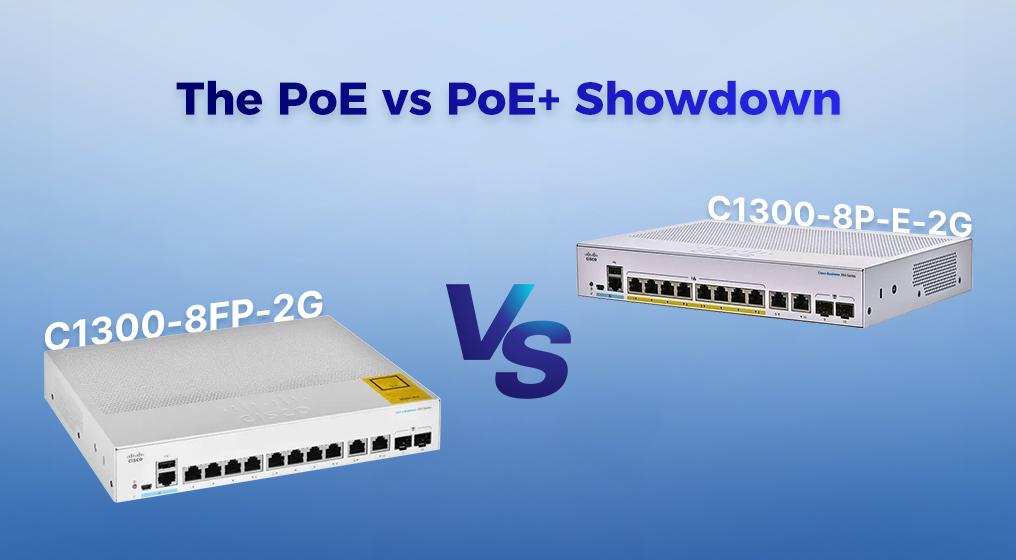

C1300-8P-E-2G vs C1300-8FP-2G: The PoE vs PoE+ Showdown
When choosing between the C1300-8P-E-2G and C1300-8FP-2G, understanding their differences is crucial for optimizing your network deployment. While both switches belong to Cisco’s Catalyst C1300 series, designed for small offices and retail environments, their PoE capabilities define their unique strengths and use cases. Here’s a deep dive into their key aspects:

Core Specifications Comparison To start, let’s outline their fundamental differences:
|
Feature
|
C1300-8P-E-2G
|
C1300-8FP-2G
|
|
Ports
|
8 x Gigabit Ethernet, 2 x SFP
|
8 x Gigabit Ethernet, 2 x SFP
|
|
PoE Standard
|
PoE (802.3af)
|
PoE+ (802.3at)
|
|
Total PoE Budget
|
62W
|
124W
|
|
Max Power per Port
|
15.4W
|
30W
|
|
Switching Capacity
|
20 Gbps
|
20 Gbps
|
|
Forwarding Rate
|
14.88 Mpps
|
14.88 Mpps
|
|
MAC Addresses
|
16,000
|
16,000
|
|
Memory (DRAM/Flash)
|
1GB / 4GB
|
1GB / 4GB
|
|
Stacking
|
Unsupported
|
Unsupported
|
Turning to their core specifications, both models offer identical port configurations (8 Ethernet + 2 SFP) and foundational networking capabilities. However, the PoE standard is where they significantly differ. The 8P-E-2G supports legacy PoE (802.3af), limiting power to 15.4W per port with a 62W total budget. Conversely, the 8FP-2G leverages PoE+ (802.3at), doubling power capacity per port (30W) and overall budget (124W). This directly impacts device compatibility: the 8FP-2G effortlessly handles power-hungry devices like Wi-Fi 6 access points or PTZ cameras, while the 8P-E-2G is better suited for basic IP phones or Wi-Fi 5 APs.
Design & Appearance Visually, these units are nearly clones. Both feature a compact, fanless metal chassis, ideal for quiet office or classroom deployments. Their front panels align perfectly: eight RJ45 ports flank two SFP slots, followed by status LEDs. Rack-mountable with an optional kit, their form factor ensures space efficiency. The only physical giveaways are subtle differences in power connectors or LED behavior during startup, but for practical purposes, they share the same unobtrusive footprint.
Power & Functionalities Functionally, their primary distinction lies in PoE capabilities. The 8FP-2G’s PoE+ support future-proofs networks for advanced deployments, while the 8P-E-2G suffices for simpler setups. Beyond PoE, both run on a 1.4GHz ARM dual-core processor, sharing robust Layer 2 features (VLANs, QoS, 802.1X security). Their fanless design enhances reliability, reducing failure risks. Management-wise, they offer similar “plug-and-play” simplicity, with Smart Install support (though best disabled for security). The web GUI and CLI interfaces remain consistent, though managing power budgets differs: the 8P-E-2G requires careful monitoring to avoid exceeding its 62W limit, while the 8FP-2G provides ample headroom.
User Experience From a user perspective, deployment is largely standardized. Beginners benefit from default settings for basic connectivity, while admins can dive into advanced configurations via the familiar IOS-XE platform. Notably, power budget management becomes pivotal. Users of the 8P-E-2G must prioritize device allocations to prevent overloads, potentially restricting device counts. In contrast, 8FP-2G users enjoy flexibility, enabling mixed deployments of high-power devices without constraints. Both models offer smooth operation, though long-term planning is essential to maximize their PoE potential.
Pros & Cons Evaluating their trade-offs:
C1300-8P-E-2G Pros: Budget-friendly upfront cost; efficient for low-power devices (IP phones, Wi-Fi 5 APs); silent operation. Cons: Limited 62W budget restricts high-power deployments; 8 ports may strain dense environments; lacks future-proofing for evolving device needs.
C1300-8FP-2G Pros: Future-proof PoE+ (124W) supports advanced Wi-Fi 6, PTZ cameras, etc.; same silent design as 8P-E-2G; long-term cost efficiency. Cons: Higher initial price; overkill for purely legacy deployments.
Value & Verdict The choice hinges on current and future device requirements. If your network consists primarily of basic devices, the 8P-E-2G offers cost-effective performance. However, for modern networks reliant on power-intensive endpoints, the 8FP-2G is a smarter investment. While pricier, its PoE+ support avoids future switch replacements, enhancing long-term性价比 (cost-performance). Ultimately, prioritize power needs over cost to ensure your infrastructure adapts to evolving technologies.
Key Takeaways:
●
PoE vs PoE+: Choose based on device power demands.
●
Budget vs Future-Proofing: Weigh upfront costs against long-term requirements.
●
Form Factor & Reliability: Both excel in silent, resilient designs.
●
Management: User experience is consistent across models.
By aligning your choice with your devices’ power profiles, you can optimize network efficiency without compromising on performance or stability.