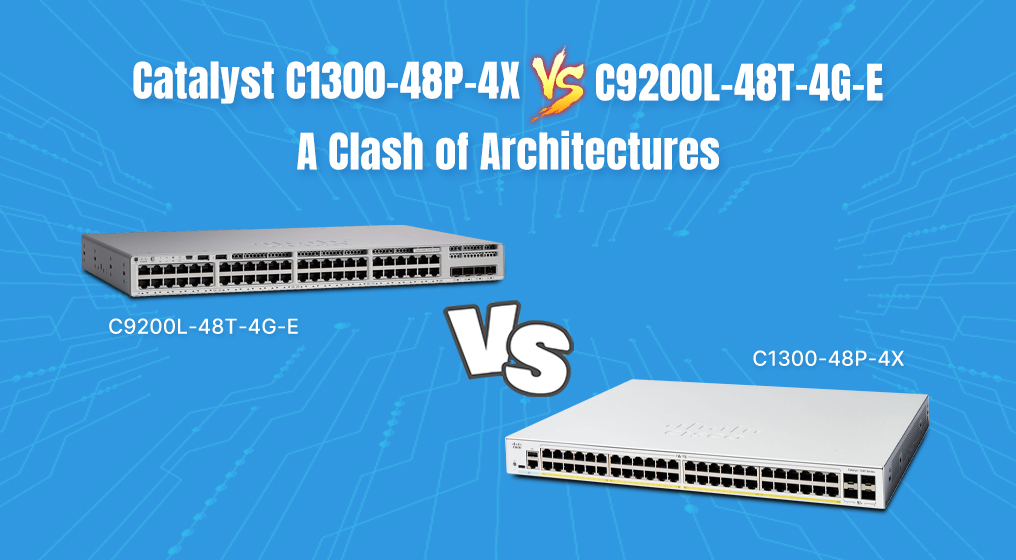

Catalyst C1300-48P-4X vs. C9200L-48T-4G-E: A Clash of Architectures
When you place the Catalyst
C1300-48P-4X next to the Catalyst
C9200L-48T-4G-E, you are looking at two switches that might seem similar on a spec sheet—both are 48-port workhorses—but they are built for entirely different realities. One is a power-heavy edge device designed to run your entire floor's endpoints, while the other is a data-centric enterprise switch focused on operating system capability and uplink flexibility. Choosing between them isn't just about speed; it is about deciding whether you need raw power delivery or advanced network logic.

The most immediate difference lies in the "P" versus "T" designation. The C1300-48P-4X is a PoE+ (Power over Ethernet) beast. It is designed to deliver electricity to 48 devices—IP phones, Wi-Fi 6 access points, and security cameras—simultaneously. This requires a massive internal power supply, making the unit physically heavy and deep. In contrast, the C9200L-48T-4G-E is a data-only switch. The "T" stands for data (Twisted pair), meaning it cannot power your devices. This makes the C9200L significantly lighter, cooler, and quieter, but it limits its use to connecting PCs, printers, and servers where power is already available.
| Feature |
Catalyst C1300-48P-4X |
Catalyst C9200L-48T-4G-E |
| Switching Capacity |
176 Gbps |
104 Gbps (184 Gbps with stacking) |
| Forwarding Rate |
130.94 Mpps |
77.38 Mpps |
| Downlink Ports |
48x Gigabit PoE+ |
48x Gigabit Data (Non-PoE) |
| Uplinks |
4x 10G SFP+ |
4x 1G SFP |
| PoE Budget |
~375W (High Power) |
0W (Data Only) |
| Processor |
1.4GHz Dual-Core ARM |
Custom UADP 2.0 Mini ASIC |
| Stacking |
Data port stacking (Uses uplinks) |
StackWise-80 (Dedicated backplane) |
| OS Layer |
Layer 3 Lite / Static |
Full IOS XE (Dynamic Routing) |
Performance-wise, the C1300-48P-4X is a surprising monster. It boasts a higher switching capacity (176 Gbps) and forwarding rate (130.94 Mpps) compared to the C9200L. This is largely because the C1300 architecture is built to handle the bursty traffic of multimedia and voice. Furthermore, the C1300 comes with 4x 10G SFP+ uplinks. This is a massive advantage for modern networks. It allows you to aggregate traffic from all 48 ports into a 40Gbps pipe to your core, eliminating bottlenecks. The C9200L-48T-4G-E is limited to 1G uplinks. While sufficient for basic office browsing, 1G uplinks can easily become choked if 48 users are transferring large files simultaneously.
However, the C9200L fights back with its operating system. It runs the full Cisco IOS XE, the same software found in massive core routers. This means it supports advanced automation, full dynamic routing protocols (OSPF, EIGRP), and deep programmability via Cisco DNA Center. The C1300 is more limited; it handles static routing and essential Layer 3 features, but it lacks the deep "brains" of the Catalyst 9000 family. If your network relies on complex routing logic and segmentation, the C9200L is the smarter choice.
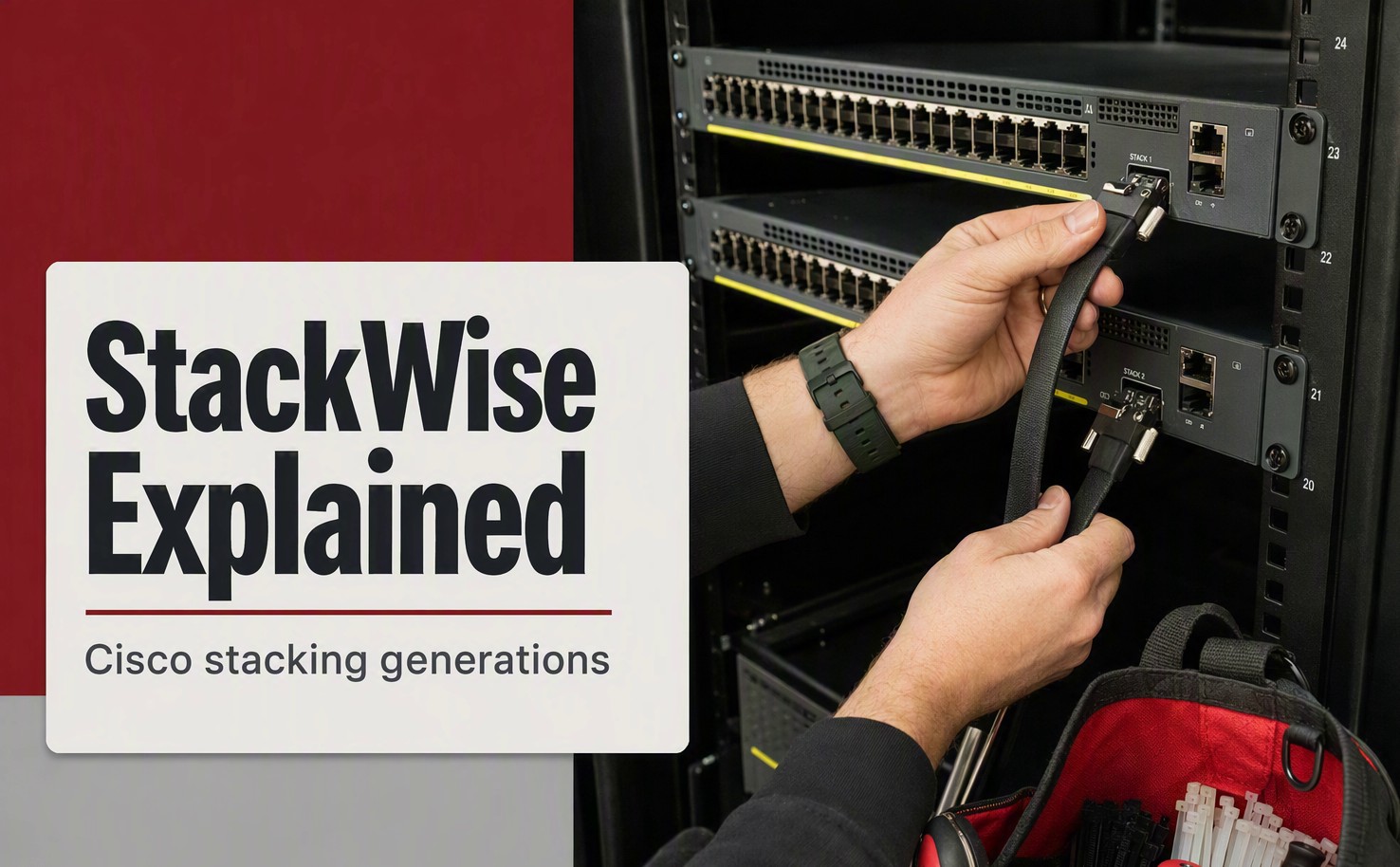
Physically, the user experience differs greatly. The C1300 is a "hot" switch. Because it is pushing nearly 400W of power to endpoints, it runs warm, and the fans can get loud. It is also deep, which can be a problem in shallow wall-mount cabinets. The C9200L is much more pleasant to live with. It runs cooler and quieter. Additionally, the C9200L supports StackWise-80, which uses a dedicated cable on the back of the unit to stack switches. This leaves your front data ports free for computers. The C1300 stacks using its front 10G uplink ports, which means if you stack them, you lose your high-speed uplinks—a significant design trade-off.
Stability is high for both, but they fail differently. The C1300 is a simpler device; it is less likely to have software bugs but offers fewer features to configure. The C9200L is an enterprise platform; it is incredibly stable but requires more maintenance and knowledge to keep the software and licensing (DNA Essentials/Advantage) up to date.
In terms of value, the C1300-48P-4X offers incredible bang for your buck if you need PoE. Getting 48 PoE+ ports and 10G uplinks at this price point is rare. It is the ultimate "all-in-one" solution for a branch office or a dense user floor. The C9200L-48T-4G-E is better suited for a wiring closet where you have a separate PoE infrastructure or strictly data needs, and where you value the ability to run complex routing protocols over raw throughput speed.
Ultimately, choose the C1300-48P-4X if you need to power devices and want 10G speed without breaking the bank. Choose the C9200L-48T-4G-E if you need a "smart" switch that can handle complex network logic, provided you don't need to deliver power over the cable.