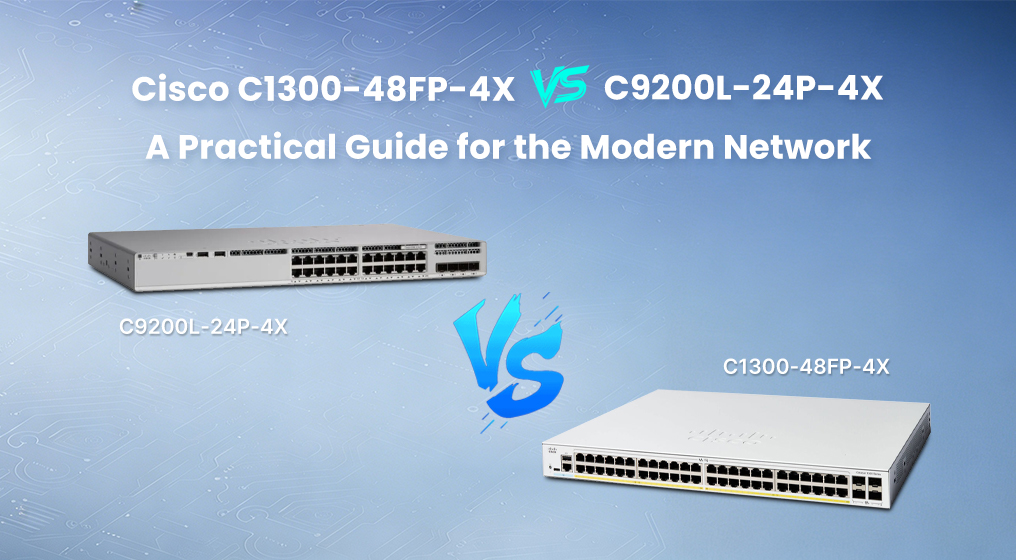
Cisco C1300-48FP-4X vs. C9200L-24P-4X: A Practical Guide for the Modern Network
When you are standing in the server room looking at your rack, the choice between the Cisco Catalyst 1300 and the Catalyst 9200L series often comes down to a battle between "access simplicity" and "performance density." You are likely comparing the
C1300-48FP-4X against the
C9200L-24P-4X (often categorized under the C9200L-24P-4X-E/A SKU family). These two switches sit in different tiers of the Cisco portfolio, and understanding the nuance between them is critical for your network design.
Let's cut through the marketing fluff. The C1300 series is designed as a straightforward, cost-effective access layer solution for small-to-medium businesses or branch offices. It prioritizes ease of use and basic connectivity. On the other hand, the C9200L series is the entry-level member of Cisco’s flagship Catalyst 9000 family. It brings enterprise-grade architecture, higher throughput, and advanced telemetry to the table.
Here is how they stack up when you get down to the brass tacks of performance, hardware, and real-world usage.
️ Core Specifications Breakdown
To understand why these switches behave differently under load, we need to look at the silicon and the switching capacity. The C9200L generally offers a more robust architecture, designed to handle heavier traffic bursts and more complex routing tables.
| Feature |
Cisco C1300-48FP-4X |
Cisco C9200L-24P-4X |
| Product Family |
Catalyst 1300 Series |
Catalyst 9200L Series (Entry Enterprise) |
| Port Configuration |
48x Gigabit Ethernet PoE+ |
24x Gigabit Ethernet PoE+ |
| Uplinks |
4x 1G/10G SFP+ |
4x 1G/10G SFP+ |
| Switching Capacity |
176 Gbps |
176 Gbps (System throughput varies by mode) |
| Forwarding Rate |
~130.94 Mpps |
~95.23 Mpps (Note: Lower due to fewer ports) |
| PoE Budget |
~740W (Total system) |
~600W (Total system) |
| DRAM / Flash |
1 GB / 4 GB |
4 GB / 16 GB (Typical for C9200L) |
| Stacking |
Limited/Basic Stacking |
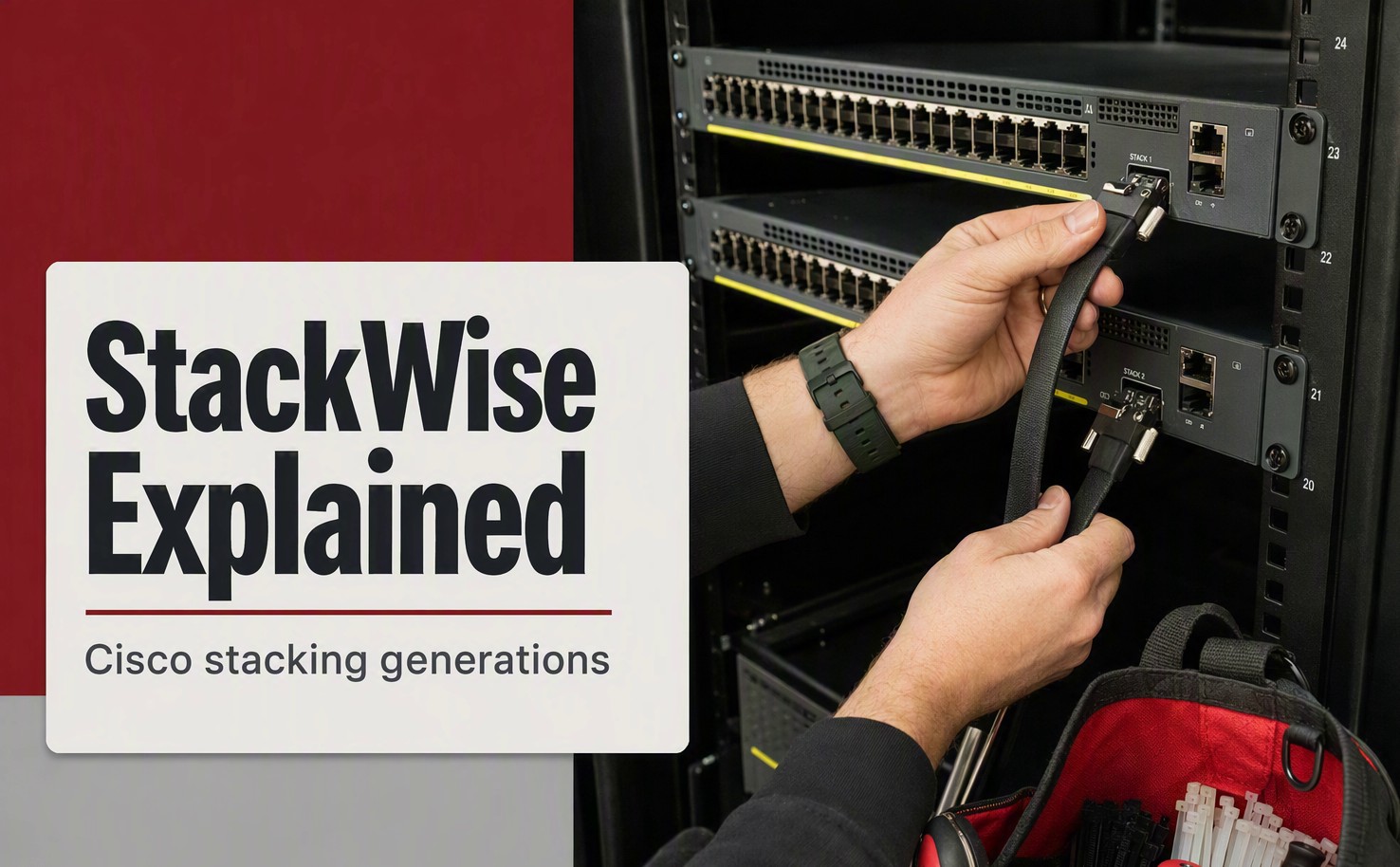
Cisco StackWise-80 (Virtual stacking) |
| OS Image |
Cisco IOS (Feature-limited) |
Cisco IOS XE (Full Enterprise Features) |
️ Physical Design and Port Density
The most immediate difference you will notice is the port density. The C1300-48FP-4X is a workhorse for connection volume. With 48 ports, it is designed to maximize the number of devices you can plug into a single rack unit. If you have a dense office floor with VoIP phones, cameras, and laptops at every desk, this unit saves you rack space compared to deploying two 24-port switches.
The C9200L-24P-4X takes up the same 1U of rack space but offers half the number of access ports. However, this isn't necessarily a bad thing. The 24-port form factor is often preferred for wiring closets where power budgets are tight or where you want to segment the network into smaller broadcast domains. Both units feature the standard SFP+ uplinks, allowing for 10G connections to your core, but the C9200L chassis often feels more robust, reflecting its positioning as a long-term enterprise investment.
Performance and Feature Set
This is where the comparison gets interesting. While the C1300 is a capable switch, the C9200L is built on the UADP 2.0 ASIC architecture, which provides significant advantages in programmability and security.
The C1300 runs a version of IOS that is streamlined for simplicity. It handles standard Layer 2 switching and basic Layer 3 static routing well. It is "simple and flexible," as Cisco describes it. However, it lacks the deep programmability of the 9000 series.
The C9200L runs Cisco IOS XE, which supports model-driven programmability (NETCONF/YANG), advanced automation, and integration with Cisco DNA Center (depending on the licensing). If your network strategy involves SD-Access or heavy automation, the C1300 will hit a wall that the C9200L will not. Furthermore, the C9200L typically supports higher scale for ACLs and routing entries, making it more future-proof as your routing tables grow.
Power over Ethernet (PoE) Capabilities
Both switches carry the "P" designation, meaning they support PoE+ (802.3at).
- C1300-48FP-4X: The "FP" usually denotes "Full PoE." This implies that the switch has a substantial power budget (often around 740W) intended to drive PoE+ on all 48 ports simultaneously. This is excellent for high-density deployments but requires careful thermal and circuit planning.
- C9200L-24P-4X: With a 600W budget across 24 ports, this switch offers a very generous amount of power per port (averaging 25W/port if all used). This is more than enough for modern Wi-Fi 6 access points and video phones.
If you are powering high-wattage devices (like PTZ cameras or high-end APs), the C9200L's 24-port design often provides more "headroom" per port without needing to configure power prioritization as aggressively as you might on a fully loaded 48-port unit.
️ Stability and User Experience
In terms of stability, both platforms are solid, but they offer different operational experiences.
Users deploying the C1300 often appreciate the "set it and forget it" nature. It boots fast, the interface is familiar to anyone who has used Cisco IOS for the last decade, and it generally stays out of the way. It is less complex, which statistically means there are fewer variables to cause configuration errors.
The C9200L offers enterprise-grade redundancy features, such as support for redundant power supplies (RPS) on many models, which the C1300 typically lacks (often relying on external RPS options or internal single PSUs). The C9200L also provides better visibility into network health through telemetry, allowing you to see why a link is flapping, rather than just seeing that it is flapping.
Value and Verdict
When looking at the price-to-performance ratio, you have to define what "value" means to your organization.
- Choose the C1300-48FP-4X if: You need maximum port density on a budget. If you are outfitting a school, a hotel, or a standard office where you just need to connect endpoints and don't care about advanced automation or massive routing tables, the C1300 is the economic winner. You get 48 ports for the price of a high-end 24-port switch.
- Choose the C9200L-24P-4X if: You are building a core distribution layer or a high-performance access layer for a critical business environment. The move to IOS XE, the support for advanced security features (like TrustSec), and the higher memory buffers make it a better long-term investment for networks that need to scale intelligently.
Ultimately, the C1300 is a bridge for connectivity, while the C9200L is a platform for network intelligence. Choose the one that matches your operational maturity.