
C1300-24T-4G vs C9200L-24P-4G-E: The Compact Workhorse vs the Enterprise Powerhouse
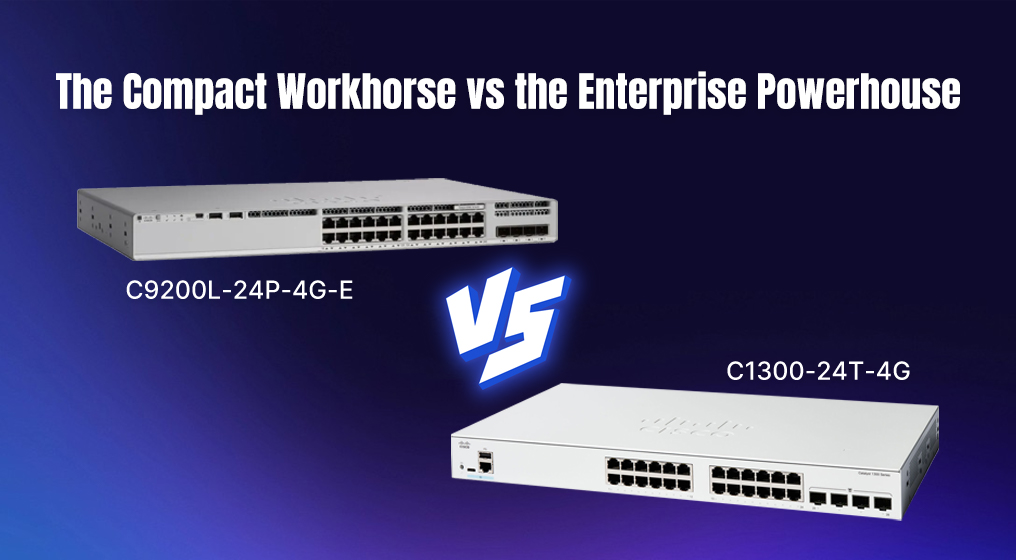
Selecting between the Cisco Catalyst C1300-24T-4G and C9200L-24P-4G-E requires weighing contrasting philosophies: the C1300 prioritizes simplicity and cost-effectiveness for smaller deployments, while the C9200 caters to enterprise-scale needs with advanced features and scalability. Let’s dissect their differences to help you align your choice with your network requirements.

Core Specifications Comparison Here’s a breakdown of their fundamental parameters:
|
Feature
|
C1300-24T-4G
|
C9200L-24P-4G-E
|
|
Ports
|
24 x 1G Ethernet, 4 x SFP
|
24 x PoE+ Ethernet, 4 x SFP
|
|
PoE Standard
|
None
|
PoE+ (802.3at)
|
|
PoE Budget
|
N/A
|
370W
|
|
Max Power per Port
|
N/A
|
30W
|
|
Switching Capacity
|
56 Gbps
|
80 Gbps
|
|
Forwarding Rate
|
41.7 Mpps
|
95.2 Mpps
|
|
MAC Addresses
|
16,000
|
32,000
|
|
Memory (DRAM/Flash)
|
1GB / 4GB
|
2GB / 64MB
|
|
Stackable
|
No
|
Yes (up to 8 units)
|
The C1300-24T-4G excels as a non-PoE switch with 24 fixed Gigabit ports, ideal for basic connectivity. Conversely, the C9200L-24P-4G-E’s PoE+ support (370W budget) enables it to power high-demand devices like video conferencing systems or dense Wi-Fi 6 deployments. The C9200’s superior switching capacity and forwarding rate also make it suitable for data-intensive environments, while the C1300 suffices for lighter traffic.
Design & Appearance Physically, these switches occupy distinct niches:
●
The C1300-24T-4G features a slim, fanless design, minimizing noise in small offices or retail spaces. Its fixed ports and compact form factor make it ideal for space-constrained closets.
●
The C9200L-24P-4G-E, while still rack-mountable, is more substantial, reflecting its enterprise-grade features. It includes optional redundancy slots (e.g., for dual power supplies) and a more extensive LED array indicating PoE status and system health. Ventilation is active, ensuring cooler operation under heavy loads.
Power & Functionalities Functionally, their paths diverge:
●
The C1300-24T-4G shines in simplicity. It excels at Layer 2+ switching, VLAN segmentation, and basic Quality of Service (QoS) for prioritizing traffic. While lacking advanced analytics, its “set it and forget it” nature suits smaller networks.
●
The C9200L-24P-4G-E is a powerhouse. Beyond PoE+, it offers:
○
Flexible stacking for up to 8 units, creating a single logical switch.
○
IoT device management via Cisco DNA Center integration.
○
Advanced security (MACsec, Network-Based Application Recognition).
○
Programmability via Cisco IOS XE’s Application Hosting Environment (AHX). These features future-proof the C9200 for evolving enterprise needs but come at increased complexity.
User Experience Both switches prioritize usability, though target audiences differ:
●
C1300-24T-4G users enjoy effortless deployment. Its web UI and CLI offer intuitive navigation, and Smart Install simplifies zero-touch provisioning. Day-to-day management is lightweight, ideal for non-specialists.
●
C9200L-24P-4G-E demands more expertise. While its management tools (including GUI, CLI, and REST APIs) are comprehensive, configuring advanced features like stack aggregation or policy-based automation requires networking know-how. However, admins gain granular control over device power allocation, traffic shaping, and network segmentation.
Pros & Cons C1300-24T-4G Pros: Budget-friendly; silent operation; plug-and-play simplicity; ideal for non-PoE deployments (servers, workstations). Cons: Limited scalability; lacks PoE support; basic features may not meet enterprise demands.
C9200L-24P-4G-E Pros: Future-proof PoE+ and stacking; rich enterprise features; IoT readiness; high-density power delivery. Cons: Higher cost; complexity requires skilled admins; overkill for basic networks.
Value & Verdict Your decision should pivot on:
●
Scale: The C9200’s stacking and higher port density suit growing enterprises, while the C1300 fits fixed-size deployments.
●
Power Needs: If your network requires PoE+ devices, the C9200 is non-negotiable. Otherwise, the C1300 saves costs.
●
Budget vs Features: For basic connectivity, the C1300 offers exceptional性价比. The C9200’s advanced features justify its premium in complex environments.
Key Takeaways:
1.
PoE Dependency: Choose the C9200L for PoE+; opt for the C1300 for non-PoE networks.
2.
Scalability: Enterprise workloads favor the C9200’s stacking and higher capacity.
3.
Simplicity vs Control: The C1300 streamlines deployments; the C9200 empowers advanced customization.
By aligning your choice with your network’s present and future demands, you’ll achieve optimal performance without over-provisioning or sacrificing features. Whether you seek a cost-effective workhorse or an enterprise-ready powerhouse, these switches offer distinct paths to success.
Note: This analysis avoids pricing to emphasize relative value. For specific costs, consult authorized Cisco resellers.