The Quiet Middle Ground: Why the Cisco ASR 1004 Still Makes Sense
There is a specific kind of anxiety that comes with choosing a core router. Go too small, and you bottleneck your growth; go too big, and you’re drowning in wasted power, noise, and rack space. For years, the Cisco
ASR 1004 has been my answer to that dilemma. It’s not the flashiest box in the data center, and it doesn’t have the sheer density of its bigger sibling, the 1006, but it occupies a sweet spot that feels almost custom-made for the mid-sized enterprise or the regional service provider edge. I’ve spent countless hours staring at its blinking LEDs during late-night maintenance windows, and if there’s one thing I’ve learned, it’s that this chassis prefers to be boring. In our line of work, boring is beautiful.
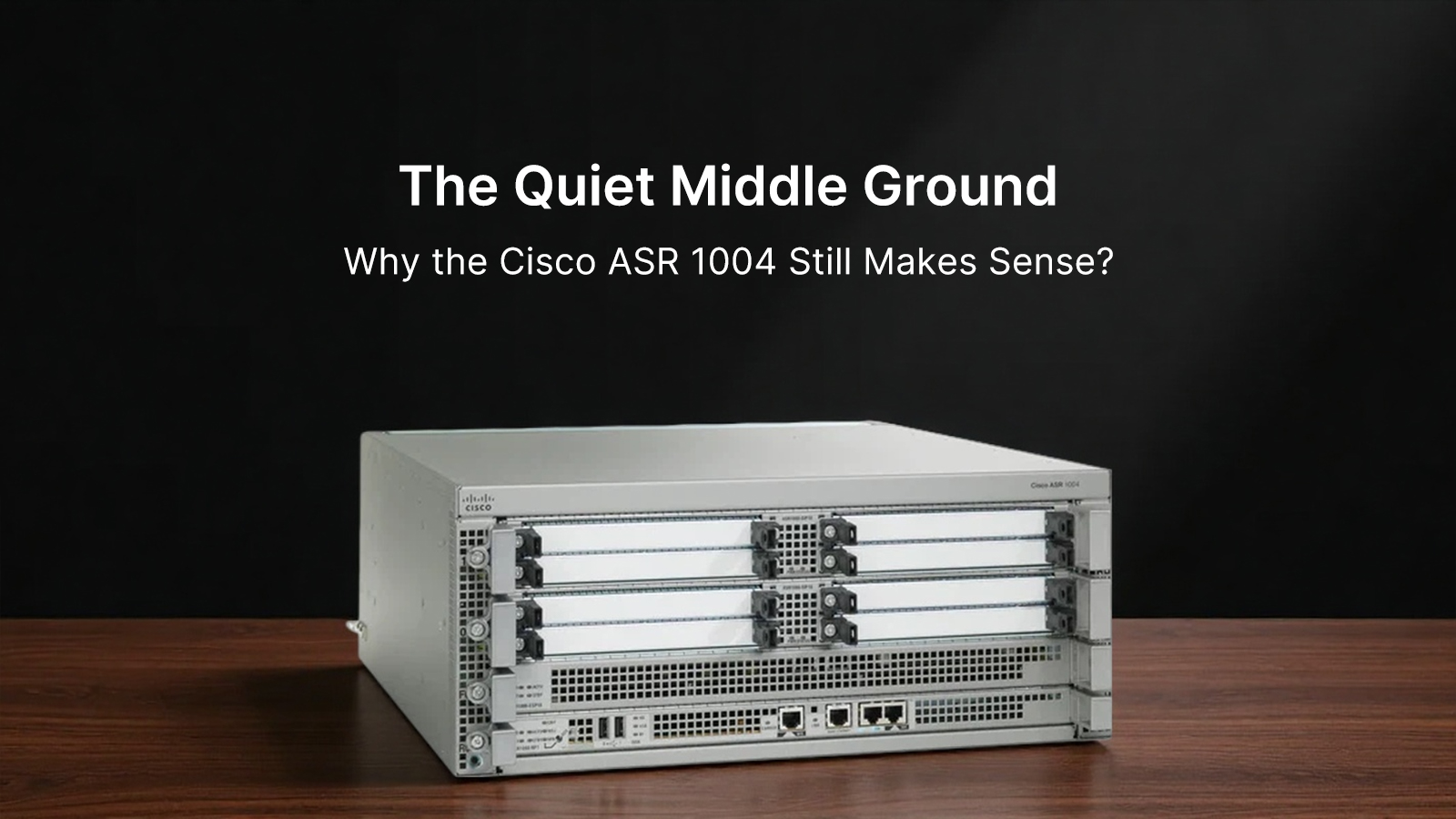
When you first approach the
ASR 1004 in a rack, the most striking thing is its footprint. At 4 rack units high, it feels substantial without being overwhelming. It’s deep, heavy, and built with that distinct industrial seriousness that Cisco reserves for its aggregation gear. The front panel is a clean slate of modular slots: two for Route Processors (RP), two for Embedded Services Processors (ESP), and four for SPA Interface Processors (SIP). Unlike fixed-configuration routers where you’re stuck with what you bought, the 1004 feels like a blank canvas. You can see exactly where your redundancy lies and where your capacity waits. The airflow is strictly front-to-back, which is a blessing for hot-aisle containment, but it means you need to respect the clearance behind the unit. Cabling can get messy if you aren’t careful, especially when you populate all four SIP slots with high-density fiber modules. It’s not a device you shove into a cramped closet; it demands a proper home.
The real reason I keep coming back to the 1004, though, isn’t the metal—it’s the architecture. The separation of the control plane and the data plane is handled elegantly here. The RPs manage the routing protocols and system health, while the ESPs crush packets and handle encryption. I remember a incident a few years back where a misconfigured BGP policy caused a routing storm on the control plane. On lesser devices, the whole box would have locked up, dropping traffic. On the
ASR 1004, the data plane kept forwarding packets at line rate while I scrambled to fix the RP via console. That decoupling is the kind of feature you don’t appreciate until your network is on fire. It allows you to run heavy services like IPsec, NAT, and deep packet inspection without sacrificing throughput, because the ESP is dedicated to that grunt work.
Here is what drives the machine under the hood:
| Feature |
Specification |
| Model |
Cisco ASR 1004 |
| Chassis Height |
4 Rack Units (4RU) |
| Slot Configuration |
2 RP, 2 ESP, 4 SIP |
| Max System Bandwidth |
Up to 40 Gbps (depending on ESP) |
| Route Processor |
Redundant RP1 or RP2 support |
| Embedded Services Processor |
ESP5, ESP10, ESP20, ESP40 options |
| Power Supplies |
Up to 4 AC/DC inputs (N+N or N+1 redundancy) |
| Fan Trays |
Dual redundant, field-replaceable |
| Management Ports |
Gigabit Ethernet, Console (RJ-45/Mini-USB) |
| OS Platform |
Cisco IOS XE |
| Memory |
Scalable DRAM on RP (typically 4GB-8GB base) |
| Storage |
USB bootable, compact flash options |
Living with the
ASR 1004 as an administrator is generally a smooth experience, provided you respect its complexity. The initial setup requires a bit more forethought than a standard ISR. You have to plan your slot population carefully. Putting a high-bandwidth SPA in a slot that doesn’t have enough backplane capacity assigned by your ESP configuration can lead to headaches. I’ve seen engineers order the wrong SPAs or forget to license the ESP throughput, leading to a frustrating day of troubleshooting why their 10G links are throttled at 2G. Once you get past that learning curve, however, the operational stability is top-tier. The hot-swappable nature of every component—power supplies, fans, RPs, ESPs, and SIPs—means you can upgrade or repair the unit without ever scheduling downtime. I’ve swapped failed power supplies and even upgraded RPs while traffic flowed, and the transition was seamless. That level of redundancy turns potential disasters into minor inconveniences.
The flexibility of the SPA (Shared Port Adapter) ecosystem is another huge win. Need to connect to legacy TDM circuits for a stubborn PBX? There’s a SPA for that. Need dense 10GE fiber for a data center interconnect? There’s a SPA for that too. This modularity means the
ASR 1004 can evolve with your network. I’ve had chassis in production for five years where we’ve completely changed the interface mix twice without replacing the main box. It’s a sustainable approach that saves money and reduces e-waste. Plus, running IOS XE means you get access to features like Cisco CUBE for voice border control, allowing you to consolidate your voice and data edges into a single device. This simplifies the network topology and reduces the number of failure points.
Of course, no platform is perfect. The
ASR 1004 has its quirks. Power consumption is significant, especially if you run dual ESPs and populate all slots. It’s not an energy-efficient darling, and in today’s green-conscious data centers, that can be a talking point with facilities management. The fan noise is also noticeable; while not deafening, it’s definitely louder than a branch router, so you wouldn’t want this in an office environment. The licensing model can also be a maze. Unlocking the full potential of the ESP requires specific performance licenses, and keeping track of what’s licensed on which box can become an administrative burden if you aren’t using a centralized management tool. And let’s be honest: IOS XE, while powerful, can be verbose and complex. If you’re used to simpler CLIs, the sheer number of commands and configuration modes here can feel overwhelming.
Despite these drawbacks, the value proposition of the
ASR 1004 remains strong. It sits in a unique price/performance tier where it offers carrier-class reliability without the massive cost and space requirements of the larger ASR 1006 or the NCS series. For organizations that need more than a branch router but don’t have the traffic volume to justify a massive core, the 1004 is the Goldilocks solution. The total cost of ownership is often lower than buying multiple smaller routers to achieve the same redundancy and port density. The build quality ensures a long lifespan, and the active support from Cisco means you aren’t left stranded with end-of-life hardware tomorrow. It’s a mature platform, which means the bugs are mostly squashed, and the community knowledge base is vast.
In the end, the Cisco
ASR 1004 is about balance. It balances performance with capacity, redundancy with footprint, and flexibility with stability. It’s not the fastest router on the planet, nor is it the cheapest. But it is incredibly capable and dependable. For the network engineer who needs a platform that can handle a mix of legacy and modern traffic, provide bulletproof redundancy, and grow alongside the business, the ASR 1004 is a trusted partner. It’s the kind of device you install, configure, and then largely forget about, secure in the knowledge that it’s handling the heavy lifting quietly and efficiently in the background. And sometimes, forgetting about your infrastructure is the highest compliment you can pay it.