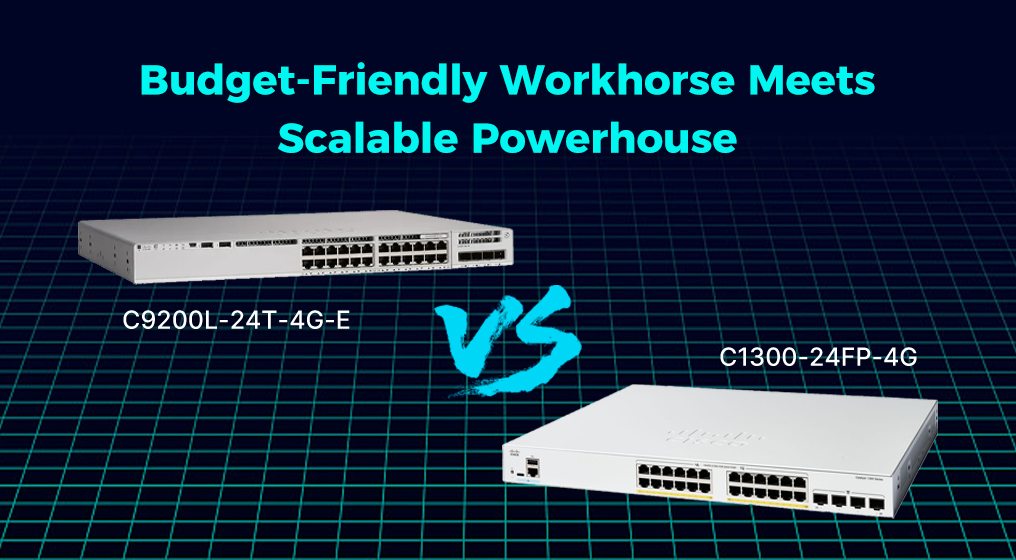

C1300-24FP-4G vs C9200L-24T-4G-E: Budget-Friendly Workhorse Meets Scalable Powerhouse
Choosing between the Cisco Catalyst C1300-24FP-4G and C9200L-24T-4G-E requires weighing your network’s needs: efficiency vs. scalability. While the C1300-24FP-4G excels as a cost-effective, entry-level switch for smaller deployments, the C9200L-24T-4G-E packs enterprise-grade features for growing environments. Here’s a deep dive into their differences to guide your decision.

Core Specifications Comparison Let’s start with the fundamentals:
|
Feature
|
C1300-24FP-4G
|
C9200L-24T-4G-E
|
|
Ports
|
24 x 10/100/1000 + 4 x SFP
|
24 x 1G + 4 x SFP (up to 10G)
|
|
Switching Capacity
|
56 Gbps
|
120 Gbps
|
|
Forwarding Rate
|
41.7 Mpps
|
95.2 Mpps
|
|
MAC Addresses
|
16,000
|
32,000
|
|
PoE Capability
|
None
|
Optional PoE+
|
|
Power Budget
|
N/A
|
Up to 370W (PoE+)
|
|
Stackable
|
No
|
Yes (up to 8 units)
|
|
Memory
|
1GB DRAM / 4GB Flash
|
2GB / 64MB
|
The C1300-24FP-4G offers a mix of fixed 1G ports and SFP slots, ideal for basic connectivity in small offices or branch locations. The C9200L-24T-4G-E steps up with higher-speed SFP+ ports (supporting 10G breakout) and optional PoE+ support, enabling it to power high-density Wi-Fi 6 access points or IP devices. Its superior switching capacity makes it a better fit for traffic-intensive environments.
Design & Appearance Their form factors reflect their use cases:
●
C1300-24FP-4G: Fanless and compact, this switch thrives in quiet environments like retail stores or home offices. Its minimalist design blends seamlessly into small closets without requiring excessive cooling or space.
●
C9200L-24T-4G-E: Built for enterprise resilience, this unit features active cooling, redundant power supply slots (optional), and diagnostic LEDs for monitoring status at a glance. Its robust chassis withstands data center temperatures and supports rack mounting for organized deployments.
Functionality & Features Feature-wise, they target different user needs:
●
C1300-24FP-4G: Simplicity is its strength. This switch excels at Layer 2/3 switching, VLAN segmentation, and basic QoS. Its “plug-and-play” nature requires minimal configuration, making it perfect for networks with limited IT resources or where advanced tweaking isn’t necessary.
●
C9200L-24T-4G-E: A powerhouse for advanced deployments:
○
Stacking: Combine up to 8 units for a unified logical switch, simplifying management and expanding capacity.
○
IoT-Ready: Integrates with Cisco DNA Center for centralized IoT device management.
○
Security: Includes MACsec encryption, Network-Based Application Recognition (NBAR), and advanced threat detection.
○
Programmability: Leverage Cisco IOS XE’s AHX for custom automation scripts or AI/ML integration.
○
Future-Proofing: Supports emerging technologies like AI-driven analytics and high-bandwidth applications.
User Experience Ease of use differs significantly:
●
C1300-24FP-4G: Novice-friendly. Its web UI and CLI are intuitive, with step-by-step wizards for common tasks. Minimal troubleshooting requirements make it ideal for SMBs or remote sites with limited admin expertise.
●
C9200L-24T-4G-E: Designed for enterprise admins. While more complex, its advanced management tools (e.g., DNA Center integration) streamline large deployments. Templates, automation scripts, and role-based access control simplify complex configurations.
Cost Considerations (Price-Free Analysis)
●
C1300-24FP-4G: Budget champion. Its lower upfront cost aligns with small business or startup needs. Minimal ongoing maintenance keeps total cost of ownership (TCO) low.
●
C9200L-24T-4G-E: Investment for growth. Higher initial costs reflect advanced features and scalability. Long-term savings may come from reduced downtime, centralized management, and PoE+ efficiency in powering multiple devices.
Stability & Reliability
●
C1300-24FP-4G: Reliable for non-critical workloads. Fanless design reduces failure points in quiet environments. Suitable for applications where occasional downtime is manageable (e.g., small office networks).
●
C9200L-24T-4G-E: Enterprise-grade resilience. Redundant power supplies, active cooling, and advanced diagnostics (e.g., real-time telemetry) minimize downtime in mission-critical environments like data centers or healthcare facilities.
Detailed Pros & Cons C1300-24FP-4G: Pros:
●
Budget-friendly for small deployments.
●
Silent operation in quiet spaces.
●
Easy setup and maintenance.
●
Reliable for basic connectivity.
Cons:
●
Limited scalability and no stacking.
●
Lacks advanced features for dynamic environments.
C9200L-24T-4G-E: Pros:
●
Scalable architecture (stacking, high-speed ports).
●
Future-proofed for IoT and high-bandwidth demands.
●
Robust PoE+ support for device-intensive networks.
●
Advanced security and management tools.
Cons:
●
Complex to configure for novice admins.
●
Requires more physical space and cooling in dense deployments.
Conclusion Choose the C1300-24FP-4G if you prioritize simplicity and cost-effectiveness in a small, non-critical environment. Opt for the C9200L-24T-4G-E when scalability, advanced management, and PoE+ support are essential for growing enterprises or data centers. Understanding your current needs and future growth plans will dictate which switch aligns best with your infrastructure strategy.
Key Takeaways:
●
C1300-24FP-4G: Budget-friendly simplicity for small offices.
●
C9200L-24T-4G-E: Scalable powerhouse for enterprise resilience.
Choose Wisely based on your network’s size, growth projections, and feature requirements.