
Intellectual Property
Hot selling product recommendations
View More



















The Cisco Catalyst 9500 Series represents a significant leap in network switching technology, and at the heart of its expansion capabilities lies the C9500-NM-8X network module. This sophisticated component transforms how enterprises scale their network infrastructure, providing the necessary bandwidth and flexibility to handle increasingly demanding digital workloads. Unlike standard networking components, this module brings carrier-grade performance to enterprise environments, enabling organizations to build networks that not only meet current needs but anticipate future requirements. The integration of this module into existing Catalyst 9500 systems creates a seamless pathway for network evolution without the need for complete infrastructure overhaul.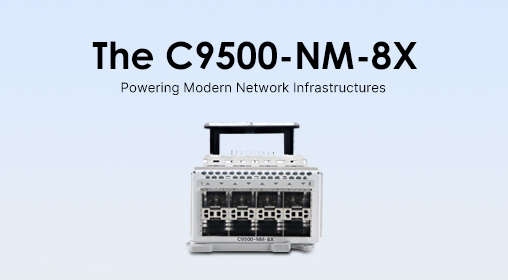
Engineered for performance-intensive scenarios, the C9500-NM-8X serves as a critical expansion tool for growing networks. Its primary function centers around adding high-speed connectivity options to the Catalyst 9500 series switches, effectively transforming these platforms into powerful aggregation points within modern network architectures. The module finds its perfect home in data centers, large enterprise core networks, and campus environments where traffic patterns demand robust, low-latency interconnections between switches, servers, and storage systems. What sets this component apart is its ability to maintain consistent performance even under extreme load conditions, thanks to its integrated architecture that works in harmony with the host switch's capabilities.
When we examine the technical specifications, the numbers speak volumes about the module's capabilities. The heart of its performance lies in the dedicated processing architecture that ensures all eight ports can operate simultaneously at full capacity without compromising speed or reliability. This non-blocking design means network administrators can genuinely utilize the theoretical maximum throughput across all interfaces, a crucial consideration for bandwidth-intensive applications like real-time data analytics, virtualized environments, and high-resolution video streaming services. The module's integration with the host switch's operating system creates a unified management experience, making complex network expansions feel surprisingly straightforward.
|
Parameter |
Specification |
|---|---|
|
Port Configuration |
8 x 10 Gigabit SFP+ |
|
Supported Standards |
IEEE 802.3ae, 802.3ak |
|
Switching Capacity |
Up to 12.0 Tbps (system with module) |
|
Forwarding Rate |
8 Bpps (system with module) |
|
Buffer Memory |
80MB dedicated low-latency with up to 8GB HBM option |
|
Compatibility |
Cisco Catalyst 9500 Series Switches |
The physical design of the C9500-NM-8X follows Cisco's tradition of robust, enterprise-grade construction. The module features a streamlined form factor that integrates neatly into the designated slot of compatible Catalyst 9500 switches, maintaining the chassis' clean aesthetics while adding significant functional value. Its front panel presents eight SFP+ cages arranged in a single row, with each port clearly labeled for easy identification during cable installation. Status indicators for each port provide immediate visual feedback on link activity and operational status, allowing network technicians to quickly assess the module's functioning state from a distance. The overall build quality ensures reliable operation even in challenging environmental conditions, with components rated for continuous operation in standard data center environments.
Functionally, this expansion module shines in its ability to extend the network fabric without introducing complexity. The integration process feels remarkably smooth—once seated properly in its slot, the module is automatically recognized by the host switch's operating system, and after a brief initialization period, all eight ports become available for configuration through the standard management interfaces. This hot-swappable capability means network upgrades can be performed with minimal disruption to existing services, a crucial benefit for organizations that cannot afford extended downtime. The module supports the full range of Layer 2 and Layer 3 features available on the native switch ports, including advanced QoS policies, security features, and monitoring capabilities, ensuring consistent policy enforcement across the entire network infrastructure.
Network engineers who have worked with the C9500-NM-8X frequently praise its operational reliability and seamless integration. The module behaves exactly like native ports, responding to all the same commands and configurations, which significantly reduces the learning curve for teams already familiar with the Catalyst ecosystem. In real-world deployments, users report noticeable improvements in network performance when aggregating multiple lower-speed links into these high-bandwidth ports, particularly when handling traffic between virtualized server farms and storage arrays. The module's comprehensive diagnostics capabilities provide valuable insights into traffic patterns and potential bottlenecks, enabling proactive network management rather than reactive troubleshooting. This level of visibility proves invaluable for maintaining service level agreements in business-critical environments.
From a total cost of ownership perspective, the module presents a compelling case for organizations looking to maximize their infrastructure investments. Rather than replacing entire switching units when port requirements grow, network architects can simply add expansion modules to existing chassis, protecting the core investment while incrementally adding capacity. This approach not only reduces immediate capital expenditure but also simplifies network management by maintaining a consolidated operational model instead of managing multiple independent devices. The module's energy-efficient design contributes to lower operating costs, with power consumption scaling intelligently based on actual port utilization rather than running at fixed maximum levels regardless of traffic conditions.
The advantages of incorporating the C9500-NM-8X into network designs are substantial. Its high-density port configuration allows for efficient space utilization within network racks, a significant consideration in space-constrained data centers. The performance consistency across all ports ensures that network planners can depend on predictable bandwidth availability rather than dealing with the variable performance that sometimes affects lower-grade expansion solutions. Compatibility with the broader Cisco ecosystem means the module supports advanced features like Cisco Application Hosting, allowing customized containerized applications to run directly on the network infrastructure for unprecedented integration possibilities.
However, no product exists without certain limitations. The module's specialization means it exclusively serves Catalyst 9500 series switches, offering no utility for other platforms, which could limit its deployment flexibility in heterogeneous environments. Organizations not fully committed to the Cisco ecosystem might find the module's advanced features underutilized if they're not implementing the comprehensive Cisco Digital Network Architecture. The requirement for specific SFP+ transceivers adds to the overall implementation cost, though this is somewhat offset by the transceivers' reliability and diagnostic capabilities. Some network designers might prefer a more balanced port distribution across multiple modules rather than concentrating eight high-speed ports in a single unit, though this is largely a matter of design philosophy rather than a technical shortcoming.
When properly implemented, the C9500-NM-8X becomes an invisible workhorse within the network infrastructure—rarely requiring attention once configured, yet delivering consistent performance day after day. Its value becomes most apparent during network expansion projects or technology refresh cycles, where its presence can eliminate the need for additional switching hardware and the associated complexity of inter-device linkages. For organizations navigating digital transformation initiatives, this expansion module provides the necessary runway to scale network capabilities in alignment with growing business demands, making it not just a technical component but a strategic enabler for modern digital business operations.