
Intellectual Property
Hot selling product recommendations
View More



















For anyone building or modernizing a business network, the Cisco Catalyst C9200L-48T-4G-E emerges as a compelling piece of hardware that strikes a careful balance. It’s designed for environments where reliable, high-density wired connectivity is paramount, but the specific need for Power over Ethernet (PoE) isn't on the checklist. This switch fits neatly into the Cisco ecosystem, offering the kind of robust management and security features you'd expect, all while aiming for operational simplicity. What makes it interesting is how it brings enterprise-grade capabilities to a broader audience, serving as a dependable access layer foundation for everything from a busy campus to a sophisticated branch office.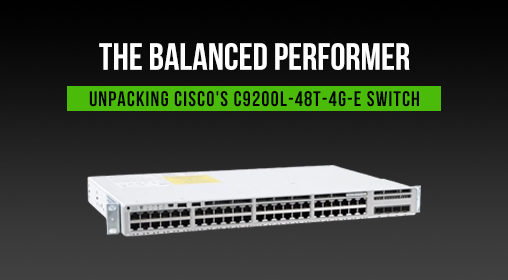
Diving into its physical presence, the switch adheres to a standard 1-rack-unit (1RU) form factor, making it a straightforward fit for most server cabinets. The design is clean and professional, with a width of 44.5 centimeters and a depth that ensures it won't stick out awkwardly in a standard rack. Weighing in at around 4.5 kilograms, it has a substantial feel without being overly burdensome to install. The front panel is logically laid out, dominated by the array of 48 RJ-45 ports for Gigabit Ethernet connections, accompanied by four dedicated SFP slots for fiber uplinks, providing a clear visual indicator of its purpose as a high-density access switch.
When it comes to raw performance, the internal specs are where this model justifies its position. The heart of the device pumps out a switching capacity of 104 Gbps, which can be expanded further when stacked with other units. Its packet forwarding rate sits at 77.38 million packets per second, which is more than capable of handling wire-speed traffic across all ports, ensuring low latency for sensitive applications like voice and video. Under the hood, it's powered by a capable ASIC and runs on the Cisco IOS XE operating system, which is a significant differentiator, bringing in features like programmability and seamless integration with the Cisco DNA Center for centralized network management.
|
Core Parameter |
Specification |
|---|---|
|
Total Ports |
48 x 10/100/1000BASE-T (RJ-45) Data Ports
|
|
Uplink Ports |
4 x 1G SFP
|
|
Switching Capacity |
104 Gbps
|
|
Packet Forwarding Rate |
77.38 Mpps
|
|
Stacking Technology |
StackWise-160 (Up to 8 units)
|
|
Software Image |
Network Essentials (Layer 3 Lite)
|
|
Power over Ethernet |
No
|
|
Dimensions (H x W x D) |
4.4 x 44.5 x 32.9 cm
|
The feature set is where this switch truly shines for technical decision-makers. The support for StackWise-160 technology is a game-changer for scalability, allowing you to connect up to eight individual switches and manage them as a single, logical entity. This dramatically simplifies the network topology and provides redundancy. On the security front, it's equipped with a robust toolkit including MACsec encryption for data confidentiality, 802.1X for port-based access control, and a suite of other features like Dynamic ARP Inspection to thwart common network attacks. For network traffic management, advanced Quality of Service (QoS) policies ensure that critical applications receive the bandwidth priority they need, guaranteeing a smooth user experience for video conferencing and other real-time services.
From a user experience perspective, the initial setup is often praised for its straightforwardness, thanks in part to features like Plug and Play (PnP) that help get the device operational quickly. The day-to-day management is flexible, offering multiple pathways from the familiar command-line interface (CLI) for veterans to a user-friendly web interface and the powerful, overarching view of Cisco DNA Center. This versatility is a boon for IT teams of varying sizes and skill sets, helping to reduce the time spent on routine maintenance and troubleshooting. The absence of fan noise, due to its efficient, fanless design in many operating conditions, makes it suitable for office environments where quiet is golden.
Assessing its value proposition, the C9200L-48T-4G-E positions itself as a smart investment for the long haul. While the initial acquisition cost is a factor, the real value comes from its operational stability and integration into the Cisco ecosystem. The reliability, backed by a high mean time between failures (MTBF) of over 500,000 hours, translates into less downtime and lower total cost of ownership. For businesses that anticipate growth, the stacking capability means you can build your network incrementally without a complete overhaul, protecting the initial investment. Its energy-efficient design, with a typical power consumption under 75 watts, also contributes to lower ongoing operational expenses.
Of course, no product is perfect, and a balanced look reveals a few trade-offs. The most notable limitation is the lack of Power over Ethernet functionality. This means it cannot power devices like wireless access points, IP phones, or security cameras directly through the network cable, which could be a deal-breaker for some deployments and necessitates a separate PoE switch or injectors. Furthermore, the four uplink ports are capped at 1 Gigabit speeds, which might feel limiting for bandwidth-intensive aggregation points compared to models offering 10 Gigabit uplinks. The Network Essentials software license, while capable, does not include some of the more advanced routing protocols available in the premium Advantage license tier.
In the final analysis, the Cisco Catalyst C9200L-48T-4G-E is a specialist tool for a specific need. It excels as a core connectivity hub for wired devices in scenarios where PoE is not a requirement. Its strengths lie in its robust performance, strong security, and exceptional scalability through stacking, all wrapped up in the reliability of the Cisco brand. For businesses focused on building a solid, manageable, and future-proof wired network foundation, this switch presents a very persuasive argument, provided its limitations around PoE and uplink speed align with the project's scope.