
Intellectual Property
Hot selling product recommendations
View More

















Juniper SRX5400: The Scalable Security Powerhouse for Demanding Networks
When you first lay eyes on the Juniper SRX5400, its physical presence immediately communicates its mission-critical status. This isn't a device meant for a small office closet; it's engineered for the core of large enterprise and service provider networks where security and performance cannot be compromised. Housed in a substantial chassis designed for robust data center racks, the SRX5400 features a modular architecture that is key to its long-term value. The front panel is a landscape of strategic functionality, dominated by slots for various interface cards and control components. You'll find dedicated slots for Switch Control Boards (SCBs), which house the routing engines, and slots for versatile I/O Cards (IOCs) or the more flexible Modular Port Concentrators (MPCs) that accept Modular Interface Cards (MICs) for granular connectivity tailoring. A series of status LEDs provide a clear, immediate health check of the system. The rear of the chassis reinforces its focus on resilience, typically featuring redundant, hot-swappable power supplies and fan trays, ensuring that a single component failure doesn't take the entire gateway offline. This is a platform built for 24/7 operation, with every design choice signaling unwavering reliability.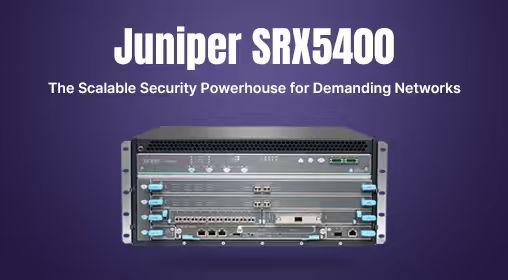
At the heart of the SRX5400's operation is a sophisticated, scalable architecture. It leverages dedicated Service Processing Cards (SPCs) to handle the heavy lifting of integrated security services like firewall policies, intrusion prevention (IDP), and IPsec VPN encryption. This separation of control plane, data plane, and service processing is crucial. The device can maintain multi-gigabit throughput even when multiple advanced security features are activated simultaneously, a scenario that would cripple lesser appliances. The use of Network Processing Cards (NPCs) helps intelligently distribute traffic flows to the SPCs, optimizing resource utilization and ensuring consistent performance. This hardware acceleration is the secret sauce that allows the SRX5400 to deliver robust security without becoming a network bottleneck, supporting high connection rates and maintaining millions of concurrent sessions for vast user bases.
Here is a snapshot of its core technical capabilities:
|
Parameter |
Specification |
|---|---|
|
Firewall Throughput |
Multi-gigabit capacity (exact figure varies with services enabled)
|
|
IPsec VPN Throughput |
High-speed encrypted tunnels
|
|
Form Factor |
Multi-rack-unit chassis
|
|
Architecture |
Modular, with slots for SCB, SPC, and MPC/MIC components
|
|
High Availability |
Supports chassis clustering for active-active/active-passive failover
|
|
Physical Interfaces |
Highly flexible via IOCs or MPC/MICs, supporting a wide range of Ethernet and WAN interfaces
|
Functionally, the SRX5400 is a true all-in-one security gateway. Its foundation is a stateful firewall capable of enforcing granular policies across the network. This is powerfully augmented by Juniper's advanced threat prevention suite, which includes a full-featured Intrusion Prevention System (IPS) to block known vulnerabilities, antivirus scanning, and web filtering capabilities. For secure site-to-site and remote access, it provides robust IPsec VPN termination. A significant advantage for growing organizations is its seamless integration with Juniper's Sky Advanced Threat Prevention cloud service, enabling the gateway to receive real-time intelligence on emerging threats, moving defenses beyond a purely signature-based model. Furthermore, its support for Junos OS means that all these services are managed through a single, consistent operating system, which also enables advanced routing protocols and comprehensive programmability via APIs for automation.
From an operator's perspective, the SRX5400 brings both power and manageability. Network teams working with the Juniper ecosystem will find the Junos OS CLI intuitive and consistent, which significantly reduces the learning curve. For large-scale deployments, centralized management solutions like Juniper Security Director simplify the task of deploying unified policies across multiple SRX devices. The ability to form chassis clusters is a critical feature for high-availability scenarios, ensuring that network security services remain uninterrupted even in the event of a hardware failure. The modularity of the system means that as network bandwidth or security processing needs grow, you can scale capacity by adding more powerful SPCs or new interface cards, often without needing to replace the entire chassis. This provides a tangible sense of control and future-proofing.
When evaluating its value proposition, the SRX5400 makes its strongest case for organizations where scalability, performance, and consolidation are paramount. While the initial investment is significant, its true value lies in its ability to consolidate multiple security functions—firewall, IPS, VPN—into a single, manageable platform, potentially reducing operational complexity and costs compared to maintaining multiple discrete devices. The modular design is a direct investment against obsolescence; the chassis is a long-term asset, and performance or connectivity can be upgraded as needs evolve. This approach can lead to a lower total cost of ownership over many years compared to repeatedly replacing smaller, fixed-configuration appliances.
Of course, such a powerful platform has considerations. Its primary strength as a high-end, modular chassis inherently places it in a higher cost bracket, making it less suitable for small businesses with limited budgets and simple needs. The sheer depth and breadth of its capabilities mean that unlocking its full potential, particularly advanced security features, requires a certain level of expertise in the Junos OS ecosystem. There can be a steeper learning curve for teams unfamiliar with Juniper's environment. Additionally, while the hardware provides the foundation, subscribing to services like the latest threat intelligence signatures for the IPS involves ongoing operational costs that must be factored into the long-term budget.
In conclusion, the Juniper SRX5400 stands as a formidable solution for enterprises and service providers who need to blend high-performance networking with deeply integrated, scalable security. It excels in environments where traffic volumes are substantial, uptime is non-negotiable, and the security posture must be both robust and adaptable. It's a strategic, long-term investment in network infrastructure, designed not just to meet today's threats but to evolve and scale gracefully to meet the unknown challenges of tomorrow.