
Intellectual Property
Hot selling product recommendations
View More



















The A9K-36X10GE-TR: A Versatile Backbone for High-Density Networking
In the fast-evolving landscape of enterprise and service provider networks, the Cisco A9K-36X10GE-TR line card stands as a cornerstone for scalable, high-performance connectivity. Designed to integrate seamlessly with Cisco ASR 9000 Series routers, this module redefines efficiency in environments demanding ultra-high port density and robust traffic management. Whether handling cloud migrations, IoT ecosystems, or 5G backhaul, its 36 dedicated 10Gigabit Ethernet ports make it indispensable for modern infrastructure.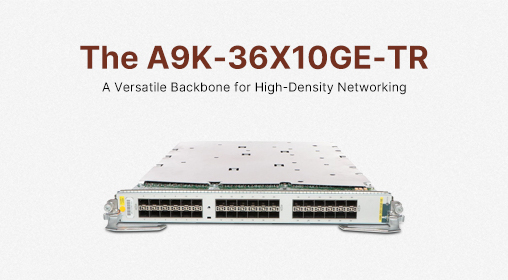
At its core, the A9K-36X10GE-TR thrives in scenarios where bandwidth and reliability are non-negotiable. Financial institutions rely on it for real-time trading data processing, telecom operators deploy it for 5G network slicing, and enterprises use it to unify SDN with traditional architectures. Unlike fragmented solutions requiring multiple hardware variants, this module consolidates Layer 2 and Layer 3 functionalities into a single form factor, slashing operational costs and simplifying deployments.
The module’s architecture is engineered for speed without compromising stability. With a bidirectional throughput of 3.6 Tbps and latency under 1μs per port, it handles bursty traffic patterns common in hyperscale data centers while maintaining sub-microsecond consistency—a critical factor for latency-sensitive applications like high-frequency trading. Its dynamic power scaling (150W–300W) and thermal throttling ensure energy efficiency without sacrificing performance, a balance crucial for 24/7 operations.
Visually, the A9K-36X10GE-TR embodies industrial-grade durability. Its compact 14″×1.7″×20.5″ form factor fits snugly into ASR 9000 chassis slots, while military-grade connectors resist vibration and corrosion. The front panel’s LED indicators provide intuitive status monitoring, and strategically placed heat sinks ensure stable operation even in harsh environments. Despite its density, the design prioritizes accessibility—tool-less latches allow rapid module replacement without disrupting adjacent components.
Beyond raw metrics, the module excels in intelligent traffic orchestration. Automated load balancing and per-flow rate limiting enable precise bandwidth allocation, vital for hybrid cloud architectures. Compatibility with Cisco’s IOS XR software ecosystem simplifies configuration through centralized tools, reducing human error. For instance, a telecom provider reduced provisioning time for new customer slices by 60% using its programmable traffic engineering features.
Network engineers praise its seamless integration with existing ASR 9000 deployments. In real-world scenarios, a healthcare network managing 10,000+ IoT devices reported zero packet loss during peak usage, a testament to deterministic performance. However, some users note the need for advanced cooling solutions in environments exceeding 35°C ambient temperatures—a minor trade-off for its compact form.
While the upfront investment is significant, the module’s longevity justifies the cost. Field-proven reliability minimizes downtime, and its 100Gigabit upgradable ports future-proof networks against escalating bandwidth demands. Organizations prioritizing scalability will find its ability to consolidate services into a single chassis particularly valuable, cutting both capital and operational expenses.
The A9K-36X10GE-TR’s strengths are undeniable: unmatched port density, energy efficiency, and future-ready design. Yet, its higher power consumption compared to disaggregated solutions and reliance on ASR 9000 chassis compatibility (limiting retrofitting) are considerations. For enterprises embracing software-defined infrastructures, these drawbacks pale against its ability to reduce network fragmentation and operational overhead.
In essence, the A9K-36X10GE-TR isn’t merely hardware—it’s a strategic enabler of digital transformation. By harmonizing performance, scalability, and agility, it empowers organizations to future-proof networks without compromising today’s demands. While careful planning is needed for thermal management and chassis selection, its long-term ROI in reducing fragmentation and costs positions it as a cornerstone for enterprises aiming to lead in connectivity.