
Intellectual Property
Hot selling product recommendations
View More



















Juniper QFX10002-36Q: The Compact Powerhouse for Data Center Backbone
When you first lay eyes on the Juniper QFX10002-36Q, its unassuming 2U chassis belies the raw power contained within. This isn’t just another switch; it’s a purpose-built engine for modern data centers and high-density spine deployments. Designed to handle the relentless demands of cloud infrastructure, this switch excels where performance, scalability, and flexibility intersect. With a robust metal housing and clean front-panel layout, it projects a no-nonsense aesthetic—all business, no flash. The rear reveals redundant, hot-swappable power supplies and fan trays, emphasizing its mission-critical role.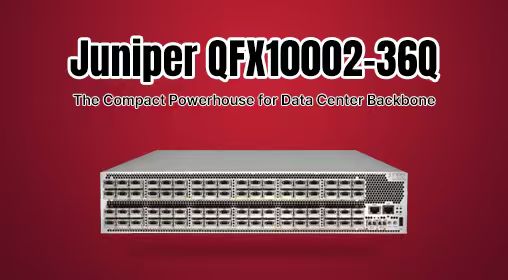
At its core, the QFX10002-36Q is powered by Juniper’s custom Q5 ASIC, which delivers a formidable 2.88 Tbps of throughput and a packet forwarding rate of 1 Bpps. What does this mean in practice? Imagine seamlessly supporting 36 ports of 40GbE QSFP connectivity, which can be broken out into 144 ports of 10GbE or configured for 12 ports of 100GbE using QSFP28 transceivers. This versatility allows network architects to adapt to evolving needs without hardware swaps. The switch also boasts a 256K MAC address table and deep buffers capable of handling up to 100 ms of traffic per port, ensuring consistent performance even during sudden traffic surges.
Here’s a quick overview of its core technical specs:
|
Parameter |
Specification |
|---|---|
|
Throughput |
2.88 Tbps |
|
Packet Forwarding Rate |
1 Bpps |
|
Port Configurations |
36×40GbE QSFP (configurable for 10GbE/100GbE) |
|
MAC Address Table |
256K entries |
|
Buffering |
Per-port buffers up to 100 ms |
|
Power Supply |
Dual, hot-swappable AC/DC options |
|
Form Factor |
2U rack-mountable |
|
Cooling |
Redundant fan trays |
Functionally, the QFX10002-36Q shines with features like Virtual Output Queuing (VOQ), which eliminates head-of-line blocking, and support for Juniper’s MC-LAG for multi-chassis link aggregation. This enables active-active topologies that enhance redundancy and load distribution. It also natively supports FCoE (Fibre Channel over Ethernet), making it ideal for converged storage and data networks. The device runs Juniper’s Junos OS, which brings advanced capabilities like MPLS, VXLAN routing, and automated zero-touch provisioning (ZTP). For SDN environments, it integrates seamlessly with platforms like OpenContrail and VMware NSX, offering programmability through APIs and tools like Puppet and Python.
From an operational perspective, the QFX10002-36Q is built for simplicity and reliability. Engineers appreciate the intuitive Junos CLI, which maintains consistency across Juniper’s product line, reducing the learning curve for teams already familiar with the ecosystem. The inclusion of ZTP means that deploying dozens of switches across a data center becomes a hands-off process—unbox, cable, and watch the device self-configure. The silent, efficient cooling system ensures the switch operates reliably in dense server racks without adding acoustic noise.
When it comes to value, the QFX10002-36Q positions itself as a long-term investment. While its initial cost is significant, its modularity and software-defined capabilities allow it to evolve with network demands. For example, an organization can start with 40GbE today and migrate to 100GbE without replacing hardware. This adaptability translates to lower total cost of ownership over time, especially when compared to hardware-specific alternatives.
Strengths and Weaknesses
The switch’s most compelling advantage is its scalability. With support for up to 2 million host routes and 512,000 MAC addresses, it effortlessly handles large-scale data center environments. The redundant power and cooling subsystems ensure high availability, while the Junos OS provides battle-tested security and automation features.
On the flip side, the sheer breadth of features can be daunting for smaller teams without specialized Juniper expertise. Additionally, while the hardware is flexible, unlocking advanced functionalities like MPLS or BGP add-path requires licensing upgrades, which can add to the overall cost.
In summary, the Juniper QFX10002-36Q is a future-proof spine switch that balances performance, density, and automation. It’s not for every network—but for enterprises and cloud providers building high-throughput, scalable infrastructures, it’s a tool that pays dividends in reliability and flexibility.