
Intellectual Property
Hot selling product recommendations
View More


















Cisco Nexus N2K-C2348UPQ-10GE: The Data Center's Silent Workhorse
In the engine room of a modern data center, where the relentless flow of information dictates the pace, the Cisco Nexus N2K-C2348UPQ-10GE operates as a steadfast and unassuming gear. It doesn't crave the spotlight reserved for core switches, but its role is absolutely critical. Think of it as a force multiplier, a Fabric Extender (FEX) that seamlessly expands the reach of a parent Cisco Nexus switch. This isn't a standalone device; it's an extension, a remote line card that brings high-density, unified connectivity directly to your server racks. By centralizing management, it slashes complexity and creates a remarkably agile network fabric, making it a cornerstone for scalable data center architectures.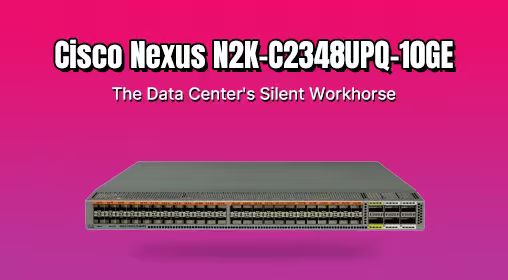
When you examine its physical form, it embodies the no-nonsense, robust design philosophy required for enterprise hardware. It's built for a standard 19-inch equipment rack, with a metallic chassis that promises and delivers long-term durability. The front panel is a study in efficient density, dominated by its array of 48 x 1/10 Gigabit Ethernet ports, providing a significant number of connections for servers or storage units. The design also includes modular uplink slots, offering the flexibility to tailor connectivity, whether you need 10G or higher-speed links back to the core network. This thoughtful layout balances high port count with critical connectivity options in a compact form factor.
Underneath this utilitarian exterior lies a capable packet-forwarding engine. The switch operates at the access layer, designed for high throughput and low latency to ensure that data moves smoothly between servers and the core network. Its architecture is optimized for its role as a fabric extender, relying on the parent switch for complex management and routing intelligence, which allows it to focus on doing one job exceptionally well: moving data efficiently.
Here’s a quick glance at its core parameters:
|
Core Parameter |
Specification |
|---|---|
|
Product Model |
Cisco Nexus N2K-C2348UPQ-10GE
|
|
Device Type |
Fabric Extender (FEX) for Cisco Nexus Series
|
|
Port Configuration |
48 x 1/10 Gigabit Ethernet ports
|
|
Uplink Options |
Modular uplink slots for 10G or higher-speed connectivity
|
|
Form Factor |
Rack-mountable
|
|
Management Type |
Fully managed, dependent on a parent Cisco Nexus switch
|
For a network administrator, the experience of integrating this switch is defined by a concept called unified management. The real magic happens because you don't manage the N2K-C2348UPQ-10GE directly. Instead, you configure and monitor it entirely through its parent Nexus switch. This simplifies the operational workload to an incredible degree. Imagine provisioning policies, applying security settings, and troubleshooting for all 48 ports from a single, centralized console. It dramatically cuts down on the time spent on routine configuration tasks and reduces the potential for human error. From a server or application perspective, the result is a consistent, high-performance connection that feels seamless and reliable.
Evaluating this device requires a clear-eyed view of its intended purpose. Its greatest strength is the elegant simplicity it brings to a scalable data center design. By acting as a fabric extender, it provides a unified network model that is far easier to manage at scale than a collection of independent switches. This centralized approach enhances consistency and reduces operational overhead. However, this very architecture defines its primary limitation: it cannot operate independently. The N2K-C2348UPQ-10GE is entirely dependent on its parent Nexus switch. If the connection to the parent switch is lost, its functionality is severely limited. This makes it a superb solution for expanding an existing Cisco Nexus environment, but not a suitable choice for a standalone deployment or for environments built on multi-vendor infrastructure.
When it comes to value, the N2K-C2348UPQ-10GE isn't about being the cheapest option on the market. Its value is measured in operational efficiency and scalability. For an organization committed to the Cisco Nexus ecosystem, investing in this Fabric Extender translates into long-term savings on management time and administrative complexity. The ability to manage dozens of ports as a single, logical entity is a powerful force multiplier for IT teams. While the hardware requires an investment, the total cost of ownership is justified by the streamlined operations and the robust, reliable performance it delivers as part of a cohesive system. It's a strategic component for growing data centers where operational simplicity is just as important as raw performance.