When the Fans Spin Up: Unpacking the Reality of the Cisco ISR 4451-X/K9
It usually starts with a specific complaint in a crowded server closet: the noise. If you have ever stood next to a Cisco
ISR 4451-X/K9 during a heavy data burst or a boot cycle, you know the sound well—a high-pitched whir that announces its presence louder than any LED blink. For many network engineers, this auditory cue is the first introduction to the device, often sparking debates about cooling requirements and rack placement. Yet, once you look past the acoustic footprint, you realize that this noise is the byproduct of a machine built to handle workloads that would choke lesser routers. The ISR 4451-X isn't designed for a quiet home office; it is an industrial-grade engine meant for the most demanding branch and enterprise edge scenarios, where performance trumps silence every time.
This specific model was engineered to be the flagship of the 4400 series, targeting large enterprises and service providers who needed to consolidate multiple network functions into a single 2U chassis. Its primary purpose goes far beyond simple packet forwarding. It acts as a convergence point for heavy-duty routing, advanced security services, voice processing, and even application hosting. In real-world deployments, you will often find the 4451-X terminating hundreds of IPsec VPN tunnels, running complex Quality of Service (QoS) policies for thousands of VoIP users, and performing deep packet inspection all simultaneously. It was the answer for organizations that outgrew the 4300 series and needed a platform capable of scaling without requiring a complete hardware swap. The "X" in the name signifies its extended capability to handle higher throughput licenses and more dense interface configurations, making it a critical node in SD-WAN architectures before the Catalyst 8000 series took the spotlight.
To truly understand why this box is so loud and so heavy, you have to look at what's driving it. The architecture is built around a multi-core processor design that separates the control plane from the data plane, ensuring that management traffic doesn't interfere with user data flow. Unlike entry-level routers that rely on shared memory, the 4451-X dedicates significant resources to each function. It comes standard with a massive amount of DRAM and flash storage, allowing it to cache extensive routing tables and run multiple virtual machines or containers directly on the router via the Cisco IOx infrastructure. The throughput capabilities are where it really separates itself from its siblings; while base licensing might start conservatively, the hardware is physically capable of pushing several gigabits per second when fully unlocked. This headroom is essential for sites anticipating traffic growth or those running bandwidth-intensive applications like video conferencing and large file transfers locally.
Here are the core specifications that define what this machine can actually do:
| Parameter |
Specification Detail |
| Model |
Cisco ISR 4451-X/K9 |
| Form Factor |
2 Rack Units (2U) |
| Fixed Ports |
4 x 10/100/1000 Mbps GE (RJ-45), 2 x 10GE SFP+ |
| Expansion Slots |
3 x NIM slots, 2 x SM slots, 1 x ISC slot |
| Default Memory |
8 GB Control Plane DRAM, 4 GB Data Plane DRAM |
| Default Flash |
8 GB (Upgradeable) |
| Max Throughput |
Up to 2 Gbps (license dependent) |
| USB Ports |
2 x USB 2.0 (Type A) |
| Console Port |
RJ-45 and Mini-USB |
| Power Supply |
Dual redundant AC/DC (field replaceable) |
| OS |
Cisco IOS XE |
| Status |
End-of-Sale (Support available) |
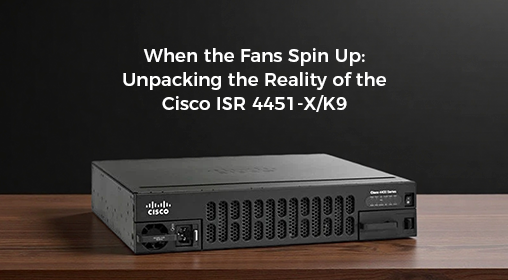
Visually, the
ISR 4451-X is an imposing piece of hardware. Standing at 2U, it dominates the vertical space in a rack, and its depth requires careful planning in shallow cabinets. The front bezel is utilitarian, featuring a prominent air intake vent that feeds the dual internal fans responsible for that characteristic noise. To the right, you'll find the modular slots covered by blanking plates, waiting for NIMs or Service Modules to be installed. The status LEDs are bright and clearly visible, providing instant feedback on system health, port activity, and module status. On the rear, the layout is dense but logical, with the two fixed 10GE SFP+ ports sitting alongside the four Gigabit Ethernet copper ports. The power supplies are redundant and hot-swappable, a critical feature for high-availability environments where uptime is non-negotiable. The build quality is tank-like; everything feels screwed down tight, designed to withstand vibrations and temperature fluctuations that would warp consumer-grade equipment.
Functionally, the
4451-X is a Swiss Army knife for the network core. Its ability to host service modules internally means you can add legacy connectivity like T1/E1 lines, high-density switch ports, or even wireless LAN controllers without eating up external rack space. The integration of Cisco's Unified Communications features allows it to act as a voice gateway, processing calls locally and reducing WAN bandwidth usage. Security is woven into the fabric of the OS; features like Zone-Based Firewalls, IPS, and encrypted traffic analytics run natively on the hardware accelerators, minimizing the performance hit usually associated with turning on security services. Furthermore, its support for Cisco IOS XE brings programmability to the table, allowing administrators to use Python scripts, YANG models, and APIs to automate configuration and monitoring, bridging the gap between traditional networking and modern DevOps practices.
For the user, the experience is a mix of immense power and a steep learning curve. This is not a plug-and-play appliance. Setting up an ISR 4451-X requires a solid grasp of Cisco's command-line interface (CLI). You won't find a colorful web wizard guiding you through every step; instead, you get a text-based prompt that demands precision. However, for experienced engineers, this raw access is empowering. Once the initial configuration hurdle is cleared, the system proves to be incredibly robust. The stability is legendary; these routers often run for years without a reboot. The management experience improves significantly if you integrate it with Cisco DNA Center or Prime Infrastructure, which provides a graphical overlay for monitoring performance and pushing updates. Still, the day-to-day reality involves respecting the device's complexity—managing licenses, monitoring thermal levels due to the high-performance CPU, and ensuring that the fan vents remain unobstructed.
When weighing the pros and cons, the
ISR 4451-X presents a clear trade-off. On the upside, its modularity is unmatched in its generation. The combination of NIM and SM slots offers a flexibility that newer, more fixed-configuration appliances struggle to match. The performance ceiling is high enough to serve as a primary edge router for large branches or small data centers. The redundancy features, including dual power supplies and field-replaceable components, make it ideal for mission-critical sites. Additionally, being an end-of-sale product means it can often be acquired on the secondary market at a fraction of its original cost, offering exceptional value for organizations willing to forego the absolute latest silicon for proven reliability.
On the downside, the physical attributes that enable its performance also create challenges. The 2U size and significant weight make it difficult to deploy in space-constrained telco closets. The noise level is a genuine issue; placing this unit in an office environment is rarely an option without a dedicated, sound-isolated server room. Power consumption is another factor; it draws significantly more wattage than modern, efficiency-focused models, which can impact operational expenses over time. Furthermore, while the hardware is capable of multi-gig speeds, unlocking that potential requires expensive performance licenses, which can complicate the total cost of ownership if not planned carefully. The complexity of the software feature set can also be overwhelming for smaller IT teams lacking specialized Cisco expertise.
In terms of value, the
ISR 4451-X occupies a unique sweet spot in the current market landscape. It is no longer the bleeding edge, but for many use cases, it is more than sufficient. For companies looking to extend the life of their existing infrastructure or needing a robust backup router, the value proposition is strong. You get enterprise-class features, high availability, and massive expandability without the premium price tag of the newest Catalyst 8000 series. It represents a mature technology stack where the bugs have been ironed out, and the best practices are well-documented. While the industry marches toward cloud-native and subscription-heavy models, the ISR 4451-X remains a testament to the era of powerful, self-contained hardware.
Ultimately, the Cisco
ISR 4451-X/K9 is a device that demands respect. It asks for space, cooling, and expertise, but in return, it delivers unwavering performance and flexibility. It may not be the quietest neighbor in the rack, and it certainly doesn't try to be trendy, but for network architects who need a platform that can adapt to almost any requirement thrown at it, the 4451-X remains a formidable choice. Its legacy is defined not by how sleek it looks, but by how many critical business connections it has kept alive through years of evolving network demands.