

Intellectual Property
Hot selling product recommendations
View More



















Cisco C9300X-NM-8Y: Expanding Network Horizons
When you first slide the C9300X-NM-8Y into a compatible Catalyst 9300 series switch, you are not just adding ports; you are fundamentally reshaping the network's potential. This expansion module acts as a force multiplier for access and distribution layer switches, designed for environments where bandwidth is not a luxury but a necessity. Think of a university campus during finals week, with thousands of students streaming lectures and submitting projects simultaneously, or a hospital's imaging department transferring massive MRI files that cannot afford a single hiccup. The module's eight physical ports are engineered to handle such relentless data flow, transforming a standard switch into a robust aggregation point capable of supporting high-speed uplinks and bandwidth-intensive applications without breaking a sweat .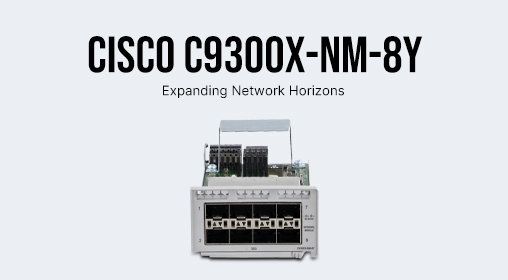
The true measure of this module lies in its performance credentials. It is built for 10 Gigabit Ethernet connectivity using SFP+ technology, but its design philosophy is about consistent, reliable throughput rather than just theoretical peaks. The architecture ensures that these eight ports can operate at full tilt concurrently, preventing the internal bottlenecks that sometimes plague lesser expansion options. This is crucial for maintaining low-latency connections for voice and video, and for ensuring that storage area networks operate at their expected speeds. The module integrates deeply with the switch's own operating system, meaning features like advanced QoS and security policies are applied uniformly across all traffic, whether it originates from a native port or one on this module.
|
Parameter |
Specification |
|---|---|
|
Port Configuration |
8 x 10 Gigabit SFP+ |
|
Compatibility |
Cisco Catalyst 9300 Series Switches |
|
Supported Form Factor |
Network Module |
Visually, the module is a study in functional elegance. It has a sleek, metal casing that slides seamlessly into the dedicated slot on the switch chassis, maintaining a clean and professional aesthetic. The front panel is straightforward and practical, featuring eight SFP+ cages neatly aligned in a single row. Each port is accompanied by clear, intuitive status LEDs that provide an immediate visual health check on link and activity from several feet away, a small but critical detail for network technicians managing a crowded rack.
From a functionality standpoint, the hot-swappable nature of the module is a significant advantage. It allows for installation or replacement without powering down the entire switch, a feature that operations teams deeply appreciate during planned maintenance or urgent upgrades. Once seated, the module is recognized automatically, and the ports become available for configuration through the same Cisco IOS XE interface used for the rest of the switch. This unified management experience is a major benefit, reducing complexity and training time. The module fully supports the switch's comprehensive feature set, including advanced security policies, granular quality of service (QoS) controls, and network analytics, ensuring a consistent operational environment .
Network administrators who have deployed the C930X-NM-8Y often highlight its reliability and how it simplifies capacity planning. Instead of forecasting years in advance and potentially over-provisioning with larger, more expensive chassis, they can start with a base switch and add modules as needs evolve. This incremental approach is not just about cost savings; it is about operational agility. The module performs as an integral part of the switch, responding identically to commands and providing the same level of diagnostic visibility. In real-world use, this translates to predictable performance that helps teams meet service-level agreements and maintain user satisfaction, especially in dynamic environments where demand can spike unexpectedly .
Assessing its value, the module presents a compelling case for maximizing infrastructure investments. The strategy of scaling a network's capacity by adding modules to an existing chassis protects the core investment and avoids the management overhead of introducing entirely new devices. This approach often leads to a lower total cost of ownership over time, considering the savings in rack space, power consumption, and administrative effort. The module's energy-efficient design also contributes to reduced operational expenses, as power usage scales with actual utilization.
The advantages are clear: high port density in a single slot, robust performance that matches the host switch's capabilities, and seamless integration that simplifies network expansion. It is an ideal solution for organizations looking to future-proof their access layer without immediate, large-scale hardware replacements. However, it is not without its considerations. Its utility is exclusive to the Catalyst 9300 series, which means it offers no flexibility for other platforms in a heterogeneous environment. Organizations must also factor in the cost of the required SFP+ transceivers. Some network designers might also prefer a more distributed approach to adding capacity, perhaps using multiple switches for redundancy rather than concentrating multiple high-speed links on a single module.
In essence, the C9300X-NM-8Y is a testament to thoughtful network design. It empowers organizations to build with confidence, knowing that when the need for more bandwidth arises—as it inevitably will—the path forward is as simple as sliding in a module. It becomes a silent, reliable workhorse in the background, enabling the fast, reliable, and secure connections that modern digital endeavors demand.