
Intellectual Property
Hot selling product recommendations
View More



















Walking into the heart of a modern network closet, the Cisco Catalyst C9300L-24T-4G-A doesn't command attention with flashing lights or a dramatic presence. Instead, it offers a quiet assurance of reliability. This switch is engineered for a specific purpose: to serve as the intelligent, secure foundation for business-critical networks. It's the unseen workhorse that connects everything from employee computers and printers to wireless access points in mid-sized offices, branch locations, and educational campuses, ensuring data flows seamlessly and securely. Its design philosophy centers on delivering enterprise-grade robustness and advanced features in a form factor that is both accessible and powerfully capable .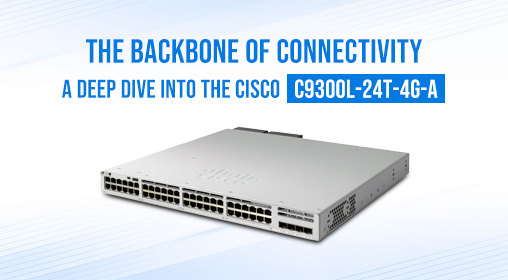
The first thing you notice is its straightforward, professional aesthetic. Housed in a dark, resilient metal chassis, it's built to occupy a standard 1U rack space, with dimensions of approximately 44.5 cm in width, 40.9 cm in depth, and 4.4 cm in height. The front panel presents a clean array of 24 RJ-45 Gigabit Ethernet ports, flanked by four dedicated 1G SFP uplink ports for flexible fiber or copper connectivity to the network core. A series of status LEDs provides a quick, visual health check. Weighing around 6.78 kg, it feels substantial without being cumbersome, designed for silent, continuous operation in a controlled environment. The inclusion of field-replaceable fan modules supports (N+1) redundancy, a nod to its design for longevity and minimal downtime .
Beneath this unassuming exterior lies impressive performance. The switch boasts a switching capacity of 56 Gbps and a forwarding rate of 41.66 Mpps, ensuring non-blocking performance across all ports even during peak traffic loads . It's powered by an x86 CPU architecture, complemented by 8 GB of DRAM and 16 GB of flash memory. This isn't just for basic switching; the memory headroom allows the switch to run Cisco's sophisticated IOS XE operating system and even host containerized applications for advanced network functions and automation .
|
Parameter Category |
Specification |
|---|---|
|
Port Configuration |
24 x 10/100/1000BASE-T RJ-45, 4 x 1G SFP Uplinks |
|
Performance |
Switching Capacity: 56 Gbps, Forwarding Rate: 41.66 Mpps |
|
Hardware |
CPU: x86, DRAM: 8 GB, Flash: 16 GB |
|
Stacking |
StackWise-320 technology, up to 320 Gbps bandwidth |
|
Power Supply |
Default 350W AC (PWR-C1-350WAC-P) |
|
Physical |
Dimensions (HxWxD): 4.4 x 44.5 x 40.9 cm, Weight: ~6.78 kg |
|
Environmental |
Operating Temperature: 0°C to 45°C |
Where this switch truly proves its worth is in its functional depth, courtesy of the included Network Advantage license. This transforms it from a simple data pipe into an intelligent network participant. It supports full Layer 3 routing protocols—including OSPF, EIGRP, and BGP—allowing it to make smart decisions about traffic routing internally, which reduces load on core routers and improves application responsiveness . For security, it offers a robust suite including 802.1X for network access control, DHCP snooping, and Dynamic ARP Inspection to prevent common spoofing attacks . A particularly clever feature is Encrypted Traffic Analytics (ETA), which can identify potential threats in encrypted data streams without needing to decrypt them . The StackWise-320 technology is a game-changer for growing businesses, allowing up to eight physical switches to be connected and managed as a single, logical entity, simplifying configuration and creating a resilient network fabric .
From an administrator's perspective, the experience is a blend of enterprise power and manageable complexity. The initial setup can be streamlined using Zero-Touch Provisioning (ZTP), which is a blessing when deploying multiple switches . You have the flexibility of managing it through the familiar Command Line Interface (CLI) for veterans or a web-based GUI for simpler day-to-day tasks . The real-world benefit is stability. Once configured, it just runs. The solid construction and efficient cooling mean it operates quietly, becoming an invisible yet trusted component of the IT infrastructure. The ability to run Python scripts directly on the switch opens doors for automation, letting network teams build custom tools for efficiency gains .
Evaluating its value proposition, the C9300L-24T-4G-A sits in a strategic sweet spot. You're investing in the reliability, security, and feature set that Cisco is known for in the enterprise world, but in a platform designed for scalability and ease of management . The stacking capability is a huge value-add, as it allows a network to grow without becoming exponentially more complex to manage. While the upfront investment might be higher than some basic alternatives, the total cost of ownership often proves favorable when you factor in years of reliable service, reduced downtime, and the operational efficiency gained from its advanced features and robust hardware warranty . It’s a strategic choice for businesses that view their network as a critical utility rather than a mere expense.
However, a balanced view requires acknowledging its trade-offs. The most significant limitation is the lack of Power over Ethernet (PoE) support. This means it cannot power devices like wireless access points or IP phones directly through the network cables, which may necessitate the use of separate power adapters or lead organizations to consider a PoE-enabled model within the same series . Furthermore, while the 1G uplinks are sufficient for many current applications, organizations planning a significant leap to multi-gigabit or 10-gigabit internal backbones might find this a limiting factor for future-proofing .
In conclusion, the Cisco Catalyst C9300L-24T-4G-A's strengths are its solid performance, extensive Layer 3 capabilities, advanced security, and exceptional flexibility through stacking. It is an ideal solution for businesses that need a reliable, scalable, and intelligent networking foundation. It's not the simplest switch on the market, nor is it suited for environments requiring direct device power. But for those who need its specific blend of power, intelligence, and resilience, it becomes the silent, dependable cornerstone of the entire digital operation, proving that the most crucial technology is often the kind you can install, configure, and then almost forget about as it reliably does its job, day in and day out .