
Intellectual Property
Hot selling product recommendations
View More



















Cisco C9200L-48P-4G-E vs. C9500-24Y4C-A: The Tactical Access Switch Meets the Strategic Core Engine
Picking between Cisco’s Catalyst C9200L-48P-4G-E and the C9500-24Y4C-A isn’t just a matter of specs—it’s a strategic decision that shapes your network’s DNA. One serves as a high-density, PoE-packed workhorse for connecting everything from phones to cameras, while the other acts as a high-throughput core switch built for speed, scalability, and relentless data movement. They’re designed for completely different battles.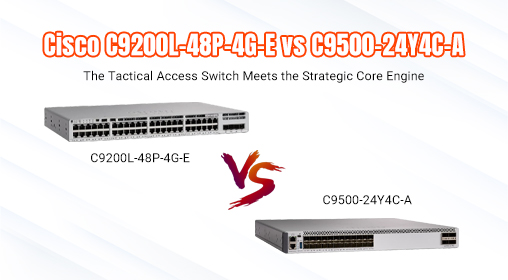
Let’s start with the raw numbers. The C9200L leans heavily on access-layer practicality, while the C9500 is engineered for core-level performance.
|
Parameter |
C9200L-48P-4G-E |
C9500-24Y4C-A |
|---|---|---|
|
Port Configuration |
48 x Gigabit Ethernet ports |
24 x multi-gigabit ports (1/10/25G) |
|
Primary Use Case |
Access layer, high-density device connectivity |
Core/aggregation layer, high-speed data routing |
|
Notable Tech |
Integrated PoE+ for powered devices |
High-speed uplinks, modular flexibility |
|
Design Profile |
Standard rack-mount, metal enclosure |
Compact, high-density rack design |
When you look at their physical presence, the C9200L-48P-4G-E sports a classic metal housing built for reliability in wiring closets or server rooms. It’s straightforward, functional, and focuses on fitting into existing rack layouts without fuss. The C9500-24Y4C-A, by contrast, packs a lot more capability into a tighter footprint—its design prioritizes port density and thermal efficiency for environments where real estate is precious, like data centers or core network stacks .
Feature-wise, the C9200L shines with robust Power over Ethernet Plus (PoE+), allowing it to deliver power to a small army of IP phones, wireless access points, and surveillance cameras without needing extra electrical circuits. It’s built for the edge of the network, where connecting and powering devices efficiently is the main goal. The C9500 skips broad PoE support in favor of sheer data speed. Its multi-gigabit and 10/25G capable ports are designed for backbone connectivity, linking to servers, storage, and other switches where latency and bandwidth trump everything. It also supports advanced features like enhanced security analytics and application visibility, which become critical when you’re managing traffic at scale .
In terms of stability, both are enterprise-grade, but the C9500 often incorporates more robust high-availability features. Think redundant, hot-swappable power supplies and cooling systems that keep the switch running even if a component fails. That’s something you’ll appreciate in a core switch, where downtime isn’t an option. The C9200L is dependable for everyday use but isn’t typically specified with the same level of hardware redundancy .
From an operational standpoint, the C9200L is relatively straightforward to deploy and manage, especially with tools like Cisco DNA Center simplifying configuration for large fleets of access switches. The C9500 demands more expertise—configuring high-speed interfaces, routing policies, and redundancy features isn’t for the faint of heart. It’s aimed at network engineers who live and breathe infrastructure .
Now, about value: the C9200L-48P-4G-E delivers solid ROI for organizations that need to connect and power a large number of end-user devices cost-effectively. Its value is in practicality and PoE density. The C9500-24Y4C-A commands a higher investment, justified by its advanced throughput, low-latency performance, and core-ready features. You’re not just buying ports; you’re buying the muscle to keep your network from bottlenecking under load .
So, what’s the final call?
The C9200L-48P-4G-E is your go-to for high-density PoE+ and straightforward access layer needs. It’s user-friendly, cost-effective, and ideal for offices, campuses, or any environment filled with devices that need power and data. What it lacks in core-level speed, it makes up in everyday usefulness.
The C9500-24Y4C-A, on the other hand, excels in high-speed port density and core-level features. It’s built for IT environments where performance, uptime, and scalability can’t be compromised. The trade-off is its higher cost and complexity—overkill if you just need to wire up a floor of desks.
Choose the C9200L for versatility at the edge. Choose the C9500 for horsepower at the heart of your network. Your decision ultimately hinges on which part of your network you’re looking to empower.