
Intellectual Property
Hot selling product recommendations
View More



















Cisco ASR1000-RP3: The Silent Backbone of Modern Networks
Walking into a busy network operations center, you’d be hard-pressed to spot the Cisco ASR1000-RP3 Route Processor at a glance. It doesn’t have flashy lights or a dramatic design. But in the world of enterprise and service provider networking, this unassuming piece of hardware is often the steadfast anchor holding the entire digital flow together. Think of it as the high-capacity brain of the ASR 1000 Series Aggregation Services Router, engineered for environments where every millisecond of latency counts and network uptime isn’t just a metric—it’s a promise. This isn’t a simple data shuffler; it’s an integrated services platform built to handle intensive tasks like advanced encryption, deep packet inspection, and WAN optimization without breaking a sweat, all while ensuring critical business applications run seamlessly across distributed clouds.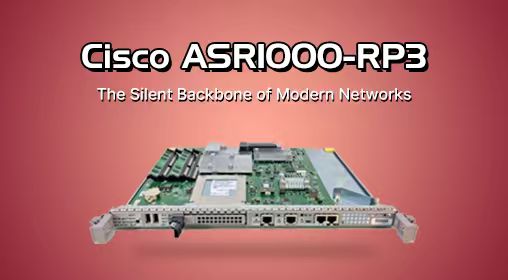
When you look at its core architecture, the specifications reveal a device crafted for heavy lifting. The RP3 is designed to be the computational heart of the router, managing complex routing tables, security policies, and application-aware services simultaneously.
|
Core Parameter |
Specification |
|---|---|
|
Form Factor |
Single-slot Route Processor for Cisco ASR 1000 Series chassis
|
|
Primary Function |
Centralized control plane processing for routing, security, and services
|
|
Forwarding Performance |
Designed for multi-gigabit, high-throughput data plane support
|
|
Memory Architecture |
Enhanced system memory for large-scale routing tables and service policies
|
|
Redundancy Support |
Typically supports high-availability configurations like SSO/NSF for stateful failover
|
|
Integrated Services |
Hardware-accelerated encryption, QoS, and application performance management
|
Physically, the RP3 embodies the robust, no-nonsense aesthetic of Cisco's enterprise-grade hardware. It’s built to slide neatly into the ASR 1000 chassis, featuring a sturdy metal casing designed for continuous operation in demanding environments. The front panel is typically clean and functional, dominated by management ports like USB and console, along with status LEDs that provide a silent, clear narrative of the system's health. Its build inspires confidence through sheer durability, signaling that this component is engineered for the long haul, capable of withstanding the thermal and vibrational stresses of a 24/7 data center or telecom exchange.
For the network engineer, the experience of working with a system powered by the ASR1000-RP3 is defined by a sense of control and predictability. The router's operating system, IOS XE, provides a unified environment that veterans can navigate through a precise command-line interface, while a modern web-based GUI offers a more visual approach for configuration and monitoring. A significant part of its appeal lies in its programmability and automation capabilities. Repetitive tasks—such as deploying security policies across thousands of interfaces or pushing configuration updates—can be scripted, saving invaluable engineering time and drastically reducing the risk of human error that can lead to costly outages. From an end-user's perspective within the organization, the impact is one of seamless connectivity. Applications feel responsive, video conferences remain stable, and large data transfers happen efficiently, all underpinned by the robust processing and advanced traffic management policies the RP3 enables.
Of course, no technological component is without its trade-offs. The primary strength of the ASR1000-RP3 lies in its powerful integration of control plane functions and advanced services in a reliable, scalable package. Its ability to handle large, complex networks with sophisticated policies makes it a foundational element for growth. However, this capability introduces complexity. The initial setup and configuration, especially for leveraging advanced features, require a solid understanding of networking principles and the Cisco ecosystem. It's unequivocally designed for medium to large enterprise or service provider environments with skilled IT staff. Furthermore, while the hardware itself represents a significant investment, the total cost of ownership also encompasses potential licensing for advanced software features and smart net flow services.
When evaluating its value proposition, the ASR1000-RP3 isn't the cheapest component on the market, but its worth is measured in resilience and strategic positioning. For an organization whose operations depend on network reliability and advanced services, the cost of downtime—in lost productivity, security vulnerabilities, and reputational damage—can far outweigh the initial investment in a robust route processor. Its integration into a cohesive system like the ASR 1000 series offers a streamlined architecture that can reduce operational overhead in the long run. It’s a strategic investment, a piece of infrastructure you install with the confidence that it will serve as a dependable core for years, adapting to evolving network demands. For businesses where the network is the central nervous system, the ASR1000-RP3 is not an expense; it's an investment in uninterrupted, intelligent, and high-performance connectivity.