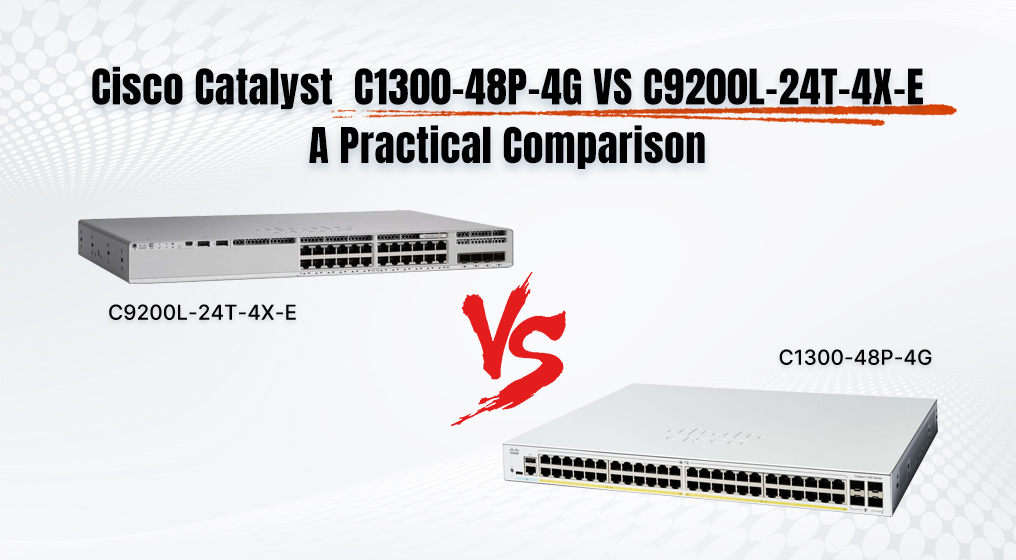
Cisco Catalyst C1300-48P-4G vs. C9200L-24T-4X-E: A Practical Comparison
Choosing the right network switch often feels like a balancing act between raw performance, budget, and the specific demands of your environment. When looking at the Cisco Catalyst
C1300-48P-4G and the
C9200L-24T-4X-E, you are essentially comparing two different philosophies of network design. One prioritizes port density and power delivery for edge devices, while the other focuses on higher throughput and uplink speed for more demanding data traffic. To make the right call, we need to look past the model numbers and see how they actually behave in a real-world scenario.
️
Core Specifications Breakdown
Before getting into the nitty-gritty of user experience, it helps to see the raw numbers side-by-side. The table below highlights where the hardware differences lie.
| Feature |
Catalyst C1300-48P-4G |
Catalyst C9200L-24T-4X-E |
| Switching Capacity |
104 Gbps |
80 Gbps (Backplane) |
| Forwarding Rate |
77.38 Mpps |
95.23 Mpps |
| Downlink Ports |
48x Gigabit Ethernet (PoE+) |
24x Gigabit Ethernet (Data only) |
| Uplinks |
4x 1G SFP |
4x 10G SFP+ |
| PoE Support |
Yes (High Power) |
No (T-Series) |
| Stacking |
StackWise-80 |
StackWise-80 |
| Layer Support |
Layer 3 (Static/Floating) |
Full Layer 3 |
️ Physical Design and Aesthetics
When you pull these units out of the box, the first thing you notice is the sheer difference in mass. The C1300-48P-4G is a beast. Because it houses a power supply capable of delivering wattage to 48 ports, it is significantly heavier and deeper. It has that utilitarian, industrial feel—bulky and imposing. If you are working in a shallow cabinet, the depth might actually be an issue.
The C9200L-24T-4X-E, on the other hand, feels more refined. It is lighter and slightly more compact since it doesn't need the heavy transformers required for PoE. The airflow design on the 9200L series generally feels a bit more optimized for standard server rooms, whereas the C1300 can sometimes sound like a small jet engine when the PoE budget is maxed out and the fans spin up. Both fit standard racks, but the C1300 demands more physical space and support.
Performance and Throughput
This is where the "T" versus "P" distinction really matters. The C9200L-24T-4X-E is the speedster here. Even though its backplane bandwidth is listed lower than the C1300's aggregate switching capacity, its forwarding rate is higher. More importantly, it boasts four 10G SFP+ uplinks. In a modern network, 1G uplinks are becoming a bottleneck. If you have heavy traffic moving between VLANs or heading to a core switch, the 10G uplinks on the 9200L provide a massive advantage in reducing latency and congestion.
The C1300-48P-4G is limited by its 1G uplinks. While 77.38 Mpps is respectable for an access switch, moving data through those 1G fiber ports can get choked if you have 48 users all trying to pull data simultaneously. It is designed for "edge" access—getting devices onto the network—rather than heavy data transport.
Features and Functionality
The C1300 series is often viewed as the successor to the legacy "Smart Plus" or smaller business switches, sitting just below the enterprise-grade Catalyst 9000 family. It supports essential Layer 3 features like static routing, which is great for segmenting traffic without needing a core router. However, its main selling point is PoE. If you have IP cameras, Wi-Fi 6 access points, or VoIP phones, this switch is a lifesaver. It simplifies cabling by delivering power and data over one wire.
The C9200L-24T-4X-E runs the full Cisco IOS XE operating system. This means it supports advanced automation, full dynamic routing protocols (like OSPF), and deeper integration with Cisco DNA Center (depending on the licensing). It is a true enterprise access switch. It lacks PoE, so it is strictly for connecting computers, printers, and servers where power is already available or not needed.
User Experience and Stability
From a stability standpoint, both units are rock solid—this is Cisco, after all. You can expect them to run for years without a reboot. However, the management experience differs. The C9200L feels snappier. The interface is responsive, and because it handles routing more efficiently, troubleshooting complex network paths is easier.
The C1300 is reliable but can feel a bit "heavier" to manage if you are doing complex configurations, simply because the hardware is often maxed out by the sheer number of connected endpoints. Users often report that the C1300 runs hotter due to the PoE load, which is something to keep in mind for your cooling setup.
Value and Trade-offs
Ultimately, comparing these two comes down to what you value more: Power or Speed.
The C1300-48P-4G is the value king for offices and surveillance setups. The ability to power 48 devices makes it incredibly versatile. You don't need to buy separate power injectors, which saves time and money on installation. If you need to plug in a phone and a laptop for 24 desks, this is the only logical choice between the two.
The C9200L-24T-4X-E offers better performance per port. It is ideal for wiring closets where you have high-density data usage but no need for PoE, or where you already have a separate PoE infrastructure. The 10G uplinks future-proof your network backbone.
If you are building a network from scratch, the C9200L is generally the "better" switch in terms of modern architecture, provided you can live without the PoE capabilities. However, for pure utility and connecting the things that actually need power, the C1300 remains a workhorse that is hard to beat.