The Invisible Engine: Living with the A10 Thunder 4430 in High-Stakes Networks
There is a specific kind of silence that happens in a data center when everything is working perfectly, and ironically, it’s the kind of silence that makes network engineers nervous. You start checking logs, wondering if the monitoring system missed something. That is exactly where the
A10 Thunder 4430 tends to live in your infrastructure. It isn’t the flashy next-generation firewall you show off in security audits, nor is it the router that defines your edge. It is the workhorse sitting behind the scenes, handling the massive, chaotic crush of application traffic that would bring lesser devices to their knees. If you have ever managed a high-traffic e-commerce platform during Black Friday or a streaming service during a major event, you know the feeling of watching connection tables spike. With the 4430, that spike often looks like a gentle hill on the graph, which changes your entire psychological relationship with your network operations.
This device is purpose-built for one thing: making sure applications stay available no matter what. While general-purpose load balancers exist, the
Thunder 4430 is engineered specifically for Layer 4 through Layer 7 traffic management, SSL offloading, and application delivery control. It sits between your users and your server farms, intelligently distributing requests so that no single server gets overwhelmed while others sit idle. It handles the heavy lifting of encrypting and decrypting SSL/TLS traffic, freeing up your backend web servers to do what they are actually supposed to do—serve content. In real-world deployments, you will find these units protecting healthcare portals, financial transaction systems, and telecommunications core networks where a millisecond of latency translates directly to lost revenue or frustrated customers.
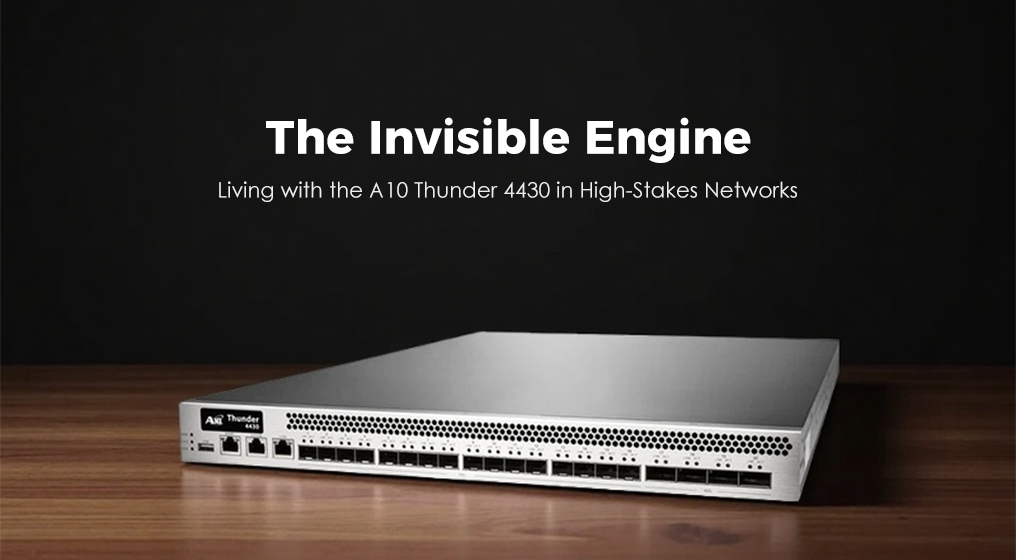
When you first unbox the unit, the physical presence is understated but dense. It slides into a standard 1U rack space, weighing in at a solid figure that suggests serious internal components rather than empty plastic. The front bezel is clean, dominated by a status LCD screen that gives you immediate IP information and system health without needing to log in. To the right, you have your console port and USB management interfaces, flanked by modular slots for network interface cards. Unlike some competitors that lock you into fixed port configurations, the 4430 lets you populate these slots with a mix of 1GbE, 10GbE, or even 40GbE interfaces depending on your topology. The airflow design is strictly front-to-back, which plays nice with most modern data center cooling layouts, though the fan noise under full load is noticeable enough that you wouldn’t want this running in an office closet.
Under the hood, the performance metrics are where the user experience really diverges from the spec sheet. On paper, the numbers are impressive, but in practice, it’s the consistency that wins you over. The system leverages a multi-core architecture optimized for parallel packet processing. When you enable heavy SSL inspection, many devices see their throughput cut in half. The 4430, thanks to dedicated hardware acceleration for cryptography, maintains remarkably high throughput even with full encryption enabled. This means you don’t have to oversize your hardware just to account for security overhead. The connection setup rate is another area where it shines, capable of establishing hundreds of thousands of new sessions per second, which is critical for applications that rely on short-lived connections like HTTP/2 or microservices architectures.
| Core Specification |
A10 Thunder 4430 Capability |
| Max Throughput (L4) |
Up to 160 Gbps |
| Max SSL TPS (2K keys) |
Up to 150,000 TPS |
| Max Concurrent Connections |
Up to 180 Million |
| New Connections Per Second |
Up to 600,000 CPS |
| Form Factor |
1U Rack Mount |
| Interface Options |
Modular (1G/10G/40G SFP+/QSFP+) |
| Power Supply |
Dual Redundant Hot-Swappable |
| Architecture |
Multi-core with Hardware Acceleration |
| Virtualization Support |
vThunder, Container support |
| Management Interfaces |
CLI, Web GUI, REST API, SNMP |
Functionally, the operating system, known as ACOS (Advanced Core Operating System), feels distinct from the Linux-based clones many competitors use. It is built from the ground up for networking, which results in a CLI that veterans of older Cisco or Foundry gear find surprisingly intuitive. The command structure is logical, and the context-sensitive help actually helps. But the real power lies in the Advanced Firewall Manager and the GSLB (Global Server Load Balancing) capabilities. You can write complex policies that route traffic based on the content of the HTTP header, the geographic location of the user, or even the current load on a specific database backend. The SSL management is particularly robust, allowing for centralized certificate management across a cluster, which saves countless hours during renewal seasons.
From a day-to-day user perspective, managing the 4430 is a mix of relief and occasional head-scratching. The relief comes from the stability. Once a policy is committed, it tends to stay committed. You rarely see the control plane hang or the management interface become unresponsive during traffic spikes, a common complaint with software-based load balancers. The visibility tools are deep; you can drill down into a specific user session and see exactly which server handled the request, how long it took, and where the latency was introduced. However, the learning curve can be steep for those coming from purely GUI-driven environments. While the web interface has improved significantly in recent years, offering better visualization of traffic flows and health maps, the true power of the box is unlocked via the command line. Junior admins might feel intimidated initially, but the investment in learning the CLI pays off in troubleshooting speed.
The cost-to-performance ratio, or value proposition, is where A10 has historically carved out its niche. They rarely compete on being the cheapest option upfront, but they compete aggressively on price-per-gigabit of SSL throughput. If your requirement involves heavy encryption, buying a competitor’s box often means purchasing a much larger chassis to get the same effective performance, driving up both capital expenditure and power consumption. The 4430 hits a sweet spot for mid-to-large enterprises that need enterprise-grade features without stepping into the pricing tier of the absolute largest carrier-grade chassis. It scales well, meaning you can start with a modest configuration and add interface modules or license upgrades as your traffic grows, protecting your initial investment.
No piece of hardware is without its flaws, and honest usage reveals some friction points. The upgrade process for the OS, while generally stable, requires careful planning. Major version jumps sometimes necessitate a reboot of the entire unit, which in a high-availability pair means navigating a failover window that can be risky if not timed perfectly. Documentation is comprehensive but can feel scattered; finding specific examples for complex iRules-style scripting (called aFlex in A10 terminology) sometimes requires digging through community forums rather than the official knowledge base. Additionally, while the hardware is robust, the proprietary nature of the ACOS ecosystem means you are locked into A10 for support and advanced features, making migration away from the platform more difficult than moving between open-standard solutions.
On the flip side, the advantages are compelling for the right use case. The sheer density of SSL processing is unmatched in this form factor. The ability to virtualize the instance allows you to run multiple logical load balancers on a single physical 4430, perfect for multi-tenant environments or separating development and production traffic without buying extra boxes. The DDoS protection features, often sold as expensive add-ons by other vendors, are integrated deeply into the packet processing engine, providing a baseline level of protection against volumetric attacks without needing external scrubbing centers for smaller incidents.
Ultimately, living with the
A10 Thunder 4430 feels like having a reliable, high-performance transmission in a race car. You don’t always notice it when it’s working, but you immediately feel the difference when you try to push the same workload through a lesser system. It demands respect and a willingness to learn its specific language, but it rewards that effort with a level of steadiness that lets you sleep through the night, even when your application traffic doubles unexpectedly. For organizations where application availability is the primary metric of success, the 4430 stops being just a box in a rack and becomes the silent guardian of the user experience.