
Intellectual Property
Hot selling product recommendations
View More



















The MX480: Powering Modern Networks Without the Noise
When you first encounter the Juniper MX480, it’s hard not to be struck by its purposeful design. This isn’t a flashy device meant for show; it’s built for serious work. With a sturdy chassis measuring 443×356×622 mm and weighing in at 81.6 kg, it commands respect without being overly imposing. The horizontal slot orientation and modular architecture give it a clean, organized look, while its 8-rack-unit height ensures it fits neatly into standard data center enclosures. The front-facing configuration emphasizes practicality, with clearly labeled slots and interfaces that make physical maintenance straightforward. It’s a piece of hardware that quietly communicates reliability just by sitting there.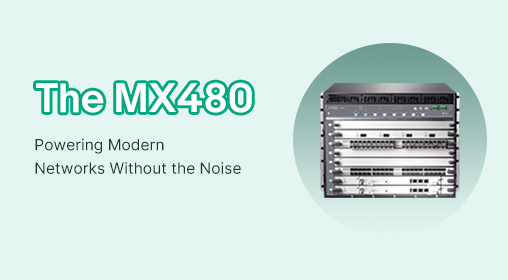
Underneath that unassuming exterior lies some serious muscle. At its heart, the MX480 is powered by a 6-core processor, backed by 64 GB of DDR4 RAM and dual 50 GB SSDs for storage. What really sets it apart is its staggering throughput capacity—up to 9 Tbps—making it capable of handling everything from high-density enterprise traffic to extensive service provider workloads. Its modular port configuration supports a wide range of interfaces, including up to 360 1GbE ports, 90 100GbE ports, and even 18 400GbE ports. This flexibility allows network architects to scale and adapt without being locked into a fixed I/O layout. Juniper’s custom Trio 5 chipset plays a key role here, delivering advanced features like flexible Ethernet (FlexE) and built-in MACsec encryption without sacrificing performance.
One of the most appreciated aspects of the MX480 is how it balances raw power with operational intelligence. It supports a comprehensive suite of services: Layer 2 and Layer 3 VPNs, stateful firewall capabilities, carrier-grade NAT, and sophisticated QoS mechanisms. For administrators, features like Juniper’s SecIntent and integration with the Paragon Automation platform simplify network monitoring and threat response. In real-world deployments, this translates to fewer unexpected outages and more predictable performance. One network engineer shared that after migrating to an MX480-based edge setup, they saw a noticeable drop in latency-related complaints during peak hours, especially in environments combining video conferencing and large data transfers. The router’s ability to handle multiple high-demand applications simultaneously—without requiring constant manual tuning—is a recurring theme in user feedback.
Of course, no hardware is perfect. The MX480’s extensive capabilities come with a learning curve, particularly for teams unfamiliar with Juniper’s Junos OS. Some administrators note that initial setup and advanced service provisioning require specialized knowledge, which can slow down deployment if in-house expertise is limited. Additionally, while the modular design is a strength, it also means that fully populating the chassis with high-density line cards represents a significant investment. However, most users argue that the long-term benefits outweigh these hurdles. The platform’s reliability in demanding scenarios—such as BNG (Broadband Network Gateway) deployments or large-scale VPN services—often leads to lower total cost of ownership compared to less robust alternatives. One service provider mentioned that despite the upfront complexity, the MX480 helped them consolidate several older devices into a single platform, reducing both power consumption and rack space.
Here’s a quick overview of its core parameters:
|
Category |
Specification |
|---|---|
|
Processor |
6-core CPU |
|
Memory |
64 GB DDR4 RAM, 2×50 GB SSD |
|
Max Throughput |
9 Tbps |
|
Expansion Slots |
6 MPC slots |
|
Interface Options |
Up to 360×1GbE, 90×100GbE, 18×400GbE, 48×10GbE DWDM |
|
Power Supply |
-40 to -72 VDC or 100-240 VAC |
|
Dimensions |
443 × 356 × 622 mm |
|
Operating Temperature |
0 to 46°C |
When placed alongside competitors, the MX480 stands out for its scalability and service integration. For example, while some rival routers may offer similar raw throughput, Juniper’s emphasis on embedding security features directly into the data plane provides an advantage in environments where security and performance are equally critical. Users also highlight the value of Juniper’s software-defined networking (SDN) compatibility, which makes the MX480 a future-proof choice for evolving network architectures. It’s not the cheapest option on the market, but for organizations needing a blend of capacity, versatility, and advanced features, it delivers a level of performance that justifies the investment.
In the end, the Juniper MX480 is like a trusted backbone—rarely in the spotlight, but always on duty. It may not be the right fit for every scenario, but for those who need a robust, scalable foundation for complex network demands, it’s a solution that earns its keep day after day.