
Intellectual Property
Hot selling product recommendations
View More



















The C9300-48U-E: More Than Just a Network Switch
Let's talk about the Cisco Catalyst C9300-48U-E. This isn't just a piece of hardware that sits in a server rack; it's the silent, hard-working core of a modern, demanding network. Imagine needing to power dozens of devices—from wireless access points and IP phones to advanced security cameras—without running a single new electrical outlet. That's the reality this switch is built to handle. It delivers both data and significant power over the same Ethernet cable, simplifying your infrastructure dramatically . As a fully managed, Layer 3 device, it gives you deep control over your network traffic, allowing you to segment it for security, prioritize critical applications, and ensure your business operations run smoothly without bottlenecks .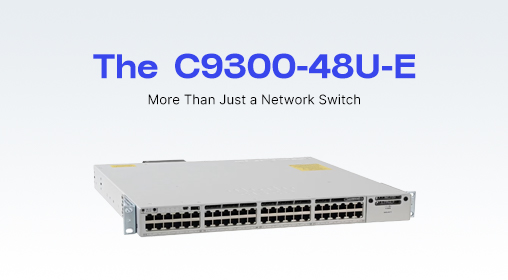
When you look at its specs, the C9300-48U-E is engineered for performance that can grow with your needs.
|
Core Parameter |
Specification |
|---|---|
|
Port Configuration |
48 x Gigabit Ethernet UPoE Ports |
|
Transmission Rate |
10/100/1000Mbps |
|
Uplink Capabilities |
Supports SFP/SFP+ modules for fiber connectivity |
|
PoE Standard |
UPoE (Universal Power over Ethernet) |
|
Switching Capacity |
256 Gbps backplane bandwidth |
|
Forwarding Rate |
190.47 Mpps |
|
Management Level |
Fully Managed, Layer 3 |
The substantial backplane bandwidth and high packet forwarding rate mean this switch can handle heavy traffic loads from all ports simultaneously without breaking a sweat. It's the difference between a multi-lane highway and a country road during peak hour. The ability to stack multiple units together is a game-changer, creating a single, logical switch from multiple physical ones that you can manage as one entity, simplifying expansion and administration .
Physically, the C9300-48U-E is built for the rigors of an enterprise environment. It's designed for standard rack mounting, and its form factor is both robust and practical, ensuring it can dissipate heat effectively even when fully loaded . The inclusion of dual, hot-swappable power supplies (1100W AC) is a critical feature for mission-critical applications; if one power supply fails, the other takes over seamlessly, preventing any network downtime .
From a user's perspective, the experience of managing this switch is a mix of power and complexity. Network administrators appreciate the granular control offered by Cisco's iOS XE operating system. They can implement advanced quality-of-service (QoS) rules, set up virtual LANs (VLANs) with ease, and monitor the health of every connected device. The peace of mind that comes with robust security features and stable performance is invaluable. However, this power comes with a learning curve. For those unfamiliar with the Cisco command-line interface (CLI), there can be a period of adjustment, though the web-based graphical interface provides a more accessible option for common tasks .
Evaluating its value isn't just about the initial investment. You're paying for legendary Cisco reliability, advanced feature sets like UPoE that future-proof your deployment, and the robust performance that ensures your network won't be the reason for slowdowns. For organizations where network uptime, security, and the ability to power a wide array of devices directly from the switch are non-negotiable, the C9300-48U-E presents a compelling long-term value proposition . It consolidates functionality, potentially reducing the need for additional power injectors and infrastructure.
Of course, no device is perfect. The primary strength of the C9300-48U-E is also its primary weakness: it's a sophisticated enterprise-class tool. The complexity of its full feature set can be daunting for small businesses without dedicated IT staff. Furthermore, the power consumption, especially when delivering PoE to all ports, is a consideration for both operational costs and cooling requirements in the equipment room . It's genuinely overkill for a small office or a home network where a simpler, unmanaged switch would suffice.
In the end, the Cisco Catalyst C9300-48U-E is a workhorse. It may not be the flashiest component of your IT infrastructure, but it’s the one you can rely on to keep everything connected and powered up, day in and day out.