
Intellectual Property
Hot selling product recommendations
View More



















Juniper MX240: The Quiet Powerhouse of Network Edge
There's a certain presence to the Juniper MX240 that you don't fully appreciate until you see it mounted in a rack. This isn't the flashy gadget that dominates consumer tech reviews; it's the steady, relentless engine that powers the digital experiences we take for granted. Occupying a compact 5U of space, its 17.45-inch width and substantial depth give it a grounded, dense feel. The chassis, finished in a standard telecom hue, is built around a rigid sheet metal structure designed for one thing: continuous operation. The front panel is a lesson in organized clarity, with status LEDs providing an immediate visual health check of the entire system. This is a device that communicates its purpose not through lights and glamour, but through a no-nonsense, professional aesthetic.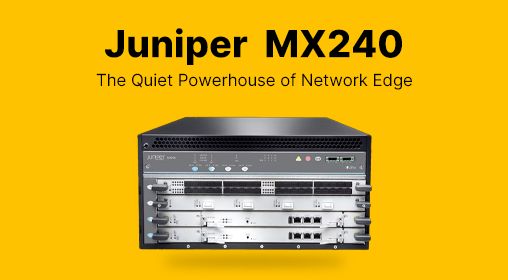
So, what exactly does this workhorse do? Think of the MX240 as a master traffic conductor for the border of large networks. It's the device that sits at the edge of service provider, large enterprise, or data center environments, making critical decisions about where to send vast rivers of data. Its primary roles are diverse and critical: acting as a Broadband Network Gateway (BNG) for subscriber management, aggregating connections from hundreds or thousands of users, serving as a core router for smaller networks, or functioning as a high-capacity edge device for MPLS and VPN services. It's the flexible, scalable foundation that allows networks to grow and adapt without needing a complete overhaul every few years.
The true magic of the MX240 lies under the hood, powered by Juniper's proprietary Trio chipset. This isn't just about raw speed; it's about intelligent processing. The Trio technology enables what Juniper calls "service-rich" routing. This means the router can handle complex tasks like advanced Quality of Service (QoS), stateful firewall policies, Network Address Translation (NAT), and MPLS all running simultaneously at line rate—without breaking a sweat. This is a crucial differentiator, as many routers can route packets quickly but stumble when asked to perform multiple advanced services at once.
Here’s a quick look at its core capabilities:
|
Core Parameter |
Specification |
|---|---|
|
Chassis Form Factor |
5U |
|
System Capacity |
1.92 Tbps |
|
Switch Fabric Capacity per Slot |
480 Gbps |
|
Line Card Slots |
3 |
|
Hardware Redundancy |
Power supplies, Routing Engines, Switch Control Boards (SCBs) |
|
Dimensions (W x H x D) |
17.45 x 8.71 x 27.75 in (44.32 x 22.12 x 70.49 cm) |
|
Power Options |
AC or DC |
The functional toolkit of the MX240 is extensive, running on the robust Junos OS. This operating system is a favorite among network engineers for its consistency and powerful CLI. The platform supports a comprehensive suite of protocols including BGP, OSPF, MPLS, and VPLS. For service providers, its subscriber management capabilities are a key feature, allowing for precise control over user policies and services. The redundancy model is particularly impressive; with components like the Switch Control Boards (SCBs), the system can be configured for either maximum bandwidth or full fabric redundancy, ensuring that a single component failure does not lead to network downtime.
For the engineers who manage it, the MX240 offers a sense of dependable control. The learning curve is smoothed by the logical structure of Junos OS, which many professionals are already familiar with. The ability to automate complex configurations using scripts, Python, and tools like Ansible turns potential operational nightmares into manageable, repeatable tasks. This reliability translates directly to peace of mind; when an MX240 is deployed, it's expected to just work, and it consistently delivers. The craft interface on the front provides clear status updates, and the comprehensive alarm system means potential issues are identified long before they affect service.
When evaluating its value proposition, the MX240 isn't competing on being the cheapest option. Its strength lies in its remarkable scalability and long-term value. The modular design means you don't buy more than you need initially, but you can expand capacity and capabilities by adding new MPC (Modular Port Concentrator) line cards as requirements evolve. This protects the investment for years, if not a decade or more. The combination of this flexibility, the powerful Trio service capabilities, and the proven reliability of Junos OS makes the total cost of ownership highly competitive for organizations that require a robust, future-proof edge platform.
Of course, no platform is perfect for every scenario. Its most significant advantage is its proven scalability and service richness thanks to the Trio chipset. The comprehensive hardware redundancy options make it exceptionally resilient for critical deployments. Furthermore, operating within the mature Junos OS ecosystem provides a stable, automatable environment that network teams trust. On the downside, the 5U chassis height is a consideration for racks where vertical space is at a premium. As a high-performance platform, it is engineered for environments that need its power, meaning the advanced features and initial investment might be overkill for a small office. Finally, to fully leverage its capabilities, engineers benefit from specific Junos expertise, which can be a factor for teams new to the Juniper environment.
In essence, the Juniper MX240 is the definition of industrial-grade networking equipment. It’s the cornerstone you build upon, the silent guardian at the edge of your network that ensures performance, security, and scalability are never compromised. It’s a testament to a design philosophy that prioritizes long-term reliability over short-term trends.