The Heavy Lifter: Unpacking the F5 VPR-LTM-C2400-AC
It usually starts with a question in a high-stakes architecture meeting: "Are we sure the load balancer won't become the bottleneck?" It is a valid fear. In the world of enterprise networking, there is nothing worse than provisioning a massive cluster of web servers, only to have your traffic choked by an underpowered gateway that can't keep up with SSL handshakes. This specific anxiety is exactly where the
F5 VPR-LTM-C2400-AC enters the conversation. It isn't just a piece of hardware; it is a statement of intent. This is a Virtual Platform (VPR) designed to handle the kind of heavy, virtualized workloads that would make a standard appliance sweat. It is built for the data centers that refuse to compromise on throughput or virtualization density.
When you talk about the specific purpose of the C2400-AC, you are talking about consolidation. In the past, you might have needed three or four physical load balancers to handle different environments or to provide redundancy for massive traffic spikes. The VPR series changes that dynamic. It is designed to act as a high-performance Local Traffic Manager (LTM) that can also slice itself into multiple virtual instances. It sits at the edge of your network, terminating SSL connections, inspecting Layer 7 traffic, and intelligently routing requests to the healthiest backend servers. It absorbs the chaos of the internet—DDoS attacks, traffic bursts, and malformed packets—and presents a clean, stable stream of data to your applications.
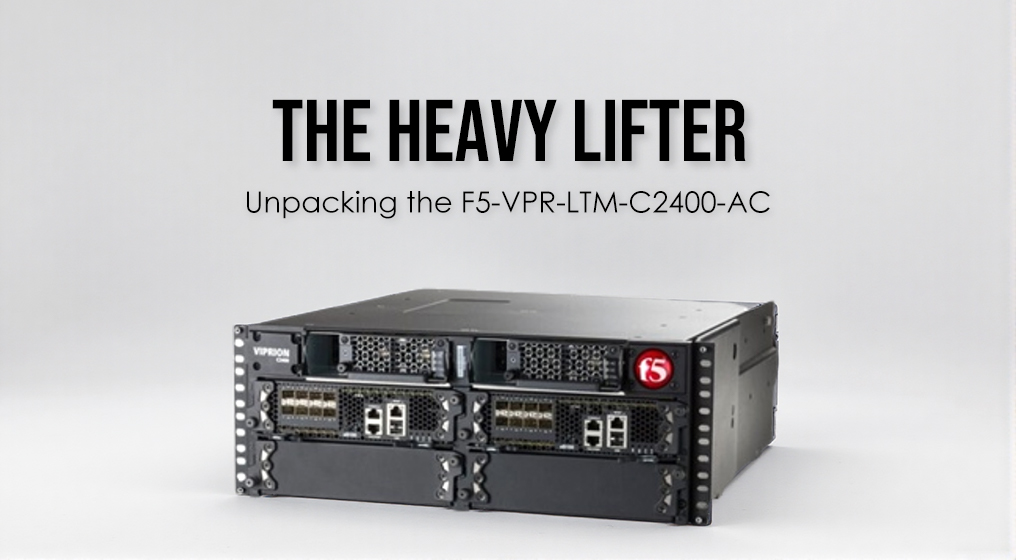
Visually, this machine commands space. Unlike the slim 1U appliances that line the bottom of a server rack, the C2400-AC is a 4U chassis. It stands about 7 inches tall and is quite deep, requiring a full-sized enterprise cabinet. It has an industrial, almost aggressive aesthetic, dominated by a large airflow intake. The front panel is a dense forest of connectivity; typically, you are looking at a configuration populated with 8 10-Gigabit or Gigabit SFP+ fiber ports, though it can support up to 32 depending on the modular setup. It feels substantial—heavy enough that you definitely want a second pair of hands when racking it. The redundant 800W AC power supplies are hot-swappable, located usually at the rear or front depending on the specific airflow SKU, humming with the promise of "five nines" availability.
The user experience of managing this beast is distinctively "F5." It runs on the Traffic Management Operating System (TMOS), which is a powerful, Unix-based architecture. For the uninitiated, the learning curve is a vertical wall. You are presented with a complex hierarchy of objects: Virtual Servers, Pools, Members, Nodes, and Profiles. The web interface (TMUI) is functional but dense, offering a million knobs to turn. However, for a seasoned network engineer, it offers a level of granular control that is incredibly satisfying. You can write custom iRules—scripts that manipulate traffic on the fly—to handle complex routing logic. It feels less like configuring a router and more like programming a network application.
Under the hood, the C2400-AC is a monster. It is powered by an Intel Quad-Core Xeon processor, but thanks to hyperthreading, the system sees 8 logical cores. This processing power is backed by a massive 32GB of RAM, which is critical for maintaining millions of concurrent connections without breaking a sweat. Storage is handled by a 400GB SSD, which ensures that logging and configuration writes are snappy—a significant upgrade over the spinning rust found in older generations.
Here is a snapshot of the raw numbers that define its capability:
| Core Specification |
Detail |
| Processor |
Intel Quad-Core Xeon (8 logical cores via hyperthreading) |
| System Memory |
32GB |
| Storage |
400GB SSD |
| Layer 4 Throughput |
40 Gbps |
| Layer 7 Throughput |
18 Gbps |
| L7 Requests/Sec |
1 Million |
| Max Concurrent Connections |
24 Million |
| SSL TPS (RSA 2K) |
4,000 (up to 10,000 max) |
| Hardware DDoS Protection |
40 Million SYN cookies/sec |
The value proposition of the C2400-AC is tied directly to its virtualization capabilities. It supports vCMP (Virtual Cluster Multi-Processing), which allows you to partition this single physical chassis into up to 8 separate virtual guests (depending on licensing). This means you can replace a rack full of older, smaller load balancers with this single unit. While the upfront hardware cost is significant, the operational expenditure savings—reduced power, cooling, and rack space—can be massive. It is a high-end investment that pays off if you utilize its virtualization features.
Compatibility and ecosystem integration are where F5 generally shines, and this model is no exception. It plays nicely with almost any infrastructure, from legacy mainframes to modern Kubernetes clusters. It supports a vast array of health monitors and integrates seamlessly with the broader F5 ecosystem, including Global Traffic Managers (GTM) for geographic load balancing. The software lifecycle is robust; F5 supports its hardware for many years, providing regular updates to TMOS that patch vulnerabilities and introduce new features. However, be warned: upgrading TMOS on a VPR platform is a serious operation that requires careful planning and maintenance windows.
No device is without its trade-offs. The most obvious downside is the physical footprint. In an era where hardware is shrinking, a 4U chassis is a commitment. It consumes significant power and generates heat, requiring a data center with decent cooling capacity. Furthermore, the complexity of the software can be a double-edged sword; it is easy to misconfigure a virtual instance and starve it of resources if you aren't careful with your resource allocations. But for organizations that need to consolidate their network edge and require massive throughput headroom, the F5 VPR-LTM-C2400-AC is a powerhouse that turns the "bottleneck" fear into a thing of the past.