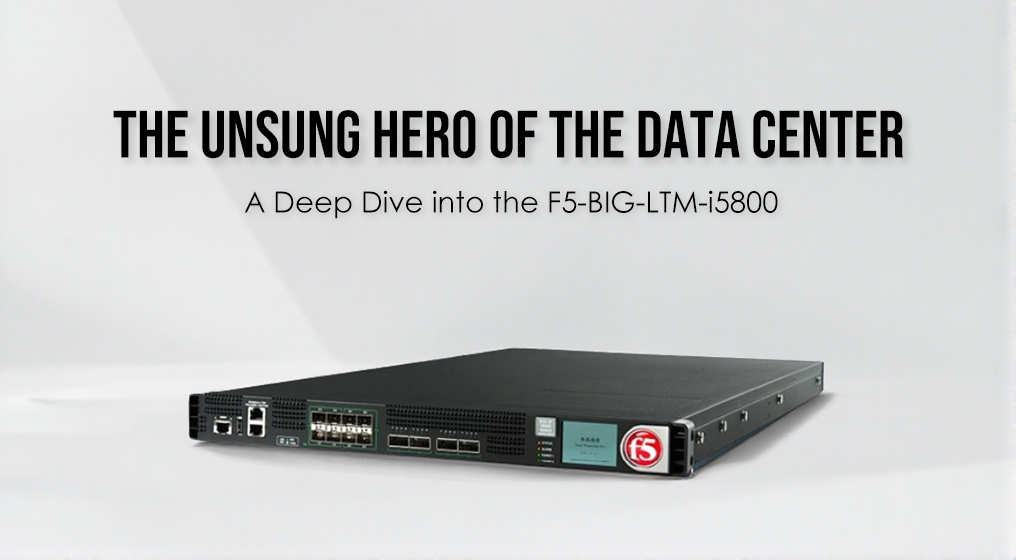
The Unsung Hero of the Data Center: A Deep Dive into the F5 BIG-LTM-i5800
You know that specific type of panic that sets in when a critical application starts timing out, but the servers themselves show green lights? It is the classic bottleneck mystery. Network engineers often find themselves asking why a perfectly capable cluster of web servers is choking under load while the network pipe seems wide open. The answer usually lies in how traffic is managed, not just how it is routed. This is where the conversation inevitably turns to the
F5 BIG-LTM-i5800. It is not just a piece of hardware; it is the traffic cop that decides whether a user gets a seamless experience or a "404 Not Found" error.
Before diving into the physical chassis, it is crucial to understand what makes this machine tick. Unlike standard routers that blindly forward packets, the i5800 acts as a full proxy, deeply inspecting traffic to ensure the backend has the resources to handle the request. Here is a snapshot of the raw power sitting inside that 1U chassis:
| Core Specification |
Detail |
| Processor |
4-core Intel Xeon (8 hyperthreaded logical cores) |
| System Memory |
48GB DDR4 |
| Storage |
480GB Enterprise SSD |
| Layer 4 Throughput |
60 Gbps |
| Layer 7 Throughput |
35 Gbps |
| L7 Requests/Sec |
1.8 Million |
| Max Concurrent Connections |
40 Million (L4) |
| SSL TPS (RSA 2K) |
35,000 TPS |
Physically, the i5800 cuts a distinct figure in the server rack. It measures roughly 1.72 inches in height and 30.6 inches deep, weighing in at about 26 pounds. It has a solid, industrial feel that suggests durability. The front panel is utilitarian, dominated by the port interfaces. Depending on the specific configuration ordered, you will typically see a dense array of SFP and SFP+ slots ready for fiber optics, or copper ports for standard ethernet. The cooling is handled by redundant fans that are surprisingly quiet for a device of this class, though they do hum with the distinct sound of forced air when the system is under heavy load.
The user experience of managing an F5 device is a journey in itself. For a junior admin, the learning curve can feel like a vertical wall. The interface, known as the Traffic Management User Interface (TMUI), is web-based and incredibly granular. It does not hold your hand. You are presented with a vast hierarchy of objects—pools, members, nodes, virtual servers, and profiles. However, once you get past the initial intimidation, the control it offers is unparalleled. You can visualize traffic flows in real-time and drill down into specific connections. It feels less like using a consumer gadget and more like piloting a complex aircraft; every switch and dial has a specific, critical purpose.
One of the strongest arguments for the i5800 is its compatibility and ecosystem integration. It plays nicely with almost everything. Whether you are running legacy mainframes or modern containerized microservices in a Kubernetes cluster, the i5800 can sit in front of them and manage the ingress traffic. It supports a wide range of health monitors, from simple ICMP pings to complex scripts that log into an SMTP server to verify it is actually sending mail. It integrates into the broader F5 ecosystem, allowing it to pair with Global Traffic Managers (GTM) for geographic load balancing, ensuring that if an entire data center goes dark, traffic is rerouted to a site in another region seamlessly.
However, no piece of hardware is without its flaws. The most glaring downside is the cost of entry and the complexity of licensing. F5 operates on a model where features are often gated behind specific licenses. You might buy the powerful hardware, only to realize you need to purchase an additional license to unlock the full potential of the compression modules or advanced DDoS protection. Furthermore, the "vCMP" virtualization capability allows you to partition this single physical box into multiple virtual instances (up to 8 guests on this model), but configuring these partitions requires a deep understanding of the underlying architecture.
From a lifecycle perspective, the i5800 runs on TMOS, F5's proprietary operating system. The software support is generally excellent, with regular updates that patch vulnerabilities and introduce new features. However, upgrades can be nerve-wracking events. Because the system is so deeply integrated into the network fabric, a failed upgrade can mean total downtime. The community support is robust, with a vast repository of "iRules"—custom scripts that allow you to manipulate traffic in creative ways. This extensibility is a double-edged sword; it allows for infinite customization but can lead to "spaghetti code" environments that are hard to troubleshoot if the original engineer leaves.
Ultimately, the value proposition of the F5 BIG-LTM-i5800 comes down to risk management. It is an expensive piece of kit, and for a small business, it is likely overkill. But for an enterprise where five minutes of downtime costs more than the hardware itself, the i5800 is an insurance policy. It absorbs the shocks of traffic spikes, mitigates DDoS attacks with its hardware-based SYN cookie protection, and ensures that the user experience remains smooth even when the backend is struggling. It is a complex, powerful, and sometimes frustrating device, but when it works—as it does 99.9% of the time—it is invisible, which is exactly what you want.