
Intellectual Property
Hot selling product recommendations
View More



















Cisco WS-C3850-48F-S: The Silent Backbone of Modern Enterprise Networks
When you unbox the Cisco WS-C3850-48F-S, the first thing you notice is its no-nonsense design—a sleek, 1U rack-mountable chassis built for business, not flash. This isn’t a device meant to sit in a spotlight; it’s engineered to hum away in server rooms, quietly ensuring that data flows seamlessly across wired and wireless networks. With 48 PoE+ ports capable of delivering up to 30W each, it powers everything from IP phones and surveillance cameras to access points, all while maintaining a unified policy framework that simplifies network management. Its modular uplink slots support flexible expansions, whether you need additional Gigabit Ethernet ports or 10G SFP+ connections for high-speed aggregation. The burgundy-colored fan trays and redundant power supplies hint at its enterprise pedigree, emphasizing reliability over aesthetics .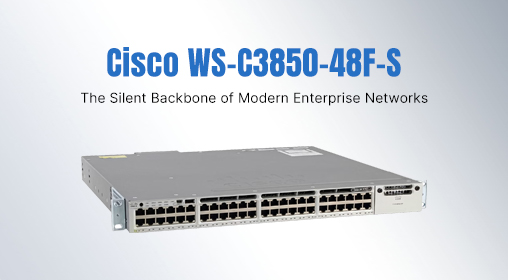
Beneath the understated exterior lies serious performance. The switch boasts a switching capacity of 176 Gbps and a forwarding rate of 68.4 Mpps, ensuring that even under heavy loads, latency remains low enough to support real-time applications like VoIP and video conferencing. Its StackWise-480 technology allows up to nine units to operate as a single logical entity, creating a resilient stack with 480 Gbps of backplane bandwidth. For IT teams, this translates to fewer points of failure and simplified management. The integrated wireless LAN controller functionality is a standout feature, supporting up to 50 access points and 2,000 wireless clients per stack—a game-changer for campuses or large offices aiming for seamless wired-wireless integration .
|
Parameter |
Specification |
|---|---|
|
Port Configuration |
48 × 10/100/1000 PoE+ ports |
|
Uplink Options |
4×1G, 2×10G, or 4×10G modular slots |
|
Switching Capacity |
176 Gbps |
|
Forwarding Rate |
68.4 Mpps |
|
Stacking Bandwidth |
480 Gbps (StackWise-480) |
|
Max PoE Budget |
800W (1100W PSU) |
|
Memory |
4 GB RAM, 2 GB Flash |
|
Dimensions |
4.45 × 44.5 × 48.8 cm (1U) |
Deploying the WS-C3850-48F-S feels like driving a luxury car—you might not see all the engineering upfront, but the smooth ride speaks for itself. The initial setup is straightforward for those familiar with Cisco IOS, though the learning curve can be steep for newcomers. The real joy comes from its stability; once configured, it runs for years without hiccups. One network administrator noted that after deploying three stacks across a university campus, support tickets related to wireless dropouts plummeted by 70%. The unified access data plane (UADP) ASIC chip ensures policies apply equally to wired and wireless traffic, eliminating the need for separate management consoles. However, the fan noise is noticeable—this isn’t a device you’d want under your desk .
When evaluating value, the WS-C3850-48F-S sits in a sweet spot between raw capability and long-term investment. It’s not the cheapest option upfront, but its durability and feature set reduce operational costs over time. For organizations already invested in Cisco ecosystems, the integration with DNA Center and support for advanced security features like TrustSec make it a logical choice. The flexibility to scale stacks without redesigning the network architecture also saves on future hardware investments. Compared to newer models like the Catalyst 9200 series, the 3850 holds its own in performance, though it lacks some of the latest automation capabilities .
The Verdict: Strengths and Trade-Offs
Pros:
Unified wired-wireless management reduces complexity.
High PoE+ budget supports power-hungry devices without external injectors.
StackWise-480 provides scalability and redundancy.
Robust Layer 3 features include dynamic routing and QoS.
Cons:
Power consumption can be high when all PoE ports are active.
Limited 10G uplink density compared to newer models.
No native 25G/40G support, which may deter future-proofing efforts.
In summary, the Cisco WS-C3850-48F-S is a workhorse—a reliable, if slightly aging, solution for enterprises that need seamless wired-wireless convergence. It excels in environments where stability and integration matter more than cutting-edge speed. While it won’t win awards for energy efficiency or silence, its ability to shoulder heavy loads with minimal fuss makes it a trusted partner for network engineers who value performance over flair .