
Intellectual Property
Hot selling product recommendations
View More



















Cisco's A9K-MOD400-TR: The Backbone of Modern Packet Transport
Walking into a data center and seeing the distinctive chassis of an ASR 9000 series router, you know you're looking at the core of a high-performance network. The A9K-MOD400-TR line card is a specific component that slots into this ecosystem, designed for one primary purpose: handling massive amounts of data traffic with relentless efficiency. It’s not a flashy consumer gadget; it’s a workhorse engineered for the demanding environments of service providers and large enterprises where packet transport is king. This modular line card focuses on moving data packets as swiftly and reliably as possible, making it ideal for aggregation roles and core network functions where complex quality-of-service (QoS) policies are less critical than raw, dependable throughput .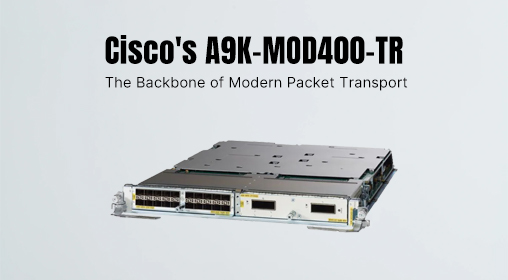
Physically, the card embodies the robust, no-nonsense design you'd expect from enterprise-grade hardware. It's a substantial piece of equipment, weighing in at nearly 21 pounds (about 9.5 kilograms), with dimensions that ensure a solid fit within the router chassis . The front panel is where the magic happens, featuring two bays for Modular Port Adapters (MPAs). This is the key to its flexibility. Instead of having fixed ports, you pop in MPAs to create the exact interface configuration you need—whether that's 100 Gigabit Ethernet, 40 Gigabit Ethernet, or a dense array of 10 Gigabit Ethernet ports . The card is designed for continuous operation, built to withstand the heat and electrical demands of a always-on network environment, meeting a long list of international safety and interference standards .
Under the hood, the performance specs are what make it a cornerstone for modern infrastructure. Its key parameters are best understood at a glance:
|
Core Parameter |
Specification |
|---|---|
|
Total Slot Bandwidth |
Up to 400 Gbps (aggregate) |
|
MPA (Modular Port Adapter) Bays |
2 |
|
Optimization Profile |
Packet Transport Optimized (TR) |
|
Compatible Router Chassis |
ASR 9006, ASR 9010, ASR 9904, ASR 9906, ASR 9910, ASR 9912, ASR 9922 |
|
Operating System |
Cisco IOS XR |
|
Key Supported Services |
MPLS, L2/L3 VPNs, QoS (Basic) |
From an operator's perspective, working with the A9K-MOD400-TR is a study in flexibility and operational consistency. The initial setup is straightforward if you're already familiar with the Cisco IOS XR environment. The command-line interface is powerful, and the modularity is the biggest win. Need to reconfigure your port densities? You don't replace the entire card; you just swap out the MPAs. This modularity protects your investment and drastically reduces operational overhead when scaling capacity or adapting to new network designs . The card's Packet Transport Optimization means it's fine-tuned for basic QoS, which translates to predictable, low-latency forwarding—exactly what you want for high-volume data flows without the need for deep packet inspection or complex service policies . The real-world experience is defined by stability; once integrated, these cards are known to run for years, silently processing terabytes of traffic without a hiccup.
When evaluating its value, the A9K-MOD400-TR sits in a strategic spot. It offers a significant step up in capacity from older or smaller cards like the A9K-MOD200, without venturing into the premium cost territory of the highest-end options like a hypothetical MOD600 . Its true economic advantage lies in its modular architecture. By allowing network architects to mix and match MPAs, it future-proofs the investment and provides incredible adaptability for changing network traffic patterns. This modularity can lead to significant capital expenditure savings over time, as upgrading port types doesn't require a full line card replacement . Furthermore, its design emphasizes energy efficiency, which contributes to lower operational costs in power-hungry data center environments .
However, no piece of hardware is perfect, and the A9K-MOD400-TR has its considerations. The most notable advantage is its scalability and flexibility. The two MPA bays are a game-changer for network design, allowing for a custom mix of 100G, 40G, and 10G interfaces to meet exact needs . This is coupled with the proven reliability of the ASR 9000 platform and the seamless integration with the powerful Cisco IOS XR operating system, which provides a consistent and automatable operational experience . The 400G bandwidth provides substantial headroom for growing network demands .
On the downside, the Packet Transport Optimized (TR) profile means it is equipped with basic QoS capabilities. This is a deliberate trade-off, making it less suited for complex service edge applications that require advanced traffic policing, deep buffering, or hierarchical QoS policies . Another point to consider is that to actually use the card, you must purchase MPAs separately. The initial investment for the base card is just the beginning, and the total cost can vary significantly based on the type and quantity of MPAs needed to populate it . Finally, as a piece of specialized hardware, it requires network engineers with specific expertise in Cisco's IOS XR to fully unlock its potential, which can add to training and staffing costs.
In essence, the Cisco A9K-MOD400-TR is a specialist. It excels in its designed role as a high-capacity, flexible, and reliable packet transport engine. For building scalable network aggregation layers and high-throughput backbones, it represents a balanced and shrewd investment. However, for deployments where advanced service policies are a requirement, or for organizations unprepared for the additional investment in MPAs and specialized expertise, its advantages may not be fully realized. It's the kind of component that forms the reliable, high-capacity backbone of the internet, working tirelessly behind the scenes.