
Intellectual Property
Hot selling product recommendations
View More



















The Silent Powerhouse: Unpacking the Cisco Nexus 9232C Switch
Walking into a modern data center, the hum is a given. But the real action is in the silent, rapid-fire conversations happening between servers, and that’s where a switch like the Cisco Nexus 9232C earns its keep. Think of it not just as a box with blinking lights, but as the central nervous system for a high-performance computing environment. It’s the piece of hardware that manages the incredible, non-stop flow of data that powers everything from your favorite streaming service to complex cloud applications. This particular model is engineered for a specific role: to be the spine that holds a large-scale network together, moving massive chunks of information with both speed and remarkable reliability .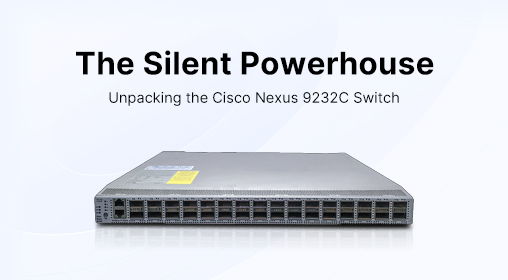
At its core, the 9232C is a layer 3 fiber switch, which is a technical way of saying it's a master traffic controller for the heart of the network. Its job is to make intelligent decisions about where to send data packets, ensuring they take the fastest and most efficient route possible. This isn't for a small office; it's built for the demanding environment of a data center spine or a high-capacity aggregation layer, where performance and uptime are non-negotiable. Here’s a quick look at what makes it tick under the hood :
|
Core Parameter |
Specification |
|---|---|
|
Port Configuration |
32 x 40/100G QSFP28 ports + 2 x 10G SFP+ ports |
|
Backplane Bandwidth |
7.2 Tbps |
|
Forwarding Rate |
2.8 Bpps |
|
Form Factor |
1 Rack Unit (1RU) |
These numbers translate to raw capability. A backplane bandwidth of 7200 Gbps means it has an enormous internal highway for data, while a packet forwarding rate of 2.8 billion packets per second (Bpps) shows just how quickly it can process the traffic on that highway. This combination ensures that even when every server is talking at once, there's no traffic jam .
Visually, the switch adheres to a classic, functional data center aesthetic. It’s designed for a standard 19-inch rack, taking up just a single unit of vertical space (1RU), which is a big plus for density-conscious data center managers. This compact design means you can pack a lot of networking power into a small footprint. The build is robust, weighing in at around 11.4 kg, reflecting its solid construction. From the front, you're greeted by the array of QSFP28 ports—ready for high-speed fiber connections—and status indicators that provide a quick visual health check of the system .
Functionality is where the 9232C truly shines. It runs on Cisco's NX-OS, a robust operating system built for the data center, offering features like advanced routing protocol support and sophisticated traffic management. A key feature for scalability is its stackability, allowing multiple physical switches to be managed as a single logical entity. This simplifies the network and makes expanding capacity a much smoother process. It's worth noting that while incredibly powerful, it operates as a triple-speed switch, and some advanced features like VLAN segmentation might be handled differently depending on the specific software mode (NX-OS vs. ACI) it's deployed in .
From a user's perspective, typically a network architect or administrator, the appeal lies in predictable performance and peace of mind. The massive throughput eliminates bottlenecks, making network congestion a problem of the past. The programmability and automation capabilities of NX-OS are a significant benefit, allowing for infrastructure-as-code practices that reduce manual configuration errors and speed up deployment times. For teams managing large, virtualized environments or private clouds, this switch provides a rock-solid foundation that can be automated and integrated into modern DevOps workflows. The learning curve for mastering all of NX-OS's advanced features can be steep, but for those who do, it offers deep control over the network .
When evaluating its value, the 9232C sits in a category where the initial acquisition price is just one part of the equation. Its real worth is measured in total cost of ownership over years of service. Its high port density and 40/100G capability provide a long lifecycle, protecting investments against the rapid evolution of data needs. The legendary reliability of Cisco's flagship hardware translates to less downtime, and in a data center, downtime is exponentially more expensive than any piece of hardware. When you factor in energy efficiency—a critical metric for any large-scale operation—and the potential savings from its compact 1RU form factor, the switch presents a compelling case for organizations where network performance is directly tied to business outcomes .
Of course, no piece of technology is without its trade-offs. The primary advantage is its raw, uncompromising performance and the rich feature set of NX-OS, making it ideal for core data center duties. Its stackability and the trusted Cisco ecosystem for support are major positives. On the flip side, the sheer complexity of its capabilities can be overwhelming for smaller teams without specialized Cisco expertise. The power and cooling requirements for a device of this caliber are substantial, and it is unequivocally overkill for any environment that doesn't genuinely need 100G speeds. It's a precision tool for a specific job, not a one-size-fits-all solution .
In the end, the Cisco Nexus 9232C is more than just a switch; it's a commitment to building a network backbone that won't buckle under pressure. It’s the right choice for those who need to move data fast, reliably, and at a scale that most can only imagine.