
Intellectual Property
Hot selling product recommendations
View More



















Walking into a server room or a network closet, you might not immediately notice the Cisco Catalyst C9300L-48P-4G-E switch. It's not designed for flashy appearances but rather for silent, relentless efficiency. This unassuming piece of hardware serves as the critical nexus where digital conversations converge—a perfect blend of form and function that keeps organizations connected without demanding attention. What makes this switch indispensable is how it balances substantial power delivery with robust security features, all while maintaining straightforward operation that network administrators appreciate during those long maintenance windows.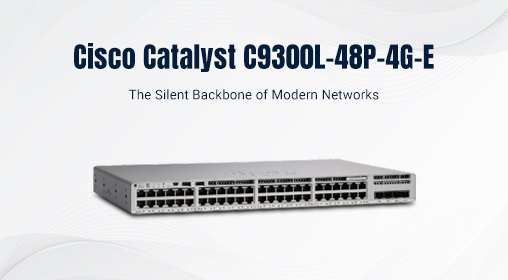
Imagine a typical Monday morning when employees arrive at the office: phones power up, wireless access points connect laptops, and security cameras stream footage—all simultaneously. The C9300L-48P-4G-E handles this digital awakening effortlessly thanks to its forty-eight Power over Ethernet Plus (PoE+) ports, each capable of delivering up to 30W to connected devices. This eliminates the need for separate power adapters for IP phones, cameras, and access points, significantly reducing cable clutter and simplifying installations. Beyond these access ports, four dedicated 1G SFP uplink ports ensure reliable backhaul connectivity to core network infrastructure, preventing bottlenecks even during peak usage. The switch operates as a full Layer 3 device, making intelligent routing decisions internally rather than pushing traffic upstream unnecessarily. With a 370W PoE budget, it can support high-density deployments without breaking a sweat, from modern offices packed with IoT devices to industrial settings requiring reliable connectivity for operational technology. It's this versatility that makes the switch equally at home in healthcare facilities powering medical devices, university campuses connecting lecture halls, or retail environments supporting point-of-sale systems and digital signage. The built-in Cisco StackWise technology allows multiple switches to operate as a single logical unit, simplifying management and creating resilient architectures where one unit can temporarily shoulder the load if another fails.
|
Parameter |
Specification |
|---|---|
|
Port Configuration |
48x 10/100/1000BASE-T PoE+ ports, 4x 1G SFP uplinks |
|
PoE Capability |
IEEE 802.3at PoE+ (30W per port), 370W total budget |
|
Switching Capacity |
104 Gbps |
|
Forwarding Rate |
77 Mpps |
|
Power Supply |
715W AC |
|
Dimensions |
1.73 x 17.5 x 16.1 inches |
|
Operating Temperature |
-5°C to 45°C |
|
Memory |
8 GB RAM, 16 GB flash |
Security isn't an afterthought with this Catalyst switch—it's woven throughout its operation. Encryption traffic analysis capabilities work behind the scenes to identify potential threats without even decrypting packets, while standard features like 802.1X authentication create secure network access controls. The switch supports dynamic ARP inspection, DHCP snooping, and IP source guard to prevent spoofing attacks, creating multiple layers of defense that protect the entire network ecosystem. These security measures operate transparently, ensuring that employees can work uninterrupted while the switch quietly monitors for anomalies. Advanced features like Cisco's StackPower technology enable intelligent power management across connected switches, providing redundancy that keeps critical systems online even during power events. Network administrators appreciate the consistency between physical units, as the uniform exterior dimensions and mounting points make installation predictable. The initial setup experience reflects Cisco's enterprise heritage, with multiple management options available including traditional CLI for veterans and web-based interfaces for those preferring graphical tools. While it doesn't include the AI-driven management features of newer models, the reliability and proven functionality make it a workhorse for IT teams.
Where this switch truly shines is in its day-to-day reliability. The solid metal housing dissipates heat effectively, with fans that maintain near-silent operation under normal loads. Those who work near these switches appreciate how they fade into the background, both audibly and visually. From a total cost of ownership perspective, the energy-efficient design translates to measurable savings over time, with the power supply achieving 80% efficiency. The enhanced limited lifetime warranty provides peace of mind, though in practice these switches often outlast their service commitments.
The balanced approach does involve some compromises. The 1G uplink ports may feel constraining for organizations transitioning to multi-gigabit internal networks, and the lack of native 10G uplinks means this switch isn't suited for aggregation roles. Compared to newer models, the PoE budget per port falls short of the latest 60W PoE++ standards, which could limit power delivery to future high-demand devices. The management interface, while comprehensive, lacks the AI-assisted analytics that some newer competing platforms offer.
Despite these limitations, the C9300L-48P-4G-E represents a thoughtful balance of capabilities for real-world scenarios. It delivers exactly what most organizations need for edge connectivity without overcomplicating deployments. The true value emerges when you consider the complete picture—not just the purchase price but the years of reliable service with minimal intervention required. While newer models promise higher specifications, this switch hits a performance plateau that satisfies current needs while offering proven stability that's sometimes preferable to bleeding-edge alternatives.
There's something to be said for a network component that does its job so effectively that it becomes invisible to both users and administrators. The C9300L-48P-4G-E embodies this principle, serving as the silent backbone that supports modern digital workplaces. It may not have the flashiest specifications sheet compared to emerging alternatives, but its reliability under pressure and thoughtful implementation of critical features make it a trustworthy foundation for organizations that depend on their network as a utility rather than an experiment. In an era of constant technological churn, sometimes the best technology is the kind you can install, configure, and then forget about for years—and by that measure, this switch delivers admirably.