
Intellectual Property
Hot selling product recommendations
View More



















The Resilient Workhorse: Revisiting the Cisco Catalyst 3750X Switch
There's a certain class of networking gear that never seems to get the spotlight but forms the unshakeable foundation of countless offices and campuses. The Cisco WS-C3750X-48P-S is precisely that—a stalwart device designed for environments where connectivity must be as reliable as gravity. This isn't a flashy, next-generation platform; it's the proven engine for core network operations, built to deliver both data and power to a small army of devices without fuss .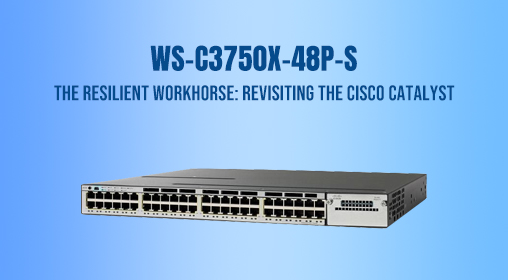
Imagine the bustling wiring closet of a medium-sized business or a school. The air might be warm, and space is always at a premium. The Catalyst 3750X slides into this world perfectly. Its 48 Power over Ethernet Plus (PoE+) ports are the main attraction, allowing a single cable to an IP phone, a wireless access point, or a security camera to carry both the network connection and the electricity needed to run it. This eliminates the tangled web of power adapters and simplifies deployments immensely . It’s a Layer 3 switch, meaning it can handle intelligent routing between different network segments (like between the finance and marketing departments), not just basic data forwarding .
Where this switch truly shows its engineering is under the hood. The numbers tell a story of deliberate, robust performance meant to handle dense network traffic without breaking a sweat .
|
Parameter Category |
Specification |
|---|---|
|
Total Ports |
48 x Gigabit Ethernet (10/100/1000) PoE+ |
|
Uplink Options |
Flexible slot for optional modules (4x1G SFP or 2x10G SFP+) |
|
Switching Bandwidth |
160 Gbps |
|
Packet Forwarding Rate |
101.2 Mpps (Million packets per second) |
|
Power Supply |
715W AC (default), with support for a redundant second power supply |
|
Max PoE Budget |
Up to 435W, delivering up to 30W per port (IEEE 802.3at) |
|
MAC Address Table |
4,000 entries |
|
VLAN Support |
Up to 4,000 VLANs |
|
Dimensions (HxWxD) |
44.5 x 445 x 460 mm (1 RU height) |
Physically, the 3750X has a purposeful, industrial aesthetic. It's built into a standard 1RU (rack unit) metal chassis that feels solid and durable. The front panel is a study in organization: 48 RJ45 ports are neatly aligned, with status LEDs providing a clear visual health check. A key feature is the modular bay at the front, which accepts various uplink modules, allowing you to tailor the switch to your network's backbone connection needs—whether that's gigabit fiber or 10-gigabit uplinks for bandwidth-hungry applications . The inclusion of redundant, hot-swappable power and fan modules is a telltale sign of its enterprise pedigree, aimed at maximizing uptime .
The feature set is where the 3750X transitions from a simple connector to an intelligent network manager. Cisco's StackWise Plus technology is its party trick. This allows you to interconnect up to nine individual 3750X switches and have them operate as a single, logical unit. This simplifies management enormously—instead of configuring nine separate devices, you manage one. It also creates a resilient ring; if the cable between two stack members fails, the system automatically reroutes data to keep the network running . Adding advanced quality of service (QoS) policies ensures that critical traffic like voice or video calls gets priority, preventing jerky performance. For security, it offers MACsec encryption at the port level, which can safeguard data as it travels over the wire between switches .
From an administrator's chair, the experience is one of dependable predictability. The initial setup can be done via a command-line interface (CLI) that will be familiar to any network professional, or through a web-based GUI for those who prefer a visual approach. Once configured, the switch tends to just… work. Its mean time between failures (MTBF) is rated highly, often exceeding 100,000 hours, which translates to years of continuous operation . The silent, fanless operation in many modes is a subtle but appreciated benefit, especially when the switch is located near workspaces. The real satisfaction comes during expansion; adding a new access point is as simple as plugging it into a PoE+ port and watching it power up, with no need for an electrician.
When evaluating its value proposition, the 3750X isn't about being the cheapest option on the market. Its value lies in the total cost of ownership over a long period. You're investing in rock-solid reliability, the flexibility of PoE+ across all ports, and the operational simplicity of stacking. For an organization looking to build a stable, scalable network infrastructure without the constant fear of downtime, the 3750X represents a wise, long-term investment. It consolidates functionality that might otherwise require multiple devices, saving on both space and ongoing management overhead .
Of course, no piece of technology is without its trade-offs.
The strengths of the Catalyst 3750X are significant. Its PoE+ capability is comprehensive, its performance is more than adequate for gigabit access layer duties, and the stacking functionality is a genuine game-changer for scalability and management. The hardware design, with its focus on redundancy, is built for the long haul.
The limitations are equally clear. As a fixed-configuration switch, you are limited to 48 ports. If you need more, you must stack another unit. While powerful, its architecture is from an era before multi-gigabit Ethernet was common, so it can't deliver speeds above 1Gbps on its copper ports. In today's context, some might view its power consumption as higher than that of newer, more efficient models.
In summary, the Cisco WS-C3750X-48P-S is a testament to a design philosophy that prioritizes resilience and operational simplicity above all else. It may not have the bleeding-edge specs of the latest models, but it offers something perhaps more valuable: proven, steadfast performance. It's the network equivalent of a trusted, hardworking colleague who consistently gets the job done, year after year.