When the Dashboard Lies: Confronting the Reality of the A10 Thunder 6630 in Carrier Networks
There is a specific moment of panic that every network engineer who has deployed the
A10 Thunder 6630 recognizes. It happens when the traffic graph on your main dashboard shows a sudden, jagged drop to zero, yet the green status LEDs on the front panel remain stubbornly lit. You rush to the console, expecting a hardware failure, only to find the system is up, the interfaces are linked, but the data plane has silently stalled while the control plane chatters away happily. This disconnect between what the management interface reports and what the wire sees is one of the most discussed quirks of this platform, often stemming from complex interactions between the multi-core packet processing engine and specific SSL offloading configurations under extreme load. It’s not a bug that happens every day, but when it does, it forces you to question everything you thought you knew about your redundancy setup. Yet, despite these occasional heart-stopping moments, the
Thunder 6630 remains a cornerstone in some of the world’s busiest telecommunications and cloud provider networks, a paradox that deserves a closer look.
This machine is not designed for the average enterprise closet; it is built for the core. The
Thunder 6630 serves as a high-density Application Delivery Controller (ADC) and a massive scale load balancer, specifically engineered to sit at the edge of carrier-grade networks or within hyperscale data centers. Its primary job is to manage the flood of traffic for millions of concurrent users, handling everything from simple Layer 4 TCP distribution to complex Layer 7 content switching, global server load balancing (GSLB), and heavy-duty SSL/TLS decryption. If you are running a 5G core network, a massive video streaming platform, or a financial exchange where microseconds matter, this is the type of metal you put in the rack. It acts as the traffic cop that ensures no single server farm gets overwhelmed while keeping encryption overhead from choking your backend application servers.
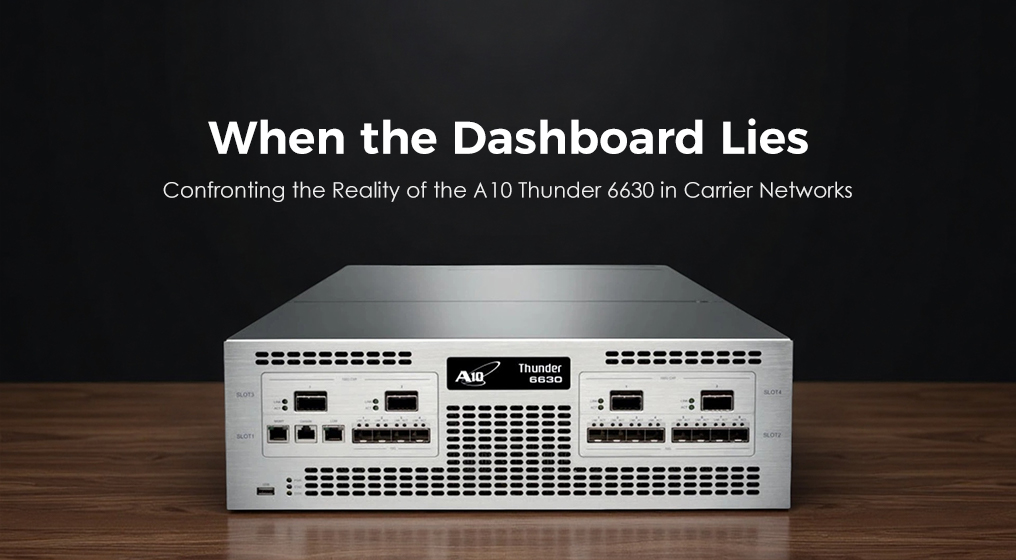
Physically, the 6630 commands respect. It is a dense, 2U chassis that feels significantly heavier than your standard 1U appliance, signaling the substantial heat sinks and power supplies hidden inside. The front panel is dominated by two large, hot-swappable fan trays that spin with a noticeable hum, a sound that says “I am working hard” rather than “I am about to fail.” Unlike the modular slot-based designs of some competitors, the 6630 often comes with a fixed but incredibly dense port configuration, typically featuring a mix of forty-eight 10GbE SFP+ ports and several 40GbE or 100GbE QSFP28 uplinks. This density allows you to consolidate what used to be three or four racks of gear into a single unit. The cable management can be a nightmare if you aren’t careful, as filling all those ports creates a solid wall of fiber that blocks airflow if not routed perfectly, a lesson many learn the hard way during initial installation.
When we talk about performance, the numbers on the spec sheet are almost abstract until you see them in action. The 6630 leverages A10’s proprietary ACOS architecture, which uses a shared-memory, multi-core design to process packets in parallel. This isn’t just marketing fluff; it means that as traffic spikes, the system distributes the load across all available cores dynamically, preventing the “one hot core” bottleneck that plagues older single-threaded architectures. The SSL performance is particularly staggering, capable of handling hundreds of thousands of transactions per second without breaking a sweat. However, the user experience here is nuanced. While the throughput is incredible, tuning the system to achieve those peak numbers requires a deep understanding of how ACOS handles connection tables and memory buffers. Default settings often leave significant performance on the table, and unlocking the full potential requires diving into CLI commands that feel more like assembly language than modern configuration scripts.
| Core Specification |
A10 Thunder 6630 Capability |
| Max Layer 4 Throughput |
Up to 640 Gbps |
| Max SSL TPS (2K keys) |
Up to 1.2 Million TPS |
| Max Concurrent Connections |
Up to 1.2 Billion |
| New Connections Per Second |
Up to 4.8 Million CPS |
| Form Factor |
2U Rack Mount |
| Interface Density |
Up to 48x 10GbE + 4x 40/100GbE |
| Power Supply |
Dual or Quad Redundant Hot-Swappable AC/DC |
| Architecture |
Multi-core Shared Memory ACOS |
| Virtualization |
Supports vThunder instances |
| DDoS Protection |
Integrated Layer 3-7 mitigation |
Functionally, the feature set is vast, bordering on overwhelming. Beyond standard load balancing, the 6630 includes robust DDoS protection capabilities that can scrub volumetric attacks directly at the ingress point, saving you from needing an external cleaning service for all but the largest assaults. The GSLB features allow you to steer traffic across different geographic data centers based on latency, site health, or even custom business logic written in aFlex, A10’s scripting language. This scripting capability is a double-edged sword; it offers infinite flexibility to customize traffic handling in ways other vendors simply don’t allow, but it also introduces complexity. A poorly written script can consume excessive CPU cycles, leading to the very performance stalls mentioned earlier. The management ecosystem includes a web GUI that has improved over the years, offering better visualization of traffic heat maps and real-time analytics, but serious administrators still live in the CLI, where the true granularity of control exists.
From a user experience perspective, operating the 6630 feels like driving a Formula 1 car. It is incredibly fast and powerful, but it demands your full attention and expertise. You cannot just plug it in and walk away. The learning curve is steep, especially for teams accustomed to the more guided, wizard-driven interfaces of competitors like F5 or Citrix. Troubleshooting requires a methodical approach, digging through detailed logs and using specialized debug commands to trace packet flows through the multi-core engine. When things work, the experience is euphoric; the device handles traffic surges that would crash other systems without a blip on the radar. But when things go wrong, the lack of hand-holding in the documentation can make resolution feel like an archaeological dig. The community support is knowledgeable but smaller, meaning you might not find a quick forum post for your specific edge case, forcing you to rely on TAC, whose response quality can vary depending on the severity of your contract.
Regarding value and cost-efficiency, the 6630 occupies a unique position. It is undeniably expensive, placing it out of reach for small to mid-sized businesses. However, when you calculate the price per gigabit of SSL throughput or the cost per million concurrent connections, it often undercuts the competition significantly. For a carrier moving terabits of data, the ability to consolidate multiple chassis into a single 6630 reduces power consumption, cooling requirements, and rack space, leading to substantial operational savings over a three-to-five-year lifecycle. The licensing model is generally more straightforward than some rivals, bundling many advanced features like DDoS protection and comprehensive analytics into the base platform rather than nickel-and-diming for every extra capability. This makes the total cost of ownership attractive for large-scale deployments, provided you have the staff expertise to manage it.
The advantages of the Thunder 6630 are clear: raw, unmatched performance density, flexible scripting for custom logic, and integrated security features that reduce the need for additional appliances. Its ability to handle massive scale while maintaining low latency is best-in-class. However, the drawbacks are equally significant. The complexity of the ACOS operating system creates a high barrier to entry, leading to a shortage of qualified administrators in the job market. The aforementioned occasional control-plane versus data-plane desynchronization issues, while rare, can be catastrophic if not mitigated by rigorous high-availability testing. Furthermore, the hardware’s density generates significant heat and noise, requiring specialized data center environments that can handle the thermal load. The upgrade paths for major OS versions can also be disruptive, often requiring maintenance windows that are hard to schedule in 24/7 environments.
In the end, the A10 Thunder 6630 is not a device for everyone. It is a specialist tool for specialists. If your organization needs a simple, set-and-forget load balancer for a few web servers, this machine is overkill and likely a source of unnecessary frustration. But if you are building the backbone of a national telecom network or managing the infrastructure for a global cloud provider, the 6630 offers a level of power and efficiency that is hard to replicate. The key to success lies in respecting its complexity, investing heavily in training your team, and designing your architecture with the understanding that this engine requires a skilled pilot to navigate its immense power safely. The silence of a stable 6630 under full load is a testament to engineering brilliance, but it’s a silence earned through vigilance, not ignorance.