The Silent Stall: Why the A10 Thunder 3430 Demands Respect Beyond the Spec Sheet
It usually starts on a Tuesday afternoon, right after a routine configuration change that seemed harmless enough. You are watching the traffic graphs for your
A10 Thunder 3430, and suddenly, the throughput flatlines. The management GUI is still responsive, the ping replies are instant, but the actual user traffic has hit a wall. This specific phenomenon, often traced back to how the ACOS operating system handles memory fragmentation under sustained high-concurrency loads, is the rite of passage for anyone deploying the 3430 model. It isn’t a hardware failure in the traditional sense; the fans are spinning, the lights are green, but the data plane has effectively choked on its own success. This quirk doesn’t mean the machine is flawed beyond repair, but it does signal that the Thunder 3430 is not a "plug-and-play" appliance. It is a high-performance engine that requires a driver who understands exactly how to tune the mixture before pushing it to the red line.
Once you move past those initial growing pains and understand the architecture, the specific purpose of the
Thunder 3430 becomes clear. It sits squarely in the mid-to-high range of the application delivery market, designed for large enterprises and service providers who have outgrown entry-level load balancers but aren’t quite ready for the massive chassis of the 6000 series. Its primary job is to act as the traffic conductor for complex, multi-tier applications. Whether it is balancing traffic across hundreds of web servers, offloading heavy SSL encryption tasks to spare the backend, or providing a first line of defense against DDoS attacks, the 3430 is built to ensure that when users click a button, the application responds instantly. It excels in environments where traffic patterns are unpredictable, such as retail sites during flash sales or media portals during breaking news events.
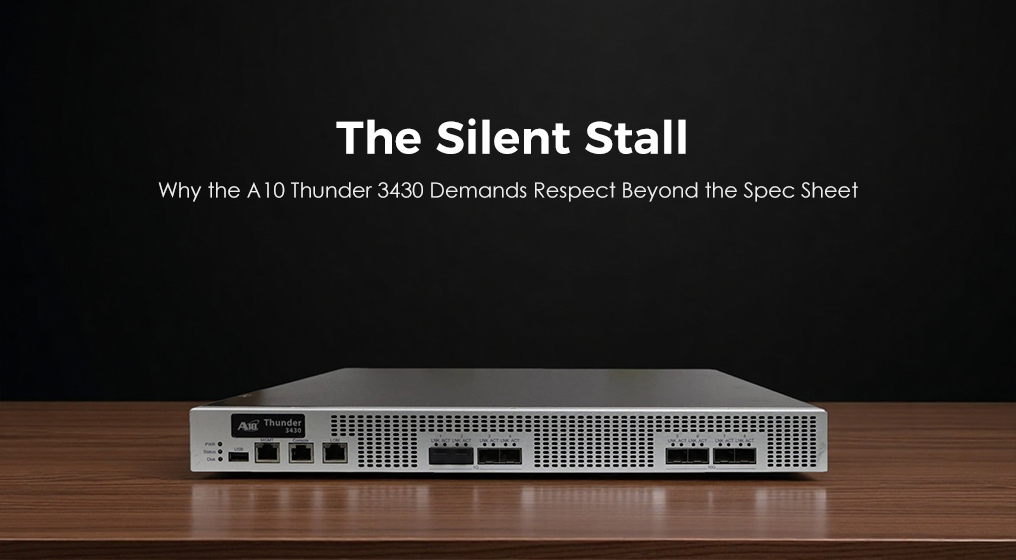
Visually, the 3430 cuts a serious figure in the rack. It is a 2U chassis, which immediately distinguishes it from the thinner 1U models, signaling the presence of more robust cooling solutions and larger power supplies needed to handle its thermal output. The front bezel is utilitarian, dominated by a dense array of SFP+ ports that can be configured with various transceivers to support 1GbE, 10GbE, or even 40GbE connections depending on the specific module installed. Two large, hot-swappable fan trays sit prominently, their design focused on moving a high volume of air front-to-back to keep the multi-core processors from throttling. The build quality feels industrial and heavy; this is not a device you want to install without a second pair of hands. The LED indicators are bright and clear, providing immediate status on power, fans, and port activity, though they can be blindingly bright in a darkened data center aisle.
Under the hood, the performance metrics are where the 3430 justifies its existence in a crowded market. It leverages A10’s proprietary ACOS (Advanced Core Operating System), which utilizes a shared-memory, multi-core architecture. This means that instead of passing packets between different cores with overhead, all cores have access to the same memory pool, allowing for incredibly efficient parallel processing. The result is a device that can handle millions of concurrent connections without breaking a sweat. The SSL throughput is particularly notable; while many competitors see their effective throughput drop by 50% or more when encryption is enabled, the 3430 maintains a high percentage of its raw capacity thanks to dedicated cryptographic accelerators. This makes it a favorite for organizations that need to inspect encrypted traffic without buying a separate decryption box.
| Core Specification |
A10 Thunder 3430 Capability |
| Max Layer 4 Throughput |
Up to 240 Gbps |
| Max SSL TPS (2K keys) |
Up to 350,000 TPS |
| Max Concurrent Connections |
Up to 500 Million |
| New Connections Per Second |
Up to 1.5 Million CPS |
| Form Factor |
2U Rack Mount |
| Interface Options |
Modular (1G/10G/40G SFP+/QSFP+) |
| Power Supply |
Dual Redundant Hot-Swappable (AC/DC) |
| Architecture |
Multi-core Shared Memory ACOS |
| Virtualization Support |
vThunder instances supported |
| DDoS Protection |
Integrated Layer 3-7 mitigation |
The functional feature set is deep, perhaps deceptively so. Beyond standard load balancing algorithms like round-robin or least-connections, the 3430 offers advanced content switching based on HTTP headers, cookies, or even payload content. The aFlex scripting language allows administrators to write custom logic to manipulate traffic in real-time, offering a level of flexibility that rivals full-blown programming environments. Global Server Load Balancing (GSLB) is integrated natively, allowing the 3430 to steer users to the closest or healthiest data center across the globe. Security features are also baked in, with robust Web Application Firewall (WAF) capabilities and single-sign-on (SSO) integration that can offload authentication burdens from identity providers. However, accessing these features often requires navigating a complex CLI, as the GUI, while improved, sometimes lags in exposing the most granular controls.
User experience with the 3430 is a tale of two cities. For the seasoned network engineer who loves the command line, it is a playground of power and precision. The CLI is logical, consistent, and offers immediate feedback. Troubleshooting tools are extensive, allowing you to capture packets, trace flows, and inspect memory usage with surgical precision. But for the admin who prefers drag-and-drop simplicity, the 3430 can feel intimidating. The learning curve is steep. The documentation is comprehensive but can be dense, assuming a level of prior knowledge that newer admins might not have. There are moments of frustration, particularly when a complex aFlex script behaves unexpectedly or when a firmware upgrade requires a careful dance of high-availability failovers. Yet, once the team climbs the learning curve, there is a profound sense of confidence. The system feels stable, predictable, and incredibly fast.
When discussing value, the 3430 occupies a sweet spot that often gets overlooked. It is not the cheapest option on the shelf, but the price-to-performance ratio is aggressive, especially regarding SSL transactions. Competitors often require you to purchase a much larger, more expensive chassis to achieve the same number of encrypted transactions per second. By consolidating what might have been two or three smaller devices into a single 3430, organizations save on rack space, power consumption, and licensing complexity. The licensing model is generally perceived as fair, with many advanced security and analytics features included in the base package rather than being sold as expensive add-ons. For a mid-sized enterprise looking to future-proof their infrastructure without stepping into carrier-grade pricing, the 3430 offers a compelling economic argument.
However, no platform is without its scars. The pros are significant: incredible density of connections, superior SSL performance, and a flexible scripting engine that can solve unique business logic problems. The cons, however, are real. The aforementioned memory management issues under specific load patterns can cause anxiety until mitigated by proper tuning and firmware updates. The reliance on CLI for advanced configuration creates a skills gap; finding staff proficient in ACOS can be harder than finding those certified on more ubiquitous platforms. Additionally, the 2U form factor, while necessary for cooling, consumes valuable rack real estate that might be at a premium in colocation facilities. The fan noise is also non-negotiable; this is a device that demands a dedicated, cooled server room, not a quiet office environment.
In the final analysis, the A10 Thunder 3430 is a specialist’s tool. It rewards expertise with unparalleled performance and stability, but it punishes negligence with obscure failures that can take hours to diagnose. It is not the device you buy because it was the easiest to demo; it is the device you buy because you have a specific, demanding problem that requires a powerful, flexible, and efficient solution. If your organization is willing to invest in training and respects the complexity of the system, the 3430 becomes an invisible engine that hums along in the background, handling millions of requests while your competitors struggle to keep their pages loading. But if you are looking for simplicity above all else, you might find yourself staring at a flatlined graph, wondering where all the traffic went.