The False Positive Panic: Why the A10 Thunder 1030S Is More Than Just an Entry-Level Box
It usually happens around 2 AM on a Sunday, right after a minor firmware patch or a seemingly innocuous change to a health monitor. The pager goes off, screaming that the primary load balancer has failed over to the secondary. You log in, heart racing, expecting to see a fried power supply or a crashed kernel. Instead, you find the
A10 Thunder 1030S sitting there, fully operational, with all lights green, but it has decided that one of your critical backend servers is "unhealthy" because it took 50 milliseconds longer than expected to respond to a specific HTTP GET request. This sensitivity, often stemming from overly aggressive default timeout settings in the health monitoring engine, is the most common complaint from new administrators deploying the 1030S. It feels like the machine is hallucinating failures. But here is the twist: that same hypersensitivity is exactly why this little box is so good at its job. It catches the micro-stutters and latent issues that larger, more sluggish appliances ignore until they become full-blown outages. Once you tune those thresholds and understand its personality, the 1030S transforms from a false-alarm generator into the most vigilant guardian your small-to-mid-sized network could ask for.
The Thunder 1030S is purpose-built for the branch office, the remote data center, or the mid-sized enterprise that needs enterprise-grade application delivery without the footprint of a massive chassis. It serves as an Application Delivery Controller (ADC), handling the critical tasks of load balancing, SSL offloading, and basic application security. Unlike a simple router that just forwards packets, the 1030S inspects traffic up to Layer 7, making intelligent decisions about where to send user requests based on server health, content type, or even the user's location. It is the device that ensures your corporate ERP system doesn’t crash when the finance team runs end-of-month reports, or that your regional e-commerce site stays online during a local marketing surge. It punches well above its weight class, bringing features typically reserved for million-dollar deployments down to a form factor that fits in a standard telecom closet.
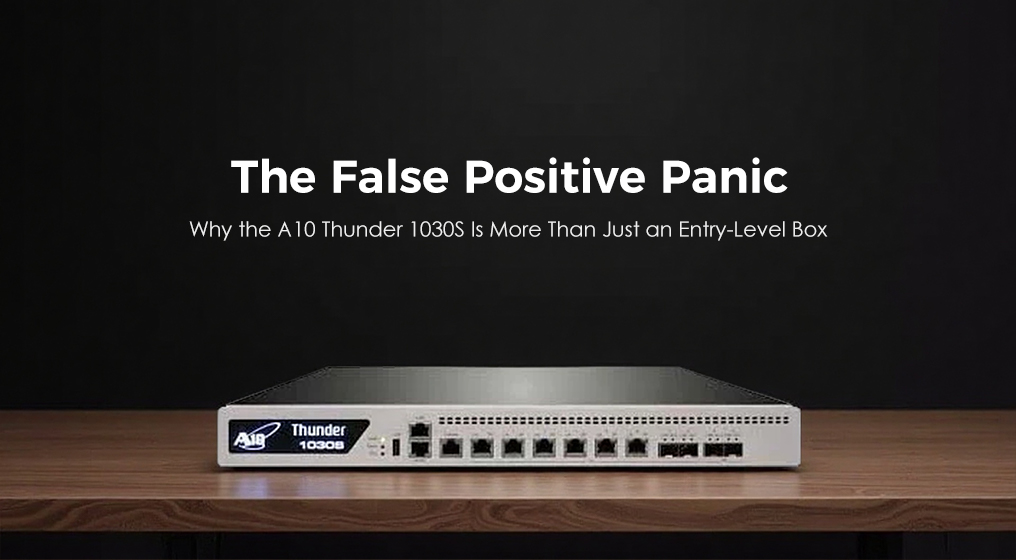
Visually, the 1030S is understated, almost humble. It is a compact 1U rack-mount unit that feels surprisingly solid given its size. The front panel is clean, dominated by a row of SFP+ ports that can accommodate either 1GbE or 10GbE transceivers, offering flexibility that fixed copper ports often lack. To the left, you’ll find the console port, a USB management interface, and a small LCD screen that provides immediate system status—IP address, hostname, and basic health metrics—without needing a laptop. The build quality is industrial; there is no plastic fluff here. The fans are small but efficient, designed to move air front-to-back, and while they aren’t silent, they are quiet enough for a server room without being disruptive. The dual power supplies are hot-swappable and redundant, a critical feature for any device claiming to ensure high availability, ensuring that a single power feed failure won’t take down your regional operations.
Under the hood, the performance of the 1030S is driven by A10’s proprietary ACOS (Advanced Core Operating System). This isn’t just a skinned version of Linux; it’s a shared-memory, multi-core architecture designed specifically for packet processing. In practical terms, this means the device can handle traffic bursts with remarkable efficiency. While the raw throughput numbers might look modest compared to carrier-grade giants, the real story is in the SSL performance. The 1030S includes dedicated hardware acceleration for cryptography, allowing it to decrypt and inspect encrypted traffic without choking. For a branch office running entirely on HTTPS, this is a game-changer. It can sustain tens of thousands of SSL transactions per second, meaning your users don’t experience that dreaded lag when establishing secure connections. The connection setup rate is equally impressive, capable of handling hundreds of thousands of new sessions per second, which is crucial for modern applications that rely on short-lived, rapid-fire connections.
| Core Specification |
A10 Thunder 1030S Capability |
| Max Layer 4 Throughput |
Up to 20 Gbps |
| Max SSL TPS (2K keys) |
Up to 15,000 TPS |
| Max Concurrent Connections |
Up to 30 Million |
| New Connections Per Second |
Up to 60,000 CPS |
| Form Factor |
1U Rack Mount |
| Interface Options |
Up to 12x 1/10GbE SFP+ |
| Power Supply |
Dual Redundant Hot-Swappable |
| Architecture |
Multi-core Shared Memory ACOS |
| Virtualization Support |
vThunder capable |
| Management |
CLI, Web GUI, REST API, SNMP |
Functionally, the 1030S is a Swiss Army knife for application traffic. It supports advanced load balancing algorithms like least-connections, fastest-response, and weighted round-robin out of the box. But it goes deeper with Layer 7 content switching, allowing you to route traffic based on URLs, HTTP headers, or cookies. The built-in Web Application Firewall (WAF) provides protection against common threats like SQL injection and cross-site scripting, adding a layer of security that often requires a separate appliance in other architectures. The Global Server Load Balancing (GSLB) feature, though often associated with larger models, is fully functional here, enabling you to manage failover between your main data center and this branch unit seamlessly. The aFlex scripting language is also present, giving you the power to write custom logic for complex traffic manipulation scenarios that standard rules can’t handle.
From a user experience perspective, the 1030S offers a mix of relief and a slight learning curve. The CLI is crisp, logical, and reminiscent of the classic networking operating systems that veterans love. It feels responsive, with commands executing instantly. The GUI has matured significantly, offering clear dashboards that visualize traffic flows, server health, and SSL certificate expiration dates. However, the initial experience can be frustrating if you don’t adjust the default health monitor settings, leading to the false positives mentioned earlier. Once you spend an hour tuning the timeouts and retry counters to match your specific application’s behavior, the system settles into a rhythm of reliable stability. Troubleshooting is straightforward thanks to detailed logging and robust packet capture tools that let you see exactly what the device sees. It feels like a tool built by people who actually manage networks, not just sell them.
When it comes to value, the 1030S is arguably the strongest contender in its segment. It delivers a price-to-performance ratio that is hard to beat, especially when you factor in the included feature set. Many competitors charge extra licenses for WAF, GSLB, or advanced SSL capabilities, turning a seemingly affordable box into a budget-buster. A10 bundles these features more generously, allowing you to deploy a comprehensive application delivery solution without hidden costs. The energy efficiency of the 1U form factor also contributes to lower operational expenses over time. For organizations looking to modernize their branch offices or replace aging, end-of-life hardware without overspending, the 1030S offers a compelling economic argument. It allows you to do more with less, consolidating multiple functions into a single, manageable device.
However, honesty requires acknowledging the drawbacks. The port density is limited; if you need more than a dozen 10GbE links, this isn’t the box for you. The storage for logs is relatively small, meaning you’ll need to ship logs to an external syslog server quickly to avoid losing historical data during an incident. The community support ecosystem is smaller than some of the industry giants, so finding a quick answer on a forum for a niche problem might take longer, requiring more reliance on official technical support. Additionally, while the hardware is robust, the upgrade process for major OS versions can sometimes require a reboot, which necessitates careful maintenance window planning in high-availability setups.
Despite these limitations, the advantages are significant. The ACOS architecture provides unmatched efficiency for its size. The security integration is deep and effective, reducing the attack surface of your applications. The flexibility of the aFlex scripting allows for customization that rivals much larger platforms. And perhaps most importantly, the reliability, once properly tuned, is exceptional. The 1030S doesn’t just forward traffic; it understands it, protects it, and optimizes it.
In the final analysis, the A10 Thunder 1030S is a device that rewards attention to detail. It might scare you initially with its eagerness to flag potential issues, but that vigilance is its greatest strength. It is the perfect solution for organizations that need high-performance application delivery and security in a compact, cost-effective package. It proves that you don’t need a massive chassis to get enterprise-grade features; sometimes, the smallest box in the rack is the one working the hardest to keep your business running. If you are willing to invest the time to understand its nuances, the 1030S will repay you with years of stable, secure, and efficient service.